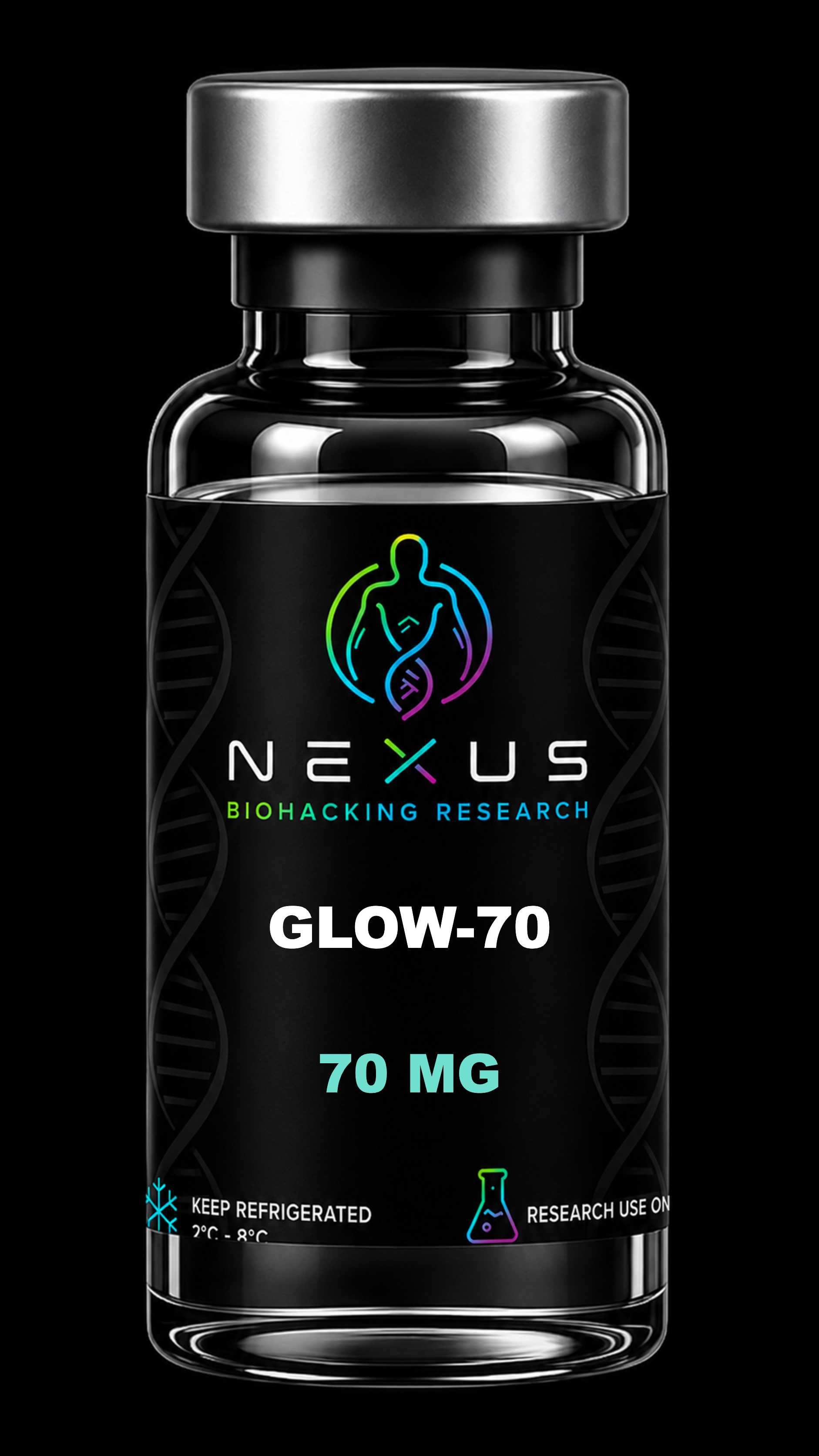
A co-lyophilized research blend combining GHK-Cu, BPC-157 and TB-500, formulated to explore the combination of tissue-repair and matrix-remodelling pathways. 70 mg total per vial, lyophilized powder, ≥99% HPLC purity verified by third-party analysis. Laboratory research use only.
Research areas
- Repair / matrix synergy
- In-vitro skin models
- Multi-peptide co-formulation
Technical data
| Field | Value |
|---|---|
| Name | GLOW-70 (Blend) |
| Dosage | 70 mg |
| Sequence / composition | GHK-Cu + BPC-157 + TB-500 (blend) |
| Molecular weight | — |
| CAS no. | — |
| Target / mechanism | Tissue remodelling & repair (combined pathways) |
| Form | Lyophilized powder (unless stated otherwise) |
| Purity | ≥ 99% (HPLC) — see batch COA |
70 mg of what, exactly: read the split before comparing
This is the confusion the blend format creates almost mechanically. A vial labelled 70 mg looks seven times better stocked than a 10 mg BPC-157 vial. The two numbers do not describe the same thing: one is a total mass shared between three molecules, the other the mass of a single peptide.
| Component | Mass per vial | Share |
|---|---|
| GHK-Cu | 50 mg | ≈ 71% |
| BPC-157 | 10 mg | ≈ 14% |
| TB-500 (thymosin β4) | 10 mg | ≈ 14% |
| Total | 70 mg | 100% |
The trap: "GLOW-70" is not a standard. No body guarantees the split behind the name, and two vials carrying the same label can hold different proportions. The only check that settles it is the batch COA, which must state the three masses separately. A certificate limited to "70 mg total, ≥99% purity" says nothing about the actual composition.
A second check applies to the third component: TB-500 refers, depending on the source, either to the short LKKTET fragment or to full-length thymosin β4 (43 amino acids) — two distinct molecules roughly a factor of five apart in mass. The component used in this blend is full-length thymosin β4, the form the literature actually covers.
Mechanisms studied
GHK-Cu is a tripeptide — glycyl-L-histidyl-L-lysine — complexed with a copper ion, naturally present in human plasma at concentrations that decline with age. The literature describes it as a modulator of gene expression: a large-scale analysis on fibroblast cultures reported altered expression of a large number of human genes, many tied to extracellular matrix composition, and it is also described as stimulating growth-factor secretion (bFGF, VEGF).
BPC-157 is a pentadecapeptide derived from a gastric protein sequence. A mechanistic detail often misreported: in rodent work it shows no direct angiogenic effect on isolated cell cultures. The angiogenesis observed is indirect, associated in vivo with upregulated VEGF expression during muscle and tendon healing.
TB-500 / thymosin β4 acts as a G-actin-binding protein: by holding actin in monomeric form it maintains a mobilisable pool supporting the polymerisation required for fibroblast, keratinocyte and endothelial cell migration.
The blend's rationale is the complementarity of these axes: matrix for GHK-Cu, indirect vascularisation for BPC-157, cell migration for thymosin β4.
What the literature shows
The evidence type differs by molecule. GHK-Cu: mostly in vitro (fibroblasts, keratinocytes) and animal (rodent and rabbit wound models), describing accelerated wound closure and matrix recomposition; human skin data come mainly from topical cosmetics. BPC-157: almost entirely preclinical, chiefly Wistar rats, on induced tendon, muscle and gastrointestinal lesions, with very limited controlled human studies. TB-500 / thymosin β4: accelerated cutaneous and corneal healing, cardiac repair and reduced scarring in animal models, with human clinical data scarce.
What the literature does not show — the key point for a blend. No publication evaluates the interactions between these three peptides administered together: everything above was obtained molecule by molecule, in isolation. A blend's "synergy" is a working hypothesis, not a documented result. The usual limits apply on top: heterogeneous protocols, unestablished extrapolation to humans, and batch-to-batch standardisation variability.
Reconstitution: a worked example
With 2 mL of bacteriostatic water in a 70 mg vial: 70 mg ÷ 2 mL = 35 mg/mL, i.e. 35,000 mcg/mL of total peptides. On a U-100 syringe, 10 IU = 0.1 mL = 3,500 mcg total, giving 20 draws per vial. Applying the 50 / 10 / 10 split, a 10 IU draw holds roughly 2,500 mcg GHK-Cu, 500 mcg BPC-157 and 500 mcg thymosin β4 — a ratio fixed at co-lyophilization, identical whatever volume is drawn.
The most common trap: the volume of water never changes how much peptide is in the vial. Using 4 mL instead of 2 mL gives 17.5 mg/mL instead of 35 mg/mL — the same total mass in twice the volume; only the graduation changes. Our reconstitution calculator computes any other combination live.
Add the solvent slowly down the vial wall, then swirl gently. No vigorous shaking, no vortex — shear denatures peptides. The copper in GHK-Cu gives the solution a characteristic bluish tint: expected, not an anomaly.
Storage
Lyophilized powder: -20 °C or below, protected from light and moisture; stable for years when unopened. After reconstitution: 2–8 °C, protected from light, with a reference shelf life of 28 days. For longer storage, frozen aliquots are preferable to repeated freeze-thaw cycles.
Common laboratory mistakes
- Comparing the blend's 70 mg with a 10 mg single-peptide vial. The 70 mg cover three molecules; the per-component fraction is what should be compared.
- Assuming a split without reading the COA. "GLOW-70" is not a standard; only the batch certificate states the masses actually present.
- Confusing the LKKTET fragment with full-length thymosin β4. Two distinct molecules, roughly a factor of five apart in mass.
- Trying to dose one component independently. The ratio is fixed at co-lyophilization; only the total volume drawn can change.
- Mistaking the blue tint for contamination. It comes from the copper ion in GHK-Cu. Persistent cloudiness or undissolved material, however, warrants discarding the vial.
Frequently asked questions
What exactly is in the GLOW-70 blend?
Three co-lyophilized peptides in one vial for a total of 70 mg: GHK-Cu 50 mg, BPC-157 10 mg and TB-500 (thymosin β4) 10 mg. That is the reference composition; the batch COA should state the three masses separately, since no standard governs the "GLOW-70" name.
Why 70 mg when a BPC-157 vial holds 10?
Because the 70 mg is the sum of three components, not the amount of a single molecule. The blend's BPC-157 fraction is 10 mg — the same as in a single-peptide vial. Comparing 70 mg with 10 mg compares a total with a share.
Is the blend's TB-500 the short fragment or full-length thymosin β4?
Full-length thymosin β4, 43 amino acids. "TB-500" refers, depending on the source, either to the complete protein or to the short LKKTET fragment reproducing residues 17 to 22: two distinct molecules, and the available literature mostly covers the full-length protein.
Why does the solution turn blue after reconstitution?
Because GHK-Cu is a tripeptide complexed with a copper ion, and copper in solution colours the liquid. The bluish tint is expected here. Persistent cloudiness, sediment or undissolved lyophilizate, by contrast, indicate a problem.
Are there published studies on the blend itself?
No. All available literature covers the three peptides in isolation — GHK-Cu, BPC-157 and thymosin β4 — and no publication evaluates their interactions when combined. Pathway complementarity is a working hypothesis, not a documented result.
Can a single one of the three peptides be drawn?
No. All three are co-lyophilized in the same vial and dissolve together: the 50 / 10 / 10 ratio is fixed and identical in every draw. Only the total volume drawn can vary.
What should this blend be reconstituted with?
Bacteriostatic water, which contains benzyl alcohol and allows multiple draws. Plain sterile water is unsuitable once the vial is pierced more than once.
What concentration does 2 mL of bacteriostatic water give?
35 mg/mL, i.e. 35,000 mcg/mL of total peptides. On a U-100 syringe, 10 IU is then 0.1 mL and 3,500 mcg total — roughly 2,500 mcg GHK-Cu, 500 mcg BPC-157 and 500 mcg thymosin β4 — giving 20 draws per vial.
How long does the reconstituted solution keep?
28 days at 2–8 °C, protected from light — the reference shelf life for a reconstituted vial. Beyond that, frozen aliquots are preferable to repeated freeze-thaw cycles.
In what context may this product be used?
Exclusively for laboratory and in vitro research. It is not intended for human or animal consumption, nor for diagnostic or therapeutic use.
NEXUS Quality Standard
Every NEXUS research compound is produced under strict quality control procedures. Each batch undergoes independent analytical testing to verify identity, assay accuracy, purity, microbial safety, endotoxin levels, heavy metal screening, and full batch traceability.
For laboratory research only. GLOW-70 70mg is not suitable for human or animal consumption. Not a drug, food or cosmetic. To be handled by qualified personnel in accordance with applicable regulations.