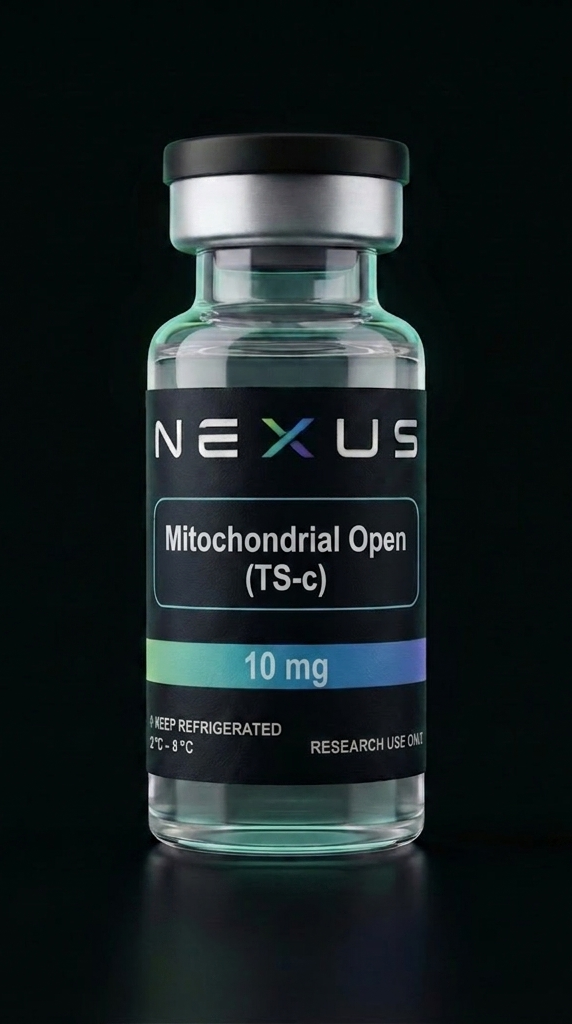
A 16-amino-acid peptide encoded by the mitochondrial genome, studied for its role in metabolic-regulation models and AMPK signalling. The best-documented member of the emerging class of mitochondria-derived peptides. 10 mg vial, lyophilized powder, ≥99% HPLC purity verified by third-party analysis. For research use only.
Research areas
- In-vitro metabolic homeostasis
- AMPK signalling
- Mitochondria-derived peptides
Technical data
| Field | Value |
|---|---|
| Name | TS-c |
| Dosage | 10 mg |
| Sequence / composition | 16 amino acids (mitochondria-derived peptide) |
| Molecular weight | ≈ 2,174 Da |
| CAS no. | 1627580-64-6 |
| Target / mechanism | Mitochondrial metabolic regulation (AMPK pathway) |
| Form | Lyophilized powder (unless stated otherwise) |
| Purity | ≥ 99% (HPLC) — see batch COA |
Does TS-c activate AMPK directly? No — and that is what sets it apart
The shorthand is everywhere: "TS-c = AMPK activator". Convenient, but a poor description of what the literature reports, and it leads to experiments that measure the wrong thing.
The peptide does not bind AMPK and is not an agonist of the enzyme. The founding work by Lee and colleagues (Cell Metabolism, 2015) describes an indirect mechanism: TS-c interferes with the folate-methionine cycle and one-carbon metabolism, causing accumulation of AICAR — a purine-synthesis intermediate known to activate AMPK. Kinase activation is therefore the consequence of a metabolic shift, not a direct receptor effect.
What that changes at the bench: an effect routed through metabolite accumulation does not follow the kinetics of target binding. It depends on the cell's metabolic state, the culture medium and one-carbon substrate availability — three variables a protocol designed around an "AMPK agonist" never thinks to control.
A second check, on the vial: TS-c belongs to the mitochondria-derived peptide (MDP) family alongside humanin and the SHLPs, with which it is sometimes confused. The markers that settle it are the 16-amino-acid length, the molecular weight of about 2,174 Da and CAS no. 1627580-64-6, all carried by the batch COA.
Mechanism studied
TS-c stands for Mitochondrial Open reading frame of the Twelve S rRNA type-c. Its defining feature is being encoded not by the nucleus but within the mitochondrial 12S ribosomal RNA gene region. Its sequence is Met-Arg-Trp-Gln-Glu-Met-Gly-Tyr-Ile-Phe-Tyr-Pro-Arg-Lys-Leu-Arg.
Beyond the AICAR / AMPK axis, the literature reports a second property: under metabolic stress the peptide undergoes translocation to the nucleus, despite carrying no classical nuclear localisation signal — a movement described as AMPK-dependent. In the nucleus it may modulate expression of stress-response and metabolic-homeostasis genes: a mitochondrion sending a peptide signal to the nucleus reverses the usual direction of communication between the two compartments.
Studies also report, within hours of exposure, shifts in purine-metabolism metabolites and increased fatty-acid beta-oxidation. Skeletal muscle is identified as the main target tissue, with increased glucose uptake and clearance.
What the literature shows
Most data come from preclinical work: in vitro cell culture and in vivo mouse models. In the 2015 studies, mice on a high-fat diet treated with TS-c showed an improved metabolic profile. A study in Nature Communications (Reynolds et al., 2021) reported that treated aged mice ran markedly longer and further on treadmill testing than controls; the peptide is described there as exercise-inducible, its levels rising after exertion.
What the literature does not show. There is no randomised human clinical trial on TS-c. The available human data are observational: circulating levels and correlations with age and exercise, which demonstrate neither causality nor benefit from exogenous supply. Clear translational obstacles remain: low bioavailability, limited stability, short half-life, and immunogenicity questions raised but unresolved.
Reconstitution: a worked example
With 2 mL of bacteriostatic water in a 10 mg vial: 10 mg ÷ 2 mL = 5 mg/mL, i.e. 5,000 mcg/mL. On a U-100 syringe, 10 IU = 0.1 mL = 500 mcg, giving 20 draws per vial.
The most common trap: the volume of water never changes how much peptide is in the vial. Using 1 mL instead of 2 mL gives 10 mg/mL instead of 5 mg/mL — the same total mass in half the volume. Only the graduation to draw changes. Our reconstitution calculator computes any other combination live.
Add the solvent slowly down the vial wall, then swirl gently. No vigorous shaking, no vortex — shear denatures peptides. Given the limited solution stability described for this peptide, aliquoting immediately after reconstitution is particularly advisable.
Storage
Lyophilized powder: -20 °C or below, protected from light and moisture; stable for years when unopened. After reconstitution: 2–8 °C, protected from light, with a reference shelf life of 28 days. For longer storage, frozen aliquots are preferable to repeated freeze-thaw cycles.
Common laboratory mistakes
- Treating TS-c as a direct AMPK agonist. The described activation is indirect, via AICAR accumulation; the kinetics and controls differ.
- Overlooking the culture medium in vitro. The mechanism runs through the folate-methionine cycle, so medium composition is a variable, not a detail.
- Extrapolating from observational human data. Circulating levels correlate with age and exercise, which establishes neither causality nor an effect of exogenous supply.
- Confusing TS-c with other mitochondrial peptides. 16 amino acids, ≈ 2,174 Da and the COA's CAS number distinguish it from humanin and the SHLPs.
- Letting the reconstituted solution go through freeze-thaw cycles. Solution stability is described as limited; aliquot at reconstitution.
Frequently asked questions
What does the acronym TS-c mean?
Mitochondrial Open reading frame of the Twelve S rRNA type-c. The name describes its origin: the peptide is encoded by an open reading frame inside the mitochondrial 12S ribosomal RNA gene region, not by nuclear DNA.
Does TS-c activate AMPK directly?
No. The peptide does not bind AMPK. The literature, starting with Lee and colleagues in Cell Metabolism in 2015, describes an indirect mechanism: interference with the folate-methionine cycle and one-carbon metabolism causes AICAR to accumulate, and AICAR is a known AMPK activator.
What is a mitochondria-derived peptide?
A short peptide whose sequence is encoded by the mitochondrial genome rather than the nucleus. TS-c is the most studied example, alongside humanin and the SHLPs. The origin implies that mitochondria emit peptide signals to the rest of the cell, reversing the usual direction of communication.
Why is skeletal muscle the most studied tissue?
Because preclinical work identifies it as the main target, with increased glucose uptake and clearance, and because the peptide is described as exercise-inducible — circulating levels rise after exertion, which steered research towards muscle metabolism and age-related functional decline.
Are there human clinical trials on TS-c?
No. No randomised human clinical trial has been published. The available human data are observational: circulating-level measurements and correlations with age or exercise. Most knowledge comes from cell cultures and mouse models.
What limits does the literature flag?
Clear translational obstacles: low bioavailability, limited stability in solution, short half-life, and immunogenicity questions raised but unresolved — on top of the absence of human clinical data and the heterogeneity of preclinical protocols.
What should this peptide be reconstituted with?
Bacteriostatic water, which contains benzyl alcohol and allows multiple draws. Plain sterile water is unsuitable once the vial is pierced more than once.
What concentration does 2 mL of bacteriostatic water give?
5 mg/mL, i.e. 5,000 mcg/mL. On a U-100 syringe, 10 IU then corresponds to 0.1 mL and 500 mcg, giving 20 draws per vial.
How long does the reconstituted solution keep?
28 days at 2–8 °C, protected from light — the reference shelf life for a reconstituted vial. Beyond that, frozen aliquots are preferable to repeated freeze-thaw cycles.
In what context may this product be used?
Exclusively for laboratory and in vitro research. It is not intended for human or animal consumption, nor for diagnostic or therapeutic use.
📚 In-depth research
Read our complete research guide on Mitochondrial Open (TS-c) 10mg.
Read the article →NEXUS Quality Standard
Every NEXUS research compound is produced under strict quality control procedures. Each batch undergoes independent analytical testing to verify identity, assay accuracy, purity, microbial safety, endotoxin levels, heavy metal screening, and full batch traceability.
For laboratory research only. Mitochondrial Open (TS-c) 10mg is not suitable for human or animal consumption. Not a drug, food or cosmetic. To be handled by qualified personnel in accordance with applicable regulations.