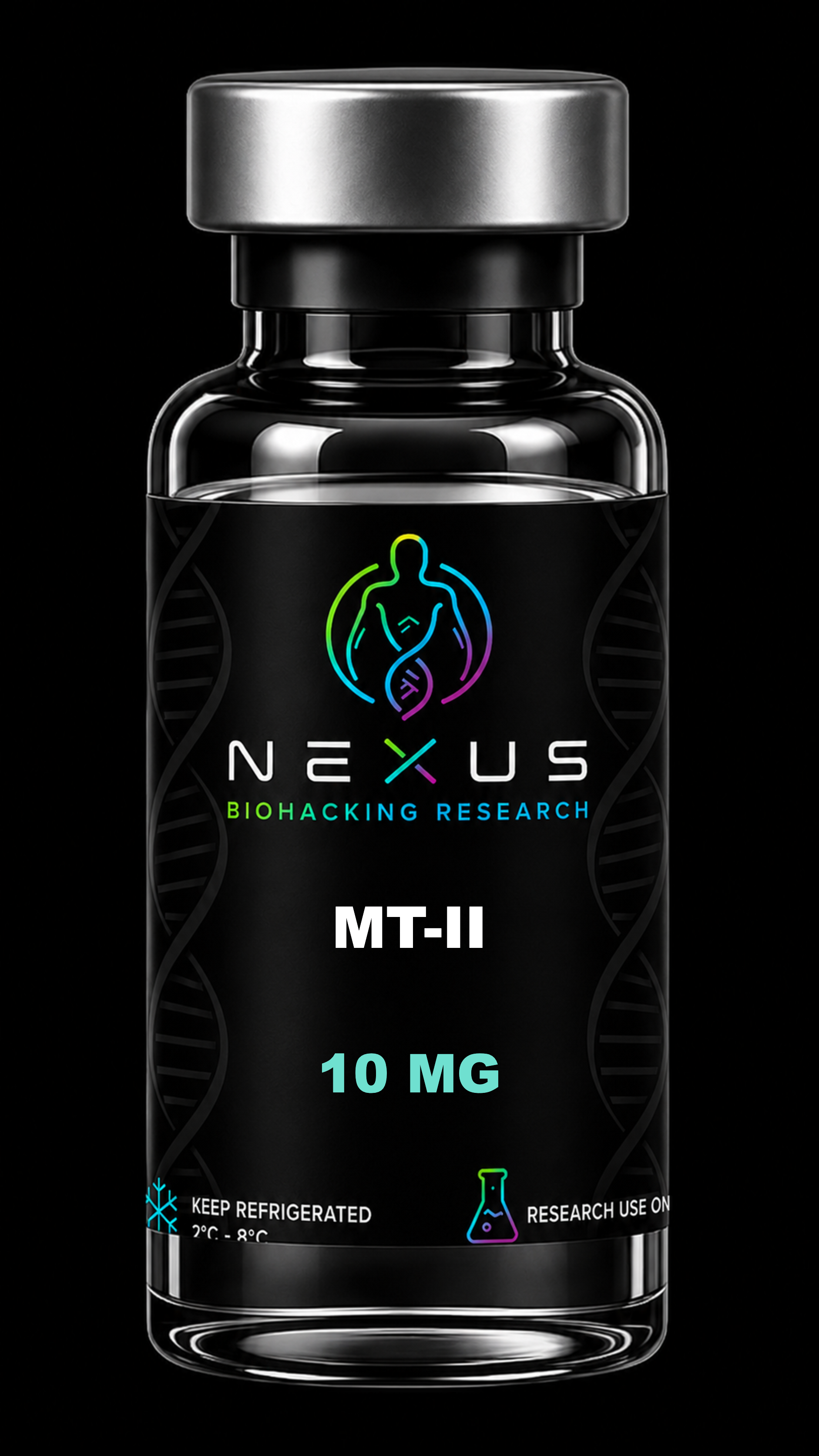
A cyclic α-MSH analogue and non-selective agonist at several melanocortin receptors, used as a reference compound in in-vitro studies of melanocortin signalling and cellular melanogenesis. 10 mg vial, lyophilized powder, ≥99% HPLC purity verified by third-party analysis. For laboratory research use only.
Research areas
- MC1R / MC3R / MC4R / MC5R signalling in vitro
- Melanogenesis in cell culture (cAMP → MITF → tyrosinase pathway)
- Comparative pharmacology of cyclic and linear melanocortin agonists
Technical data
| Field | Value |
|---|---|
| Name | MT-2 |
| Dosage | 10 mg |
| Sequence / composition | Cyclic peptide (Nle-Asp-His-D-Phe-Arg-Trp-Lys) |
| Molecular weight | ≈ 1,024.2 Da |
| CAS no. | 121062-08-6 |
| Target / mechanism | Melanocortin receptors (MC1R / MC4R) |
| Form | Lyophilized powder (unless stated otherwise) |
| Purity | ≥ 99% (HPLC) — see batch COA |
MT-2, MT-I, afamelanotide: three names, two different molecules
This is the most widespread confusion in this family, and a single number settles it.
MT-I and afamelanotide are the same molecule: [Nle⁴, D-Phe⁷]-α-MSH, usually abbreviated NDP-MSH — a linear 13-amino-acid peptide of roughly 1,646 Da, reproducing the full length of α-MSH with two substitutions that slow enzymatic degradation. Under the name afamelanotide it holds a marketing authorisation for a rare and very narrow indication, under strict hospital supervision.
MT-2 is something else: a cyclic heptapeptide of roughly 1,024 Da, closed by a lactam bridge between the Asp and Lys side chains. It retains the His-D-Phe-Arg-Trp motif, the pharmacophore core common to melanocortins, but not the peripheral residues of α-MSH.
The verifiable criterion is therefore molecular mass: ≈ 1,024 Da for MT-2, ≈ 1,646 Da for MT-I. A COA that does not specify the form (cyclic or linear) does not tell you what is in the vial.
The second point matters even more: MT-2 is not selective. It activates MC1R, MC3R, MC4R and MC5R with potencies of the same order of magnitude; only MC2R, the ACTH receptor, is largely out of reach. Direct methodological consequence: in an integrated model, no read-out obtained with MT-2 can be assigned to a single receptor. Protocols aiming to isolate one receptor subtype use selective tools, not MT-2. MT-2's legitimate role is as a pan-melanocortin positive control.
Mechanism studied
The five melanocortin receptors (MC1R–MC5R) are class A G-protein-coupled receptors, canonically coupled to Gαs. Activation stimulates adenylate cyclase, raises intracellular cAMP and activates protein kinase A. In melanocyte models in vitro, this cascade phosphorylates CREB, induces MITF, and drives transcription of the melanin pathway enzymes — chiefly tyrosinase, the rate-limiting step — measured by cAMP assay, tyrosinase activity or cellular melanin content.
For the other subtypes the literature describes distinct roles, largely established in rodent models and by genetics: MC3R and MC4R, expressed in the central nervous system, are involved in energy homeostasis; MC5R is associated with exocrine gland function. The central melanocortin system is also under the control of an endogenous antagonist, AgRP — a reminder that this circuit is bidirectionally regulated, not driven by simple agonism.
What the literature shows
What is solidly established concerns receptor pharmacology: affinity and efficacy profiles of MT-2 across melanocortin receptor subtypes in recombinant systems, cAMP responses, and the role of the lactam ring's conformational constraint. As such, MT-2 is a documented and frequently used comparator.
What the literature does not show must be stated just as plainly. There is no large randomised clinical trial establishing a safety profile for MT-2 in humans, and no marketing authorisation anywhere. Human data are limited to small, early studies and to a case-report literature from dermatology and toxicology, collected after the fact on uncontrolled exposures. That literature describes changes in naevi — darkening, new pigmented lesions — and melanoma cases reported after exposure to products of this family sold outside controlled channels, along with acute systemic effects consistent with the molecule's non-selectivity. A further problem is product identity: analyses of such preparations have shown highly variable content, incorrect labelling and contamination, so part of the reported effects cannot even be attributed to the peptide with certainty.
Regulatory status and public warnings
MT-2 is not authorised as a medicine in any jurisdiction. Several national health agencies — in the United Kingdom, in several Nordic countries, in Australia, among others — have issued public warnings against products of this family sold outside controlled channels and against their use outside a medical or laboratory setting, citing the absence of any benefit-risk evaluation, the reported adverse effects, and the unknown pharmaceutical quality of circulating preparations. European safety notifications have targeted products of this type.
This reference is accordingly offered solely as a laboratory reagent, to qualified teams, for in-vitro work and experimental models. No effect outside the experimental setting is described, claimed or implied by NEXUS.
Reconstitution: a worked example
With 2 mL of bacteriostatic water in a 10 mg vial: 10 mg ÷ 2 mL = 5 mg/mL, i.e. 5,000 mcg/mL. On a U-100 syringe, 10 IU = 0.1 mL = 500 mcg, giving 20 draws per vial.
The most common trap: the volume of water never changes how much peptide is in the vial. Only the volume to draw changes. Our reconstitution calculator computes any other combination live.
Add the solvent slowly down the vial wall, then swirl gently. No vigorous shaking, no vortex — shear denatures peptides.
Storage
Lyophilized powder: -20 °C or below, protected from light and moisture; stable for years when unopened. After reconstitution: 2–8 °C, protected from light, with a reference shelf life of 28 days. For longer storage, frozen aliquots are preferable to repeated freeze-thaw cycles.
Common laboratory mistakes
- Confusing MT-2 with MT-I / afamelanotide. Two distinct molecules: a ≈ 1,024 Da cyclic heptapeptide versus a ≈ 1,646 Da linear 13-mer. Check molecular mass on the COA before applying a published result.
- Assigning a read-out to MC1R alone. MT-2 also activates MC3R, MC4R and MC5R. Without a selective tool in parallel, no single-receptor conclusion holds.
- Using plain sterile water for a multi-draw vial. Without a preservative, the solution is no longer protected once the stopper has been pierced several times.
- Vortexing the vial. Vigorous agitation denatures peptides.
- Repeatedly refreezing the reconstituted solution. Each cycle degrades a fraction of the peptide.
Frequently asked questions
What is the difference between MT-2 and MT-I?
Two different molecules. MT-I, also called afamelanotide, is a linear 13-amino-acid peptide of about 1,646 Da; MT-2 is a cyclic heptapeptide of about 1,024 Da closed by a lactam bridge. Molecular mass on the COA settles it, and results obtained with one do not transfer to the other.
Is MT-2 receptor-selective?
No, and that is its defining characteristic. It activates MC1R, MC3R, MC4R and MC5R with potencies of the same order of magnitude, MC2R excepted. In an integrated model no read-out can therefore be attributed to a single subtype without a selective tool in parallel.
What mechanism is studied in cell culture?
Melanocortin receptors couple to Gαs: activation stimulates adenylate cyclase, raises cAMP and activates protein kinase A, leading to CREB phosphorylation, MITF induction and transcription of melanin pathway enzymes including tyrosinase — what cAMP and tyrosinase assays measure in vitro.
Is there human clinical data on MT-2?
There is no large randomised clinical trial establishing a safety profile for this molecule, and no marketing authorisation anywhere. Human data are limited to small early studies and to a case-report literature collected after the fact on uncontrolled exposures.
Have health agencies taken a position on this molecule?
Yes. Agencies in several countries — the United Kingdom, Nordic countries and Australia among them — have published warnings against products of this family sold outside controlled channels and against their use outside a medical or laboratory setting, citing the absence of benefit-risk evaluation, reported adverse effects and unknown pharmaceutical quality.
What purity is stated, and why does the COA matter particularly here?
Purity is ≥ 99% verified by HPLC, with a third-party certificate of analysis per batch. That document matters all the more for this molecule because analyses of such preparations bought outside controlled channels have shown highly variable content, incorrect labelling and contamination: without a COA, neither the identity nor the quantity of peptide is verifiable.
What should this peptide be reconstituted with?
Bacteriostatic water, which contains benzyl alcohol and allows multiple draws. Plain sterile water is unsuitable once the vial is pierced more than once.
What concentration does 2 mL of bacteriostatic water give?
5 mg/mL, i.e. 5,000 mcg/mL. On a U-100 syringe, 10 IU then corresponds to 0.1 mL and 500 mcg, giving 20 draws per vial.
How long does the reconstituted solution keep?
28 days at 2–8 °C, protected from light — the reference shelf life for a reconstituted vial. Beyond that, frozen aliquots are preferable to repeated freeze-thaw cycles.
In what context may this product be used?
Exclusively for laboratory and in vitro research, by qualified personnel. Not for human or animal consumption, nor for cosmetic, diagnostic or therapeutic use. The restriction is all the stricter here given that diverted use of this molecule is the subject of health agency warnings.
NEXUS Quality Standard
Every NEXUS research compound is produced under strict quality control procedures. Each batch undergoes independent analytical testing to verify identity, assay accuracy, purity, microbial safety, endotoxin levels, heavy metal screening, and full batch traceability.
For laboratory research only. MT-2 10mg is not suitable for human or animal consumption. Not a drug, food or cosmetic. To be handled by qualified personnel in accordance with applicable regulations.