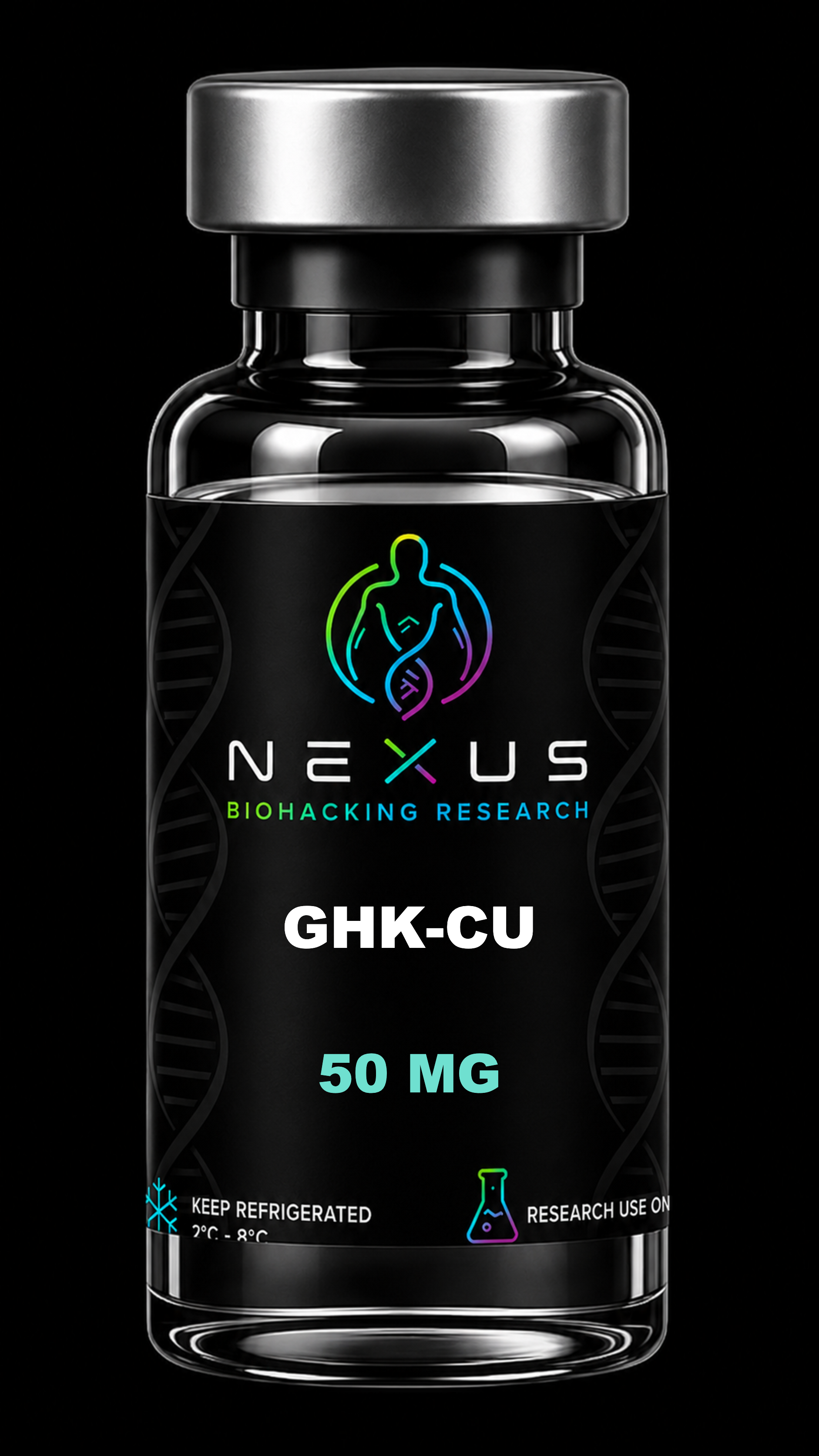
A copper-complexed tripeptide extensively studied in in-vitro dermatological research for its role in extracellular-matrix remodelling and collagen synthesis. 50 mg vial, characteristic blue lyophilized powder, ≥99% HPLC purity verified by third-party analysis. For research use only.
Research areas
- In-vitro collagen synthesis
- Extracellular-matrix remodelling
- Skin wound-healing models
Technical data
| Field | Value |
|---|---|
| Name | GHK-Cu (Copper GHK) |
| Dosage | 50 mg |
| Sequence / composition | Gly-His-Lys : copper(II) complex |
| Molecular weight | ≈ 340.8 Da (GHK) + Cu |
| CAS no. | 49557-75-7 / 89030-95-5 |
| Target / mechanism | Matrix remodelling, collagen expression |
| Form | Lyophilized powder (unless stated otherwise) |
| Purity | ≥ 99% (HPLC) — see batch COA |
GHK or GHK-Cu: copper is not an additive
This is the costliest confusion around the molecule. Two products circulate under near-identical names: GHK, the bare Gly-His-Lys tripeptide, and GHK-Cu, the same tripeptide complexed with a copper(II) ion. They are not interchangeable.
GHK was isolated from human plasma in the early 1970s through the work of Pickart and Thaler. Its interest rests on a chemical motif: the N-terminal glycine, the deprotonated peptide nitrogen and the histidine imidazole form a coordination site chelating copper(II) with high affinity — of the same order, the literature describes, as the copper-transport site of serum albumin. GHK is first a physiological copper carrier, and virtually every mechanism reported concerns the complex, not the free ligand.
Two criteria settle it. Colour: the complex is a distinctly blue powder giving a blue solution, from the d-d electronic transitions of coordinated copper(II); the bare peptide is white to off-white and gives a colourless solution. Mass: the complex adds roughly 63.5 for copper to the ≈ 340.8 Da tripeptide, so a spectrum peaking near 340 Da describes the free peptide.
Copper being redox-active, complex stability also depends on its chemical environment: a strong reducing agent such as ascorbic acid, or a competing chelator such as EDTA, shifts the equilibrium and can break the complex apart.
Mechanism studied
Copper delivery to cuproenzymes. Copper is the cofactor of lysyl oxidase, which cross-links collagen and elastin fibres, and of Cu/Zn superoxide dismutase. The complex is studied as a carrier of that ion rather than as an isolated signalling molecule.
Matrix remodelling. In vitro, on dermal fibroblasts, the literature describes stimulated synthesis of type I collagen, elastin, glycosaminoglycans and decorin, alongside modulation of matrix metalloproteinases (MMPs) and their tissue inhibitors (TIMP-1, TIMP-2). It is the synthesis/degradation balance that is described as shifted.
Broad transcriptional modulation. Transcriptomic analyses reported by Pickart and colleagues describe modulated expression of a very large number of genes, touching tissue repair, inflammation and antioxidant response — transcriptional correlations drawn from expression databases, not clinical effects. Wound-healing models also report an angiogenic component, with increased VEGF and FGF-2 expression.
What the literature shows
The corpus is dense but overwhelmingly in vitro and preclinical: fibroblast cultures, skin explants, animal wound models, where results are consistent between teams for matrix synthesis and wound-closure speed.
What the literature does not show. There is no large, randomised, adequately powered clinical demonstration of efficacy in humans. Existing human skin studies mostly concern topical cosmetic formulations, with small samples, short durations and heterogeneous endpoints; transcutaneous penetration of the intact complex is itself debated. A second uncertainty is the dose-dependence of copper, cytotoxic in excess through Fenton chemistry: GHK-chelated copper is described as behaving differently from a free copper salt, but the threshold beyond which the advantage reverses depends on the cell model and is not standardised.
Reconstitution: a worked example
With 2 mL of bacteriostatic water in a 50 mg vial: 50 mg ÷ 2 mL = 25 mg/mL, i.e. 25,000 mcg/mL. On a U-100 syringe, 10 IU = 0.1 mL = 2,500 mcg, giving 20 draws per vial. That concentration is high for a 50 mg vial, so a larger solvent volume is often chosen: with 5 mL, 50 mg ÷ 5 mL = 10 mg/mL, i.e. 10,000 mcg/mL, 10 IU = 0.1 mL = 1,000 mcg, and 50 draws per vial.
The most common trap: the volume of water never changes how much peptide is in the vial. Only the volume to draw changes. Our reconstitution calculator computes any other combination live.
Add the solvent slowly down the vial wall, then swirl gently. No vigorous shaking, no vortex — shear denatures peptides. The resulting solution should be blue.
Storage
Lyophilized powder: -20 °C or below, protected from light and moisture; stable for years when unopened. After reconstitution: 2–8 °C, protected from light, with a reference shelf life of 28 days. For longer storage, frozen aliquots are preferable to repeated freeze-thaw cycles.
Common laboratory mistakes
- Accepting a white powder labelled GHK-Cu. The copper(II) complex is blue; white powder or a colourless solution indicates the bare tripeptide.
- Mixing the solution with ascorbic acid or a chelator. A strong reducing agent, or a competing chelator such as EDTA, displaces the copper and breaks the complex.
- Using plain sterile water for a multi-draw vial. Without a preservative, the solution is no longer protected once the stopper has been pierced several times.
- Vortexing the vial. Vigorous agitation denatures peptides.
- Carrying a concentration across cell models. Copper is dose-dependent and cytotoxic in excess; described thresholds are not standardised.
Frequently asked questions
What is the difference between GHK and GHK-Cu?
GHK is the bare Gly-His-Lys tripeptide; GHK-Cu is that same tripeptide complexed with a copper(II) ion. Virtually every mechanism reported in the literature concerns the complex, not the free ligand, so they are two distinct products despite the similar names.
Why is the powder blue?
The colour comes from the d-d electronic transitions of copper(II) coordinated to the tripeptide. It is the most immediate identity check: the complex gives a blue powder and a blue solution, while the bare peptide is white to off-white and gives a colourless solution.
What is the copper for?
The GHK N-terminal motif — terminal glycine, deprotonated peptide nitrogen and histidine imidazole — forms a coordination site that chelates copper(II) with high affinity. The complex is studied as a carrier of that ion towards copper-dependent enzymes such as lysyl oxidase and Cu/Zn superoxide dismutase.
Can the solution be mixed with ascorbic acid?
No, this is a documented incompatibility. Ascorbic acid is a strong reducing agent and shifts the copper(II) equilibrium. A competing chelator such as EDTA has the same effect by capturing the copper ion.
Is there adequately powered human clinical data?
No. The corpus is overwhelmingly in vitro and preclinical. Existing human skin studies mostly concern topical cosmetic formulations with small samples and heterogeneous endpoints, and transcutaneous penetration of the intact complex remains debated.
What should this peptide be reconstituted with?
Bacteriostatic water, which contains benzyl alcohol and allows multiple draws. Plain sterile water is unsuitable once the vial is pierced more than once. The resulting solution should be blue.
What concentration does 2 mL of bacteriostatic water give?
25 mg/mL, i.e. 25,000 mcg/mL, with 10 IU = 0.1 mL = 2,500 mcg and 20 draws per vial. For a 50 mg vial a larger volume is often chosen: 5 mL gives 10 mg/mL, i.e. 1,000 mcg per 10 IU and 50 draws.
How long does the reconstituted solution keep?
28 days at 2–8 °C, protected from light — the reference shelf life for a reconstituted vial. Beyond that, frozen aliquots are preferable to repeated freeze-thaw cycles.
Is purity verified by a certificate of analysis?
Yes. Every batch is HPLC-tested at ≥ 99% purity and covered by a third-party COA available for the batch shipped.
In what context may this product be used?
Exclusively for laboratory and in vitro research. It is not intended for human or animal consumption, nor for diagnostic, therapeutic or cosmetic use.
NEXUS Quality Standard
Every NEXUS research compound is produced under strict quality control procedures. Each batch undergoes independent analytical testing to verify identity, assay accuracy, purity, microbial safety, endotoxin levels, heavy metal screening, and full batch traceability.
For laboratory research only. GHK-CU 50mg is not suitable for human or animal consumption. Not a drug, food or cosmetic. To be handled by qualified personnel in accordance with applicable regulations.