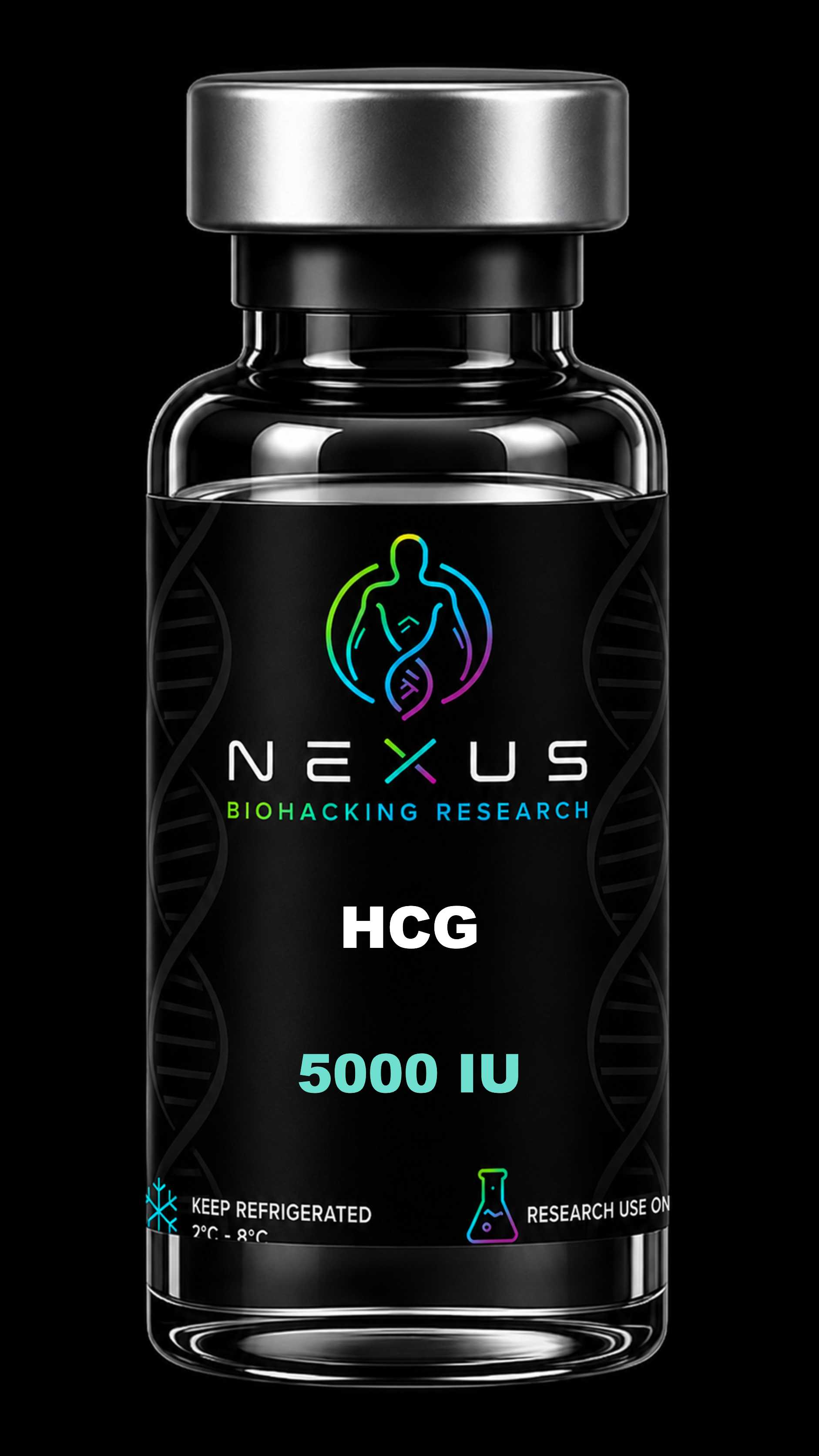
Human chorionic gonadotropin, a heterodimeric glycoprotein agonist of the LH/CG receptor, used in laboratory models of gonadotropic signalling and steroidogenesis. 5,000 IU vial, lyophilized for laboratory reconstitution, with a third-party certificate of analysis per batch. A reagent for laboratory research use only, excluding any human or veterinary use.
Research areas
- LHCGR signalling
- Steroidogenesis models
- Corpus luteum studies in vitro
Technical data
| Field | Value |
|---|---|
| Name | HCG (Chorionic gonadotropin) |
| Dosage | 5000 IU |
| Sequence / composition | Glycoprotein heterodimer (α + β) |
| Molecular weight | ≈ 36,700 Da |
| CAS no. | 9002-61-3 |
| Target / mechanism | LH/CG receptor (LHCGR) |
| Form | Lyophilized powder (unless stated otherwise) |
| Purity | ≥ 99% (HPLC) — see batch COA |
5,000 IU, not 5 mg: why HCG is quantified in international units
The first thing to correct, because everything follows from it: HCG is not a synthetic peptide. It is a heterodimeric glycoprotein of about 36,700 Da, made of two non-covalently associated chains — an α subunit shared with LH, FSH and TSH, and a specific β subunit. Close to a third of its mass is carbohydrate, and the dissociated heterodimer loses activity.
Hence the unusual unit. A gonadotropin's biological activity depends on its glycosylation, which varies between preparations, so two samples of identical mass need not have identical activity. The relevant quantity is not a mass but an activity, measured by bioassay and calibrated against a WHO international standard.
Hence the trap: there is no universal mg ↔ IU conversion. Highly purified recombinant preparations are described at around 250 µg for 6,500 IU, whereas urinary-derived preparations of lower specific activity require far more mass for the same activity. Converting "5,000 IU" into milligrams by proportion is meaningless: the only reference is the bioassay on the certificate of analysis.
HCG and LH: one receptor, two ligands
Both hormones activate the same LHCGR receptor, which does not make them equivalent. Their β subunits are highly homologous over the first residues, but HCG's carries an additional C-terminal peptide (CTP) rich in O-linked glycans terminating in sialic acid. That CTP sharply slows renal clearance: LH's circulating half-life is described in tens of minutes, HCG's in tens of hours — sustained stimulation in vitro where LH gives a transient signal. Qualitatively different intracellular signalling profiles are also described for the two ligands at this receptor, so treating HCG as "long-acting LH" is a shortcut the data do not fully support.
Mechanism studied
LHCGR is a class A G-protein-coupled receptor with a large leucine-rich extracellular domain carrying the binding site. The main described pathway is Gαs → adenylate cyclase → cAMP → protein kinase A: PKA phosphorylates CREB and the StAR protein, which transports cholesterol to the inner mitochondrial membrane — the rate-limiting step of steroidogenesis, where CYP11A1 converts it to pregnenolone. Gq/phospholipase C and ERK/AKT branches are also described at high occupancy.
Models further document desensitisation and then downregulation of LHCGR under sustained stimulation: prolonged exposure does not give a response proportional to its duration.
What the literature shows
HCG is among the best-characterised LHCGR agonists and a reference in in vitro steroidogenesis models; its detection is also the principle behind pregnancy tests, hence the well-established international standards.
Pharmaceutical products based on chorionic gonadotropin do exist, prescribed and medically supervised in specific reproductive medicine indications. Those medicines are distinct from the reagent sold here: manufactured, released and controlled to pharmaceutical standards, their clinical data qualify this product in no way. It is not a medicine and human use is excluded.
What the literature does not show: no data supporting any use outside the laboratory; limited comparability between preparations, since glycoform heterogeneity makes results preparation-dependent; and substantial species differences in LHCGR and in the steroidogenic response.
Reconstitution: a worked example
With 2 mL of bacteriostatic water in a 5,000 IU vial: 5,000 IU ÷ 2 mL = 2,500 IU/mL. On a U-100 syringe, 1 mL is 100 IU of graduation, so 10 IU of graduation = 0.1 mL = 250 IU of HCG, giving 20 draws of 10 graduations per vial.
Mind the vocabulary trap, specific to this product. The syringe's "IU" are volume graduations: a U-100 syringe is calibrated for insulin at 100 units per millilitre, so one graduation is 0.01 mL whatever liquid it holds. The vial's IU are units of biological activity, defined by bioassay against an international standard. Reading "10 IU" on the syringe and concluding that 10 IU of HCG were drawn is the commonest error here — above, 10 graduations are 250 IU of activity, twenty-five times more.
Then the general trap: the volume of water never changes how much product is in the vial. 1 mL instead of 2 mL gives 5,000 IU/mL — the same total activity in half the volume. Only the volume to draw changes. Our reconstitution calculator computes any other combination live.
Add the solvent slowly down the vial wall, then swirl gently. No vigorous shaking, no vortex — shear denatures proteins and, on a non-covalent heterodimer, promotes subunit dissociation and foaming.
Storage
Lyophilized powder: -20 °C or below, protected from light and moisture; stable for years when unopened. After reconstitution: 2–8 °C, protected from light, with a reference shelf life of 28 days. For longer storage, frozen aliquots are preferable to repeated freeze-thaw cycles.
Common laboratory mistakes
- Converting 5,000 IU into milligrams by proportion. Specific activity depends on the preparation; no universal conversion exists.
- Confusing the syringe's IU with the vial's IU. The former are volume graduations (0.01 mL each on a U-100), the latter units of biological activity.
- Treating HCG as equivalent to LH. Same receptor, but an extra glycosylated C-terminal peptide and a half-life of a wholly different order.
- Ignoring LHCGR desensitisation under sustained stimulation, followed by receptor downregulation.
- Using plain sterile water for a multi-draw vial, vortexing, or repeatedly refreezing. A heterodimeric glycoprotein is particularly sensitive to shear, foaming and adsorption onto plastic.
Frequently asked questions
Why is HCG quantified in IU rather than mg?
Because HCG is not a synthetic peptide but a heterodimeric glycoprotein whose activity depends on glycosylation, which varies between preparations. Two samples of identical mass can differ in activity, so the relevant quantity is an activity measured by bioassay against a WHO international standard.
How many milligrams are 5,000 IU?
There is no universal answer, and that is the point. Specific activity depends on the preparation: highly purified recombinant material is described at around 250 µg for 6,500 IU, whereas a less purified urinary-derived preparation needs far more mass. Only the batch certificate of analysis is authoritative.
What is the difference between HCG and LH?
Both activate the same LHCGR receptor, but HCG's β subunit carries an additional C-terminal peptide rich in O-linked glycans terminating in sialic acid. That CTP sharply slows renal clearance: LH's circulating half-life is described in tens of minutes, HCG's in tens of hours.
Which receptor is targeted, and through which pathway?
The LH/CG receptor (LHCGR), a class A G-protein-coupled receptor. The main described pathway is Gαs, adenylate cyclase, cAMP and protein kinase A, with phosphorylation of CREB and of the StAR protein, which controls the rate-limiting step of steroidogenesis.
Are the syringe's "IU" the same as the vial's IU?
No, and this is the commonest confusion with this product. A U-100 syringe's IU are volume graduations — calibrated for insulin at 100 units per millilitre, one graduation is 0.01 mL whatever the liquid. The vial's IU are units of biological activity. With a 2,500 IU/mL solution, 10 graduations are 0.1 mL, i.e. 250 IU of activity, not 10.
What should this product be reconstituted with?
Bacteriostatic water, which contains benzyl alcohol and allows multiple draws. Plain sterile water is unsuitable once the vial is pierced more than once. Add the solvent slowly down the wall and swirl gently.
What concentration does 2 mL of bacteriostatic water give?
2,500 IU/mL. On a U-100 syringe, 10 IU of graduation then corresponds to 0.1 mL and 250 IU of activity, giving 20 draws of 10 graduations per vial.
How long does the reconstituted solution keep?
28 days at 2–8 °C, protected from light — the reference shelf life for a reconstituted vial. Beyond that, frozen aliquots are preferable to repeated freeze-thaw cycles.
Are there medicines based on chorionic gonadotropin?
Yes, pharmaceutical products exist, prescribed and medically supervised in reproductive medicine. They are distinct from the reagent sold here and controlled to pharmaceutical standards: their clinical data qualify this product in no way, and it is not a medicine.
What purity is stated, and in what context may the product be used?
Purity is ≥ 99% verified by HPLC, with a third-party certificate of analysis per batch that also reports the activity in international units. The product is for laboratory and in vitro research only, by qualified personnel: not for human or animal consumption, nor for diagnostic or therapeutic use.
NEXUS Quality Standard
Every NEXUS research compound is produced under strict quality control procedures. Each batch undergoes independent analytical testing to verify identity, assay accuracy, purity, microbial safety, endotoxin levels, heavy metal screening, and full batch traceability.
For laboratory research only. HCG 5000 iu is not suitable for human or animal consumption. Not a drug, food or cosmetic. To be handled by qualified personnel in accordance with applicable regulations.