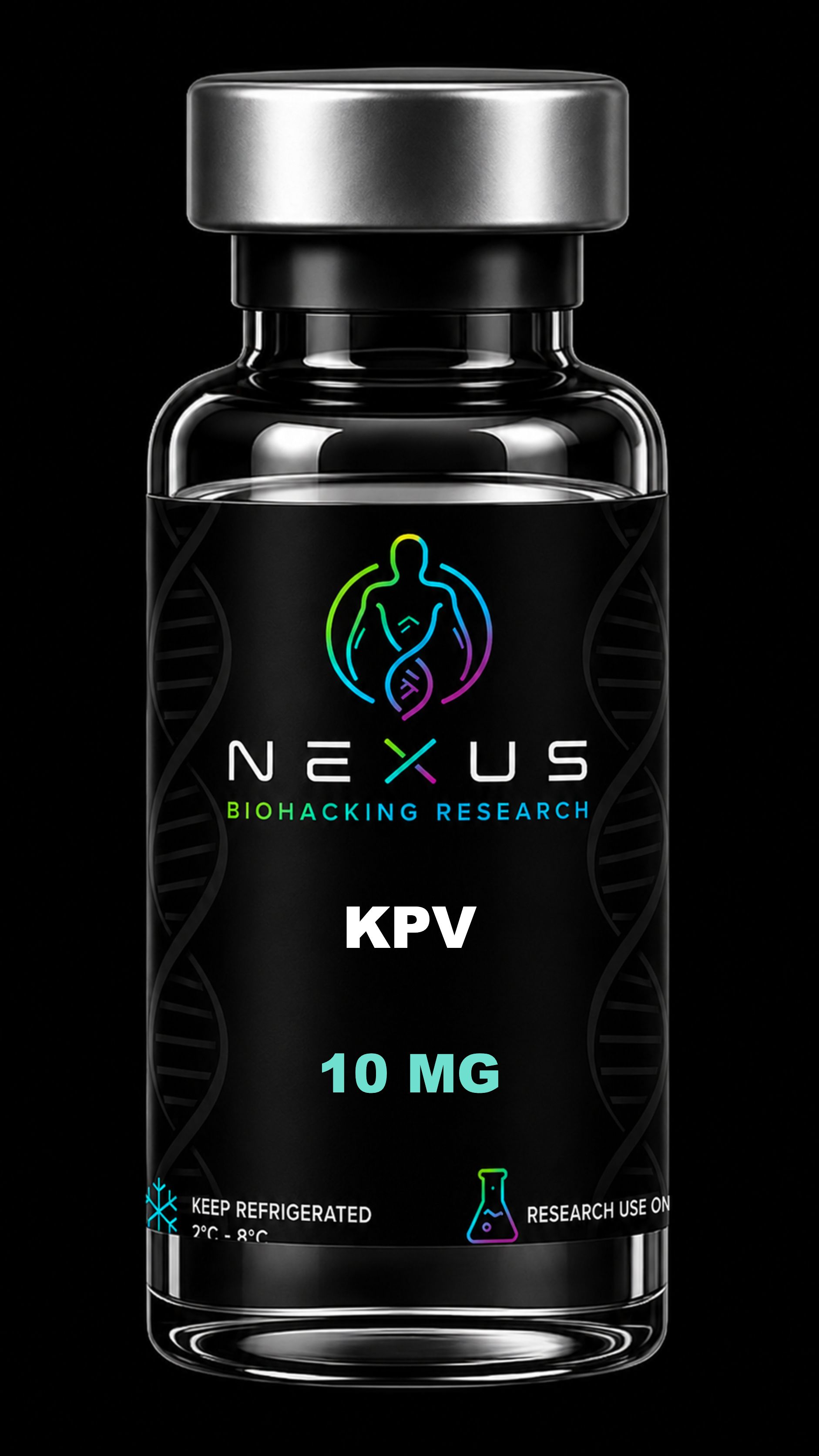
A tripeptide corresponding to the C-terminal fragment of α-MSH, studied in in-vitro models of inflammatory regulation and epithelial function. 10 mg vial, lyophilized powder, ≥99% HPLC purity verified by third-party analysis. For laboratory research use only.
Research areas
- In-vitro inflammatory models
- Melanocortin signalling
- Epithelial barrier (models)
Technical data
| Field | Value |
|---|---|
| Name | KPV |
| Dosage | 10 mg |
| Sequence / composition | Lys-Pro-Val (C-terminal fragment of α-MSH) |
| Molecular weight | ≈ 342.4 Da |
| CAS no. | 67727-97-3 |
| Target / mechanism | Anti-inflammatory (melanocortin) pathways |
| Form | Lyophilized powder (unless stated otherwise) |
| Purity | ≥ 99% (HPLC) — see batch COA |
KPV or α-MSH: why the tripeptide alone is studied
α-MSH is a 13-amino-acid peptide cleaved from pro-opiomelanocortin. Its last three C-terminal residues — lysine, proline, valine — are KPV. The product name is literally the sequence.
The confusion the market keeps alive comes from that lineage: a hormone fragment is casually presented as "a version of the hormone", and assumed to reproduce its effects. That is not what the literature describes. Whole α-MSH binds the MC1R-MC5R melanocortin receptors with high affinity — receptors involved in pigmentation and appetite regulation. The tripeptide is not described as reproducing that binding: published work presents it as retaining the anti-inflammatory side of the parent sequence while shedding the pigmentary and metabolic effects of the whole hormone. This dissociation is what makes the fragment worth studying.
The criterion that settles it is checkable on a COA and purely a matter of mass: ≈ 342.4 Da over 3 residues for KPV, against ≈ 1,665 Da over 13 residues for α-MSH. A vial sold as "KPV" whose mass spectrum peaks near 1,665 Da does not contain the tripeptide. It follows that KPV does not belong with the compounds studied for skin pigmentation — mistaking it for a melanotropic analogue is the most common identification error on this reference.
Mechanism studied
Mechanistic work converges on intracellular inflammatory signalling. KPV is studied as an inhibitor of the NF-κB pathway, interfering upstream at IκB kinase activation, with reduced nuclear translocation of NF-κB reported in some cell models. Several studies also describe modulation of the MAPK pathways and a decrease in reactive oxygen species, translating in vitro into lower production of TNF-α, IL-1β and IL-6.
A third strand concerns transport: in intestinal epithelium, KPV is described as taken up by PepT1, a di- and tripeptide transporter. That route follows directly from the compound's size — PepT1 does not carry long peptides — and it underpins the intestinal-inflammation literature.
What the literature shows
Two publications anchor the field. Dalmasso et al. (Gastroenterology, 2008) described PepT1-mediated uptake of KPV together with reduced intestinal inflammation across cultured epithelial and immune cells and animal models. Kannengiesser et al. (Inflammatory Bowel Diseases, 2008) reported anti-inflammatory potential of the tripeptide in murine models of inflammatory bowel disease. Beyond those, three strands structure the corpus: intestinal inflammation, the best documented; skin, with re-epithelialisation and keratinocyte-migration models; and general inflammation, with exploratory work on neuroprotection and antimicrobial activity.
What the literature does not show matters just as much. This is preclinical evidence, from cell culture and rodents: no established human clinical trial validates therapeutic efficacy, and translation to humans is not demonstrated. Bioavailability, stability and pharmacokinetics remain partly characterised, heterogeneous models and the absence of standardisation limit generalisation, and the human safety profile is not documented in any regulatory framework.
Reconstitution: a worked example
With 2 mL of bacteriostatic water in a 10 mg vial: 10 mg ÷ 2 mL = 5 mg/mL, i.e. 5,000 mcg/mL. On a U-100 syringe, 10 IU = 0.1 mL = 500 mcg, giving 20 draws per vial.
The most common trap: the volume of water never changes how much peptide is in the vial. Reconstituting with 1 mL gives 10 mg/mL — the same total mass in half the volume. Only the volume to draw changes. Our reconstitution calculator computes any other combination live.
Add the solvent slowly down the vial wall, then swirl gently. No vigorous shaking, no vortex — shear denatures peptides.
Storage
Lyophilized powder: -20 °C or below, protected from light and moisture; stable for years when unopened. After reconstitution: 2–8 °C, protected from light, with a reference shelf life of 28 days. For longer storage, frozen aliquots are preferable to repeated freeze-thaw cycles.
Common laboratory mistakes
- Expecting α-MSH effects from KPV. The fragment is not described as binding melanocortin receptors with high affinity: no pigmentation, no appetite effect in published models.
- Treating published concentrations as a dose. Micromolar culture concentrations and rodent doses are protocol-specific and do not transpose.
- Using plain sterile water for a multi-draw vial. Without a preservative, the solution is no longer protected once the stopper has been pierced several times.
- Vortexing the vial. Vigorous agitation denatures peptides.
- Repeatedly refreezing the reconstituted solution. Each cycle degrades a fraction of the tripeptide.
Frequently asked questions
What is the difference between KPV and α-MSH?
KPV is the last three C-terminal amino acids of α-MSH, a 13-residue peptide. Mass separates them clearly: about 342.4 Da for the tripeptide against about 1,665 Da for the whole hormone. The literature describes the fragment as retaining the anti-inflammatory side of the parent sequence without reproducing high-affinity melanocortin receptor binding.
Does KPV affect pigmentation?
Not according to published work. The pigmentary action of α-MSH runs through high-affinity binding to MC1R, which the tripeptide is not described as reproducing. That dissociation is precisely why the fragment is studied on its own.
What mechanism does the literature describe?
Inhibition of the NF-κB pathway, with upstream interference at IκB kinase activation, modulation of the MAPK pathways and a decrease in reactive oxygen species. In vitro these effects come with lower production of TNF-α, IL-1β and IL-6.
What is the PepT1 transporter?
A di- and tripeptide transporter expressed notably in intestinal epithelium. KPV is described as taken up through it, which would explain its internalisation by epithelial and immune cells of the gut. The route follows from the compound's size — PepT1 does not carry long peptides.
Are there human clinical trials on KPV?
No. Available data are preclinical: cell cultures and rodent models. No established human clinical trial validates therapeutic efficacy, and translation to humans is not demonstrated.
What should this peptide be reconstituted with?
Bacteriostatic water, which contains benzyl alcohol and allows multiple draws. Plain sterile water is unsuitable once the vial is pierced more than once. The powder is described as highly water-soluble.
What concentration does 2 mL of bacteriostatic water give?
5 mg/mL, i.e. 5,000 mcg/mL. On a U-100 syringe, 10 IU then corresponds to 0.1 mL and 500 mcg, giving 20 draws per vial.
How long does the reconstituted solution keep?
28 days at 2–8 °C, protected from light — the reference shelf life for a reconstituted vial. Beyond that, frozen aliquots are preferable to repeated freeze-thaw cycles.
Is purity verified by a certificate of analysis?
Yes. Every batch is HPLC-tested at ≥ 99% purity and covered by a third-party COA available for the batch shipped.
In what context may this product be used?
Exclusively for laboratory and in vitro research. It is not intended for human or animal consumption, nor for diagnostic or therapeutic use.
NEXUS Quality Standard
Every NEXUS research compound is produced under strict quality control procedures. Each batch undergoes independent analytical testing to verify identity, assay accuracy, purity, microbial safety, endotoxin levels, heavy metal screening, and full batch traceability.
For laboratory research only. KPV 10mg is not suitable for human or animal consumption. Not a drug, food or cosmetic. To be handled by qualified personnel in accordance with applicable regulations.