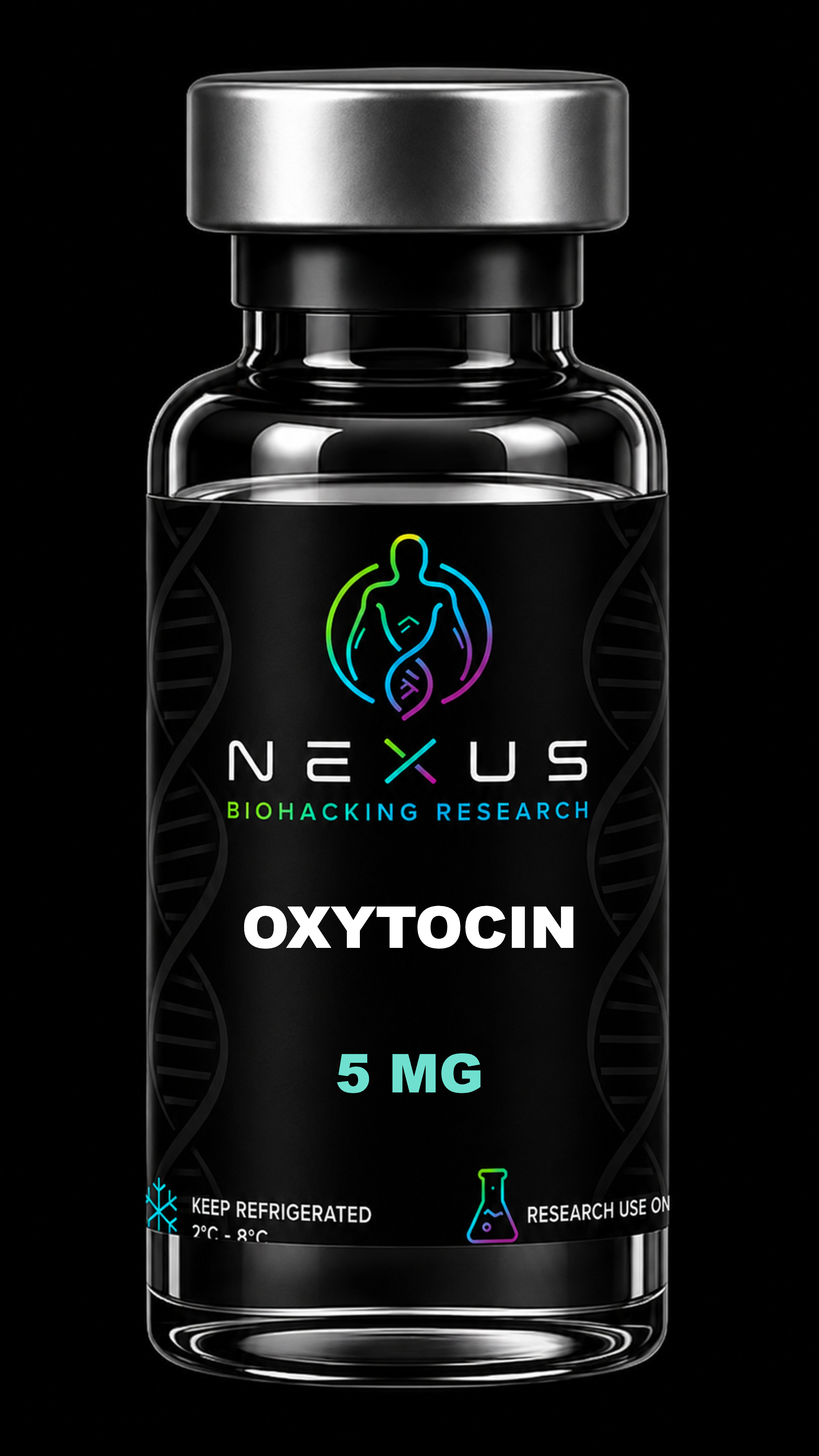
A native cyclic nonapeptide and oxytocin-receptor (OXTR) agonist, used as a reference compound in in-vitro models of Gq/11 signalling and in comparative oxytocin/vasopressin receptor pharmacology. 5 mg vial, lyophilized powder, ≥99% HPLC purity verified by third-party analysis. For laboratory research use only.
Research areas
- OXTR signalling in vitro (Gq/11 pathway, calcium mobilisation)
- OXTR / vasopressin V1a cross-selectivity
- Neurobehavioural and smooth-muscle contraction models (animal models)
Technical data
| Field | Value |
|---|---|
| Name | Oxytocin |
| Dosage | 5 mg |
| Sequence / composition | Cys-Tyr-Ile-Gln-Asn-Cys-Pro-Leu-Gly-NH₂ (cyclic) |
| Molecular weight | ≈ 1,007.2 Da |
| CAS no. | 50-56-6 |
| Target / mechanism | Oxytocin receptor (OXTR) |
| Form | Lyophilized powder (unless stated otherwise) |
| Purity | ≥ 99% (HPLC) — see batch COA |
Native peptide or analogue: why the distinction changes everything
Two very different categories of compound circulate under the label "oxytocin", and the choice between them determines both whether a published result applies and how the vial must be handled.
This reference is the native nonapeptide: the original, unmodified sequence — a six-residue ring closed by a Cys1–Cys6 disulfide bridge, extended by a C-terminally amidated Pro-Leu-Gly tail. Its structure was established and its chemical synthesis achieved in the early 1950s, the first polypeptide hormone ever synthesised.
Analogues are distinct molecules. Pharmaceutical development produced modified versions precisely because the native peptide is fragile and short-lived: removal of the position-1 amine, replacement of the disulfide bridge by a reduction-resistant thioether, side-chain methylation. More stable, more persistent — and pharmacologically different. A result obtained on an analogue does not transfer to the native peptide, or vice versa.
A subtler confusion: oxytocin and vasopressin differ by only two amino acids, at positions 3 and 8 — two residues out of nine. Oxytocin is therefore not perfectly selective for its own receptor and shows measurable activity at vasopressin receptors, particularly V1a. A protocol attributing a response to OXTR without a V1a antagonist control leaves its conclusion open to that objection.
And then stability in solution — the most underestimated point. The disulfide bridge closing the ring is essential to activity and is also the molecule's weak spot. In aqueous media the literature describes several competing degradation routes: intermolecular disulfide exchange, producing inactive dimers and oligomers; deamidation of asparagine and glutamine residues; reactions catalysed by trace metal ions. Their rate depends strongly on temperature, pH and buffer — which is why cold chain is a documented issue for oxytocin solutions, and why frozen aliquoting is not optional here. Practical corollary: any reducing agent (DTT, β-mercaptoethanol) in a buffer inactivates the peptide by opening the ring.
Mechanism studied
OXTR is a class A seven-transmembrane G-protein-coupled receptor. Its canonical coupling is to Gαq/11, activating phospholipase C β, which hydrolyses PIP2 into inositol trisphosphate (IP3) and diacylglycerol (DAG): IP3 releases calcium from intracellular stores, DAG activates protein kinase C. Downstream, models also describe MAPK recruitment, notably ERK1/2. Alternative coupling to Gi/o proteins is described depending on cellular context — the same receptor occupancy can produce opposite signals from one cell type to another.
The literature further describes a dependence of high-affinity binding on membrane cholesterol and divalent cations, magnesium in particular: in membrane binding assays, the lipid composition of the preparation and the buffer's magnesium content directly influence the constants measured, accounting for part of the inter-laboratory variation.
Pharmacokinetically, the native peptide is described with a plasma half-life on the order of a few minutes, degraded notably by aminopeptidases — the very parameter modified analogues were designed to correct.
What the literature shows
The solid ground is peripheral and cellular: OXTR pharmacology in smooth-muscle tissue is among the best-characterised in endocrinology, with oxytocin serving as the standard for decades. Calcium mobilisation assays, concentration-response curves on recombinant receptor and competitive binding assays form a reproducible corpus.
The central side is far less established, and that must be said plainly. A large body of work has explored intranasal oxytocin and its supposed effects on social cognition, and has met major replication difficulties: small effect sizes, small samples, methodological heterogeneity, documented publication bias. Two fundamental limits persist. First, how much oxytocin actually reaches the central nervous system after intranasal administration remains debated. Second, a multicentre randomised controlled trial published in 2021 in an autism spectrum context found no benefit over placebo.
In short: the literature shows robust receptor pharmacology and does not show an established dose-effect relationship on human behavioural endpoints.
Reconstitution: a worked example
With 2 mL of bacteriostatic water in a 5 mg vial: 5 mg ÷ 2 mL = 2.5 mg/mL, i.e. 2,500 mcg/mL. On a U-100 syringe, 10 IU = 0.1 mL = 250 mcg, giving 20 draws per vial.
The most common trap: the volume of water never changes how much peptide is in the vial. Only the volume to draw changes.
A trap specific to this molecule: the "IU" on a U-100 syringe is not the international unit of oxytocin. The U-100 graduation is a volume graduation inherited from insulin (1 IU = 0.01 mL). Oxytocin has its own international standard, unrelated to that scale. In research, reason in mass and concentration, never in syringe "IU".
Our reconstitution calculator computes any other combination live. Add the solvent slowly down the vial wall, then swirl gently. No vigorous shaking, no vortex — shear denatures peptides.
Storage
Lyophilized powder: -20 °C or below, protected from light and moisture; stable for years when unopened. After reconstitution: 2–8 °C, protected from light, with a reference shelf life of 28 days. For longer storage, frozen aliquots are preferable to repeated freeze-thaw cycles.
Common laboratory mistakes
- Comparing an analogue result to the native peptide. Thioether bridge, deamination, methylation: different molecules, different profiles.
- Concluding "OXTR effect" without a V1a antagonist control. Two amino acids separate oxytocin from vasopressin; cross-activity at V1a is documented and must be excluded experimentally.
- Adding a reducing agent to the buffer. DTT or β-mercaptoethanol open the Cys1–Cys6 disulfide bridge and inactivate the peptide.
- Working at very low concentration without a blocking agent. Peptides adsorb onto plastic and glass; actual concentration then falls below nominal.
- Repeatedly refreezing the solution. Each cycle degrades a fraction of the peptide, and disulfide exchange produces inactive oligomers.
Frequently asked questions
What is the difference between native oxytocin and its analogues?
Native oxytocin is the original, unmodified nonapeptide closed by a Cys1–Cys6 disulfide bridge. Analogues are distinct molecules whose disulfide bridge, N-terminus or a side chain has been modified for greater stability and longer lifetime. A result obtained on an analogue does not transfer to the native peptide.
How does oxytocin differ from vasopressin?
By two amino acids only, at positions 3 and 8, out of the nine both peptides contain. That close structural proximity is why oxytocin is not perfectly selective for its own receptor and shows measurable activity at vasopressin receptors, particularly V1a.
Which receptor is targeted, and through which pathway?
OXTR, a class A G-protein-coupled receptor. Its canonical coupling is to Gαq/11, activating phospholipase C β, which generates IP3 and DAG, mobilises intracellular calcium and activates protein kinase C; alternative coupling to Gi/o is also described depending on cell type.
Why is oxytocin considered unstable in solution?
Because the disulfide bridge closing the ring, essential to activity, is also its weak point. In aqueous media the literature describes intermolecular disulfide exchange producing inactive dimers and oligomers, deamidation of asparagine and glutamine residues, and reactions catalysed by trace metal ions — all strongly accelerated by temperature.
What does the literature not show about oxytocin?
It does not show an established dose-effect relationship on human behavioural endpoints. Work on intranasal administration and social cognition has met major replication difficulties, how much reaches the central nervous system remains debated, and a multicentre randomised trial published in 2021 in an autism spectrum context found no benefit over placebo.
What purity is stated, and what does the COA contain?
Purity is ≥ 99% verified by HPLC, with a third-party certificate of analysis issued per batch. The COA gives the peptide's identity, its measured molecular mass and the chromatographic profile of the delivered batch — the only document that lets you verify the vial matches the reference ordered.
What should this peptide be reconstituted with?
Bacteriostatic water, which contains benzyl alcohol and allows multiple draws. Plain sterile water is unsuitable once the vial is pierced more than once. Also avoid any buffer containing a reducing agent, which would open the disulfide bridge.
What concentration does 2 mL of bacteriostatic water give?
2.5 mg/mL, i.e. 2,500 mcg/mL. On a U-100 syringe, 10 IU then corresponds to 0.1 mL and 250 mcg, giving 20 draws per vial. Note that this "IU" is a volume graduation inherited from insulin (1 IU = 0.01 mL) and is unrelated to oxytocin's own international units.
How long does the reconstituted solution keep?
28 days at 2–8 °C, protected from light — the reference shelf life for a reconstituted vial. Beyond that, frozen aliquots are preferable to repeated freeze-thaw cycles.
In what context may this product be used?
Exclusively for laboratory and in vitro research, by qualified personnel. It is not intended for human or animal consumption, nor for diagnostic or therapeutic use.
NEXUS Quality Standard
Every NEXUS research compound is produced under strict quality control procedures. Each batch undergoes independent analytical testing to verify identity, assay accuracy, purity, microbial safety, endotoxin levels, heavy metal screening, and full batch traceability.
For laboratory research only. Oxytocin 5mg is not suitable for human or animal consumption. Not a drug, food or cosmetic. To be handled by qualified personnel in accordance with applicable regulations.