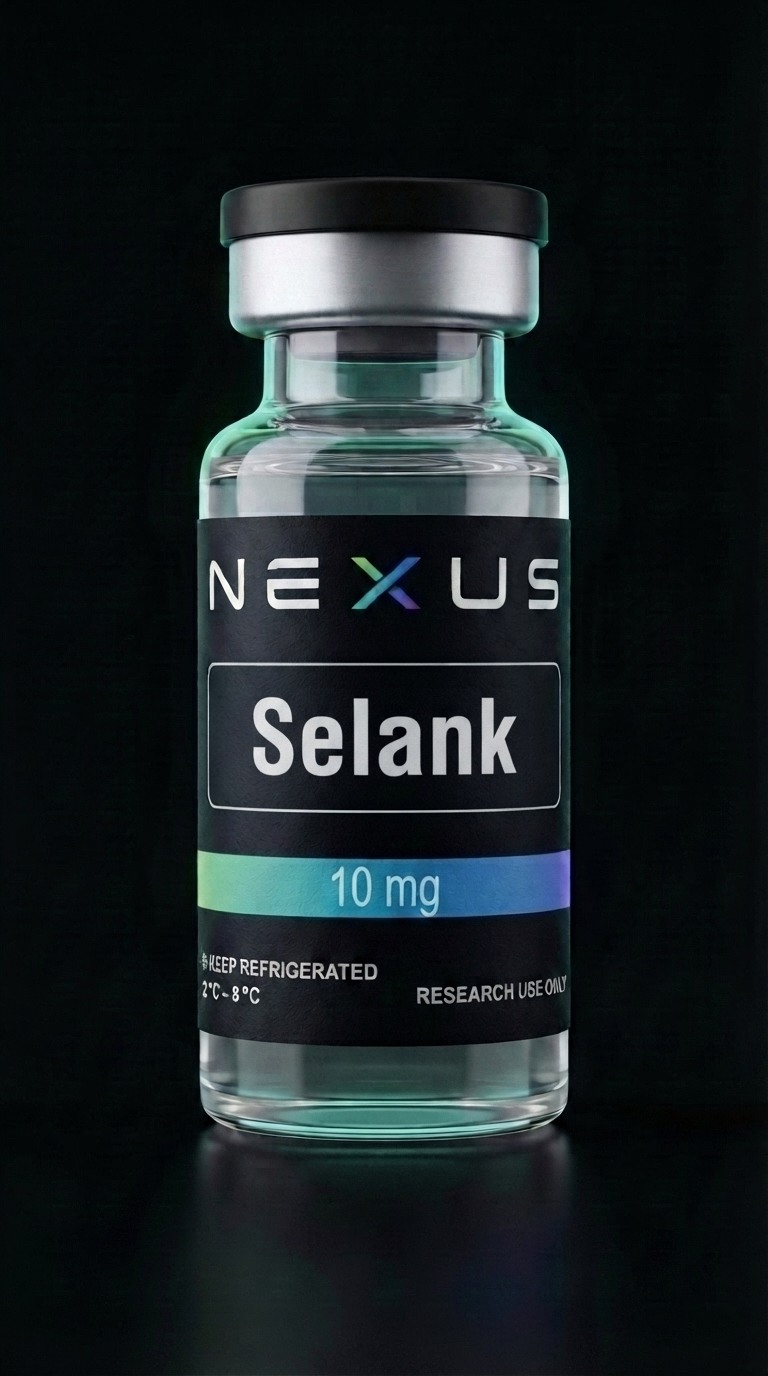
A synthetic heptapeptide, a stabilised tuftsin analogue, studied in models of neuro-immune regulation, GABAergic gene expression and enkephalin metabolism. 10 mg vial, lyophilized powder, ≥99% HPLC purity verified by third-party analysis. For laboratory research use only.
Research areas
- Neuro-immune regulation (cytokine expression, models)
- Modulation of GABAergic and serotonergic gene expression (rodent models)
- Enkephalin metabolism and plasma peptidases in vitro
Technical data
| Field | Value |
|---|---|
| Name | Selank |
| Dosage | 10 mg |
| Sequence | Thr-Lys-Pro-Arg-Pro-Gly-Pro |
| Molecular weight | ≈ 751.9 Da |
| CAS no. | 129954-34-3 |
| Target / mechanism | Tuftsin analogue · GABA / neuro-immune regulation |
| Form | Lyophilized powder (unless stated otherwise) |
| Purity | ≥ 99% (HPLC) — see batch COA |
Tuftsin, Selank, Semax: same tail, different parent fragments
Three peptides are routinely confused in this corner of the catalogue, and structure alone separates them.
Tuftsin is a natural tetrapeptide, Thr-Lys-Pro-Arg (≈ 500 Da), released by proteolysis of a fragment of the CH2 domain of the immunoglobulin G heavy chain. The literature describes it as stimulating the phagocytic activity of macrophages and granulocytes, and has proposed neuropilin-1 as its receptor. Its practical flaw: it is very rapidly degraded by plasma peptidases.
Selank is the synthetic answer to that flaw: the same tuftsin, extended at the C-terminus by a Pro-Gly-Pro motif. Full sequence Thr-Lys-Pro-Arg-Pro-Gly-Pro, ≈ 752 Da. The PGP tripeptide is not decorative — proline-rich, and prolines sterically hinder exopeptidases, which markedly extends the peptide's lifetime compared with bare tuftsin. Its role is pharmacokinetic, not pharmacodynamic.
Semax uses the same trick on an entirely different fragment: Met-Glu-His-Phe-Pro-Gly-Pro, a short ACTH fragment followed by the same Pro-Gly-Pro, ≈ 814 Da.
This is where the costliest confusion sits. Selank and Semax look alike — same length, same PGP tail, same geographical origin, often the same catalogue shelf — but their parent fragments are unrelated: an immunoglobulin fragment on one side, a melanocortin/ACTH-family fragment on the other. Semax is studied mostly around neurotrophin expression (BDNF, NGF) in rodent models, Selank around the neuro-immune axis and enkephalin metabolism. Mixing the two corpora is a reasoning error, not cautious extrapolation.
The verifiable criterion is again the COA's molecular mass: ≈ 500 Da → tuftsin; ≈ 752 Da → Selank; ≈ 814 Da → Semax. Watch also for N-acetyl Selank amidate: N-terminal acetylation adds roughly 42 Da and C-terminal amidation removes about 1, placing that form around 793 Da. This reference is unmodified Selank at ≈ 752 Da.
One last point: peptidase resistance is not vial stability. The PGP motif shields the peptide from enzymes in a biological medium; it protects it neither from hydrolysis nor from freeze-thaw cycles in a stored solution.
Mechanism studied
Selank has no identified receptor of its own — a feature of the molecule, not a gap in this page: the available literature describes functional and transcriptional effects without establishing a single binding target.
Enkephalin metabolism. The literature describes inhibition of enkephalin-degrading enzymes in plasma, prolonging Leu-enkephalin half-life in the preparations studied. The effect is indirect: the peptide does not bind opioid receptors, it changes how long an endogenous ligand persists.
Gene expression. Work largely in rodent models describes changes in the expression of genes encoding GABA-A receptor subunits, and of serotonin-related genes, across several brain structures. Read that literally: the literature does not describe direct binding of Selank to the GABA-A receptor in the way a benzodiazepine does. What is described is modulation of expression.
Neuro-immune axis. Consistent with tuftsin's immunoglobulin origin, studies describe modulation of cytokine expression — interleukin-6 and interferons are cited most often — and of immune activation markers.
What the literature shows
The nature of the corpus has to be stated before its content. Most publications on Selank are Russian in origin and in Russian, produced by or around the institutions that developed the molecule. The peptide is registered as a medicine in Russia and nowhere else: no marketing authorisation from the European Union, the United States or any other major health authority.
This has three concrete consequences. Independent replication is rare — few outside groups have repeated the protocols. Sample sizes are small and methodological standards heterogeneous: many reported clinical studies involve a few dozen participants, often without the blinding, pre-registration and controls expected today. And there is no large international randomised clinical trial on this molecule, nor any high-level evidence synthesis, nor a published human pharmacokinetic characterisation at the usual level of detail.
What the literature shows most solidly therefore belongs to molecular biology and animal models: effects on peptidases, gene expression profiles, immune markers. What it does not show: an identified molecular target, an established dose-effect relationship in humans, or validation by teams independent of the original developers.
Reconstitution: a worked example
With 2 mL of bacteriostatic water in a 10 mg vial: 10 mg ÷ 2 mL = 5 mg/mL, i.e. 5,000 mcg/mL. On a U-100 syringe, 10 IU = 0.1 mL = 500 mcg, giving 20 draws per vial.
The most common trap: the volume of water never changes how much peptide is in the vial. Only the volume to draw changes. Our reconstitution calculator computes any other combination live.
Add the solvent slowly down the vial wall, then swirl gently. No vigorous shaking, no vortex — shear denatures peptides.
Storage
Lyophilized powder: -20 °C or below, protected from light and moisture; stable for years when unopened. After reconstitution: 2–8 °C, protected from light, with a reference shelf life of 28 days. For longer storage, frozen aliquots are preferable to repeated freeze-thaw cycles.
Common laboratory mistakes
- Treating Selank and Semax as interchangeable. They share the Pro-Gly-Pro tail and nothing else. COA molecular mass: ≈ 752 Da versus ≈ 814 Da.
- Confusing Selank with bare tuftsin. Tuftsin weighs ≈ 500 Da and degrades very quickly in biological media — precisely the problem the PGP tail solves.
- Mistaking peptidase resistance for storage stability. The PGP motif shields from enzymes, not from hydrolysis in the vial or from freeze-thaw cycles.
- Using plain sterile water for a multi-draw vial. Without a preservative, the solution is no longer protected once the stopper has been pierced several times.
- Vortexing the vial, or repeatedly refreezing the solution. Vigorous agitation denatures peptides; each freeze cycle degrades a fraction. Swirl gently, and aliquot at reconstitution.
Frequently asked questions
What is tuftsin, and how does it relate to Selank?
Tuftsin is a natural tetrapeptide, Thr-Lys-Pro-Arg, of about 500 Da, released by proteolysis of a fragment of the CH2 domain of the immunoglobulin G heavy chain. Selank is that same sequence extended by a C-terminal Pro-Gly-Pro motif, which shields it from peptidases and markedly extends its lifetime compared with bare tuftsin.
What is the difference between Selank and Semax?
Both use the same stabilising Pro-Gly-Pro tail, but on unrelated parent fragments: tuftsin, of immunoglobulin origin, for Selank; a short ACTH fragment for Semax. Their literatures differ accordingly — neurotrophins and rodent models for Semax, the neuro-immune axis and enkephalins for Selank. Molecular mass separates them: ≈ 752 Da versus ≈ 814 Da.
Does Selank act directly on the GABA-A receptor?
No, that is not what the literature describes. Available work, largely in rodent models, reports changes in the expression of genes encoding GABA-A receptor subunits, not direct binding to the receptor in the way a benzodiazepine does. The distinction between modulation of expression and binding is essential here.
Does Selank have an identified receptor?
No. No single binding target has been established for this molecule. The literature describes functional and transcriptional effects — inhibition of enkephalin-degrading enzymes, gene expression profiles, immune markers — without a characterised receptor of its own.
What are the limits of the scientific corpus on Selank?
It is mostly Russian in origin and in Russian, produced by or around the institutions that developed the molecule. Independent replication is rare, reported clinical sample sizes are small, methodological standards heterogeneous, and there is no large international randomised trial nor high-level evidence synthesis. The peptide is registered in Russia and nowhere else.
How can I check that a vial really contains Selank?
Through the molecular mass on the batch certificate of analysis: ≈ 752 Da for unmodified Selank. A value near 500 Da is tuftsin, 814 Da is Semax, and around 793 Da is the N-acetyl Selank amidate variant, whose N-terminal acetylation adds roughly 42 Da and C-terminal amidation removes about 1.
What should this peptide be reconstituted with?
Bacteriostatic water, which contains benzyl alcohol and allows multiple draws. Plain sterile water is unsuitable once the vial is pierced more than once.
What concentration does 2 mL of bacteriostatic water give?
5 mg/mL, i.e. 5,000 mcg/mL. On a U-100 syringe, 10 IU then corresponds to 0.1 mL and 500 mcg, giving 20 draws per vial.
How long does the reconstituted solution keep?
28 days at 2–8 °C, protected from light — the reference shelf life for a reconstituted vial. Beyond that, frozen aliquots are preferable to repeated freeze-thaw cycles.
In what context may this product be used?
Exclusively for laboratory and in vitro research, by qualified personnel. It is not intended for human or animal consumption, nor for diagnostic or therapeutic use.
NEXUS Quality Standard
Every NEXUS research compound is produced under strict quality control procedures. Each batch undergoes independent analytical testing to verify identity, assay accuracy, purity, microbial safety, endotoxin levels, heavy metal screening, and full batch traceability.
For laboratory research only. Selank 10mg is not suitable for human or animal consumption. Not a drug, food or cosmetic. To be handled by qualified personnel in accordance with applicable regulations.