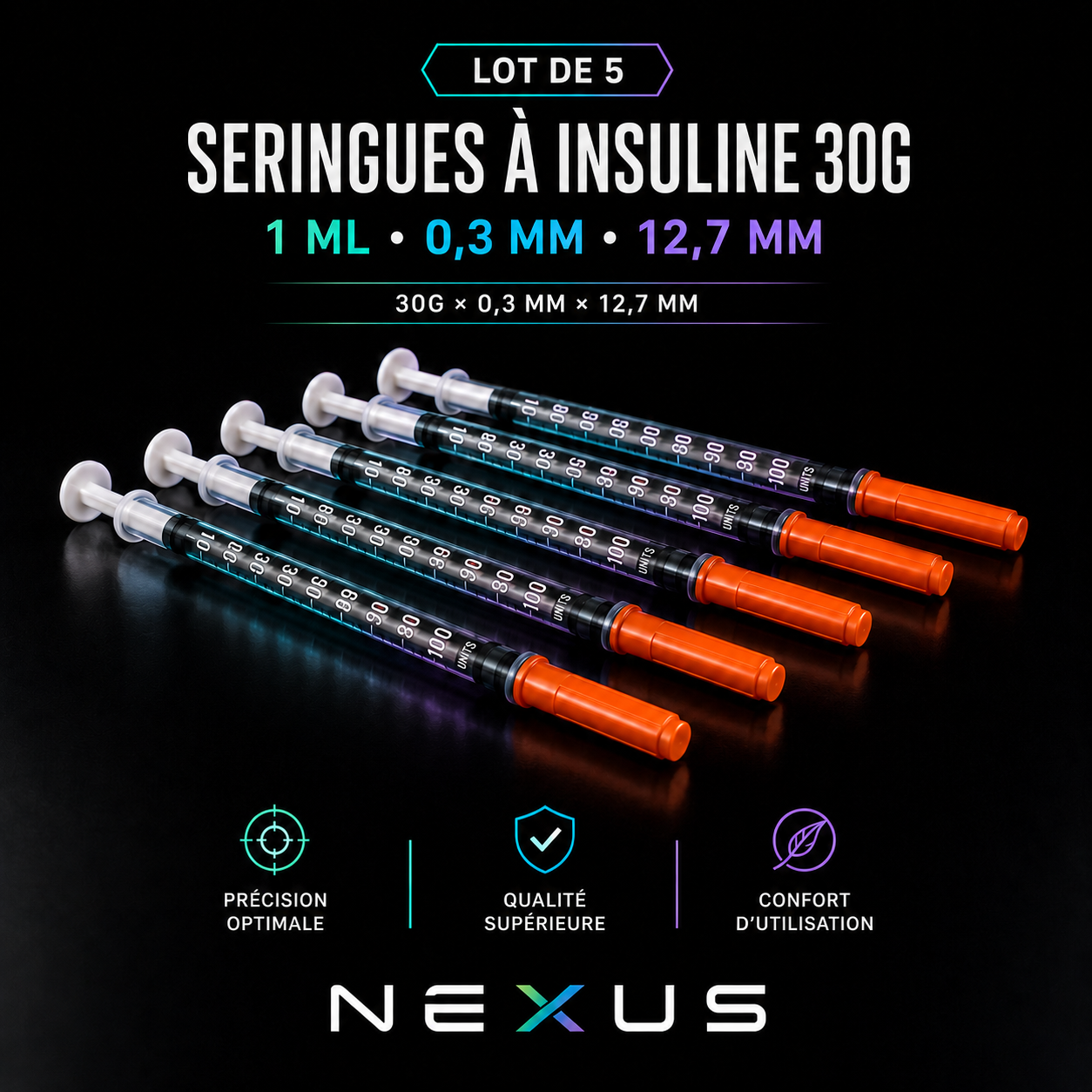
Sterile 1 ml insulin syringes with a fixed 30G · 0.3 × 13 mm needle, graduated in 100 units for precise volumetric withdrawal of reconstituted solutions in the laboratory. Pack of 5 single-use units. Laboratory consumable, research use only.
Research areas
- Withdrawal of reconstituted solutions
- Precise volumetric measurement
- Peptide handling in the laboratory
Technical data
| Field | Value |
|---|---|
| Name | 1 ml insulin syringes |
| Dosage | 30G · 0.3 × 13 mm |
| Volume | 1 ml (graduated) |
| Packaging | Pack of 5, sterile |
| Target / mechanism | Withdrawal consumable (laboratory use) |
| Form | Syringe + fixed needle |
Reading a U-100 syringe: IU, millilitres and micrograms
This is the number-one confusion, and it comes from one misread word. On a U-100 syringe the graduations are numbered in "units" — IU. The reflex is to read them as units of biological activity, as with an international unit of a vitamin or an enzyme. They are in fact units of volume, and nothing else.
The definition is purely geometric. A 1 ml U-100 syringe carries 100 graduations across its total volume, which gives one fixed equivalence, valid whatever the contents:
1 IU of graduation = 0.01 ml.
That equivalence depends on no product — it is the same for water, for a buffer, for any reconstituted solution.
What those 0.01 ml represent in mass depends entirely on the concentration reached at reconstitution. The same mark can mean 25 mcg or 250 mcg depending on how much solvent was added to the vial. The syringe measures a volume; reconstitution fixes how much material that volume holds.
Hence the reading rule: a graduation never transfers as-is from one protocol to another. "10 IU" is complete information only when the concentration is stated alongside it. Each small line is normally 1 IU, i.e. 0.01 ml, and the 50 IU mark is exactly half the volume, 0.5 ml.
What 30G and 0.3 × 13 mm mean
Two notations sit on the packaging, describing the same needle.
30G is the gauge. The scale is counter-intuitive: the higher the number, the thinner the needle. A 30G is thinner than a 27G, itself thinner than a 25G — an inversion inherited from a scale based on the number of drawing passes needed to stretch the metal tube. 0.3 × 13 mm is the metric translation: 0.3 mm outer diameter, matching gauge 30, and 13 mm of metal length.
A thin needle narrows the channel and so reduces flow. Drawing a viscous solution takes a little longer, and aspirating too fast pulls in bubbles; slowing the gesture solves it. The needle is fixed to the barrel, with no detachable hub — a construction that removes the dead volume of the cone, where a fraction of solution would otherwise stay trapped.
A worked example
Take a 5 mg vial reconstituted with 2 ml of solvent.
- concentration: 5 mg ÷ 2 ml = 2.5 mg/ml, i.e. 2,500 mcg/ml;
- 10 graduations = 0.1 ml;
- 0.1 ml × 2,500 mcg/ml = 250 mcg;
- the vial therefore yields 20 draws of 10 IU.
A pack of 5 covers the first five of those twenty draws — a quarter of a vial reconstituted at that volume, or a short protocol drawn five times. It is the pack to pick for a first series or to top up an existing stock.
Changing the reconstitution volume changes the reading, not the mass in the vial. With 1 ml instead of 2 ml the concentration becomes 5 mg/ml and the same 250 mcg are drawn at 5 IU. Our reconstitution calculator displays the graduation matching any given volume and mass.
Good withdrawal practice
- A fresh syringe for every draw. A needle tip blunts on its first pass through a septum, and a blunt tip shaves micro-fragments of elastomer into the solution.
- Purge bubbles before withdrawing the needle. Syringe upright, tip up, flick the barrel, then push the plunger gently. A 0.05 ml bubble in a 0.1 ml draw is a 50% volume error.
- Wipe the septum before each puncture and let it dry.
- Never reuse a needle, even on the same vial minutes apart.
- Discard used syringes in a sharps container, per the regulations applicable to the laboratory.
Common mistakes
- Reading IU as units of biological activity. They are units of volume: 1 IU = 0.01 ml, whatever the syringe holds.
- Carrying over a graduation without its concentration. "10 IU" means nothing until the concentration is known.
- Confusing gauge with thickness. 30G is thinner than 27G — the gauge scale is inverted.
- Drawing too fast with a fine needle. Fast aspiration pulls in bubbles and falsifies the volume.
- Reusing a syringe for a second draw. The needle is blunt after the first puncture and sterility is no longer assured.
Frequently asked questions
What does 1 IU represent on a 1 ml insulin syringe?
A unit of volume, not a unit of biological activity. A 1 ml U-100 syringe carries 100 graduations, so 1 IU of graduation is exactly 0.01 ml, whatever liquid it contains.
How many micrograms is 10 IU?
That depends entirely on the concentration of the solution. 10 IU is always 0.1 ml; on a 2.5 mg/ml solution those 0.1 ml hold 250 mcg, while on a 5 mg/ml solution they hold 500.
What does U-100 mean?
That the syringe is graduated on a 100-unit scale across 1 ml of total volume. It is a graduation convention, not an indication of contents.
What does 30G mean?
It is the needle gauge. The scale is inverted: the higher the number, the thinner the needle. A 30G is thinner than a 27G.
What does 0.3 × 13 mm refer to?
The metric description of the same needle: 0.3 mm outer diameter, which corresponds to gauge 30, and 13 mm of metal length.
How many draws does a pack of 5 cover?
Five, since each syringe is single-use. On a 5 mg vial reconstituted with 2 ml and drawn at 10 IU, that is a quarter of the twenty draws available.
Can a syringe be reused on the same vial?
No. The tip blunts on its first pass through the septum and can then shave micro-fragments of elastomer into the solution, and needle sterility is no longer assured after use.
How are bubbles purged before a draw?
Hold the syringe upright with the tip up, flick the barrel to raise the air, then push the plunger gently before withdrawing the needle from the vial. In a 0.1 ml draw, a 0.05 ml bubble halves the accuracy of the volume.
Is drawing slower with a 30G needle?
Slightly, yes: the narrow channel limits flow, particularly with a viscous solution. Slowing the aspiration is enough to avoid drawing in bubbles.
Are these syringes suitable for medical use?
No. They are supplied as a laboratory consumable, intended solely for handling research solutions by qualified personnel.
NEXUS Quality Standard
Every NEXUS research compound is produced under strict quality control procedures. Each batch undergoes independent analytical testing to verify identity, assay accuracy, purity, microbial safety, endotoxin levels, heavy metal screening, and full batch traceability.
For laboratory research only. Seringues insuline 1ml — lot de 5 30G 0,3×13mm is not suitable for human or animal consumption. Not a drug, food or cosmetic. To be handled by qualified personnel in accordance with applicable regulations.