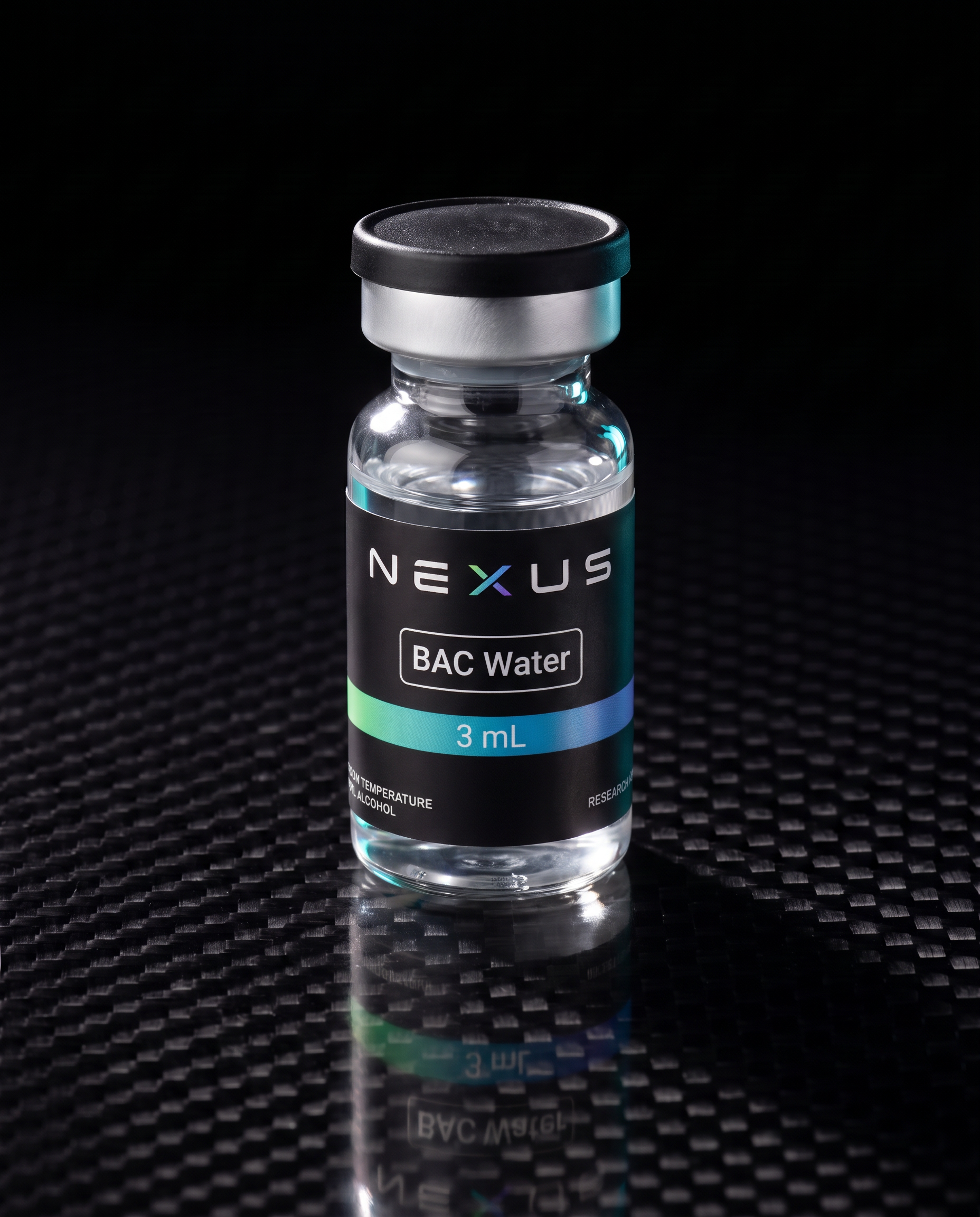
Sterile water with 0.9% benzyl alcohol, used in the laboratory as a reconstitution solvent for lyophilized peptides. The bacteriostatic preservative is what allows the stopper to be pierced several times, and therefore several withdrawals from the same vial. 3 ml vial: the volume of one reconstitution, with no opened vial left lingering in the fridge afterwards. Laboratory use only.
Uses
- Reconstitution of lyophilized peptides
- Dilution of stock solutions in the laboratory
- Preparation of aliquots
Technical data
| Field | Value |
|---|---|
| Volume | 3 ml |
| Composition | Sterile water + 0.9% benzyl alcohol |
| Function | Multi-withdrawal reconstitution solvent |
| Packaging | Crimp-sealed glass vial, pierceable stopper |
| Storage before opening | Room temperature, protected from light |
| After first piercing | 28 days |
| Shipped from | France, within 24 business hours |
Bacteriostatic water or sterile water: the difference
Both are sterile water. The difference is the preservative: 0.9% benzyl alcohol slows bacterial growth once the stopper has been pierced. A vial of plain sterile water is meant for a single withdrawal; a vial of bacteriostatic water withstands repeated withdrawals for 28 days. The same preservative also protects the reconstituted peptide solution when its own vial is pierced several times.
The trap most people fall into: the "0.9%" in bacteriostatic water is not the one in saline. In bacteriostatic water it is benzyl alcohol; in saline, sodium chloride. The two solvents are not interchangeable.
Why a 3 ml vial?
The 3 ml vial covers a reconstitution of 1 to 3 ml: exactly the volume of one peptide vial, with no leftover solvent to store. One vial per reconstituted peptide is also the simplest hygiene rule: each solvent vial is pierced for a single preparation, which limits cross-contamination and opened vials forgotten in the fridge. For several peptides, order one 3 ml vial per peptide vial.
Worked example: what 2 ml of solvent gives
The solvent volume never changes the mass of peptide in the vial, only its concentration. With 2 ml drawn from the 3 ml vial:
| Peptide vial + volume added | Resulting concentration |
|---|---|
| 5 mg + 2 ml | 2.5 mg/ml (2,500 µg/ml) |
| 10 mg + 2 ml | 5 mg/ml (5,000 µg/ml) |
| 10 mg + 3 ml | 3.33 mg/ml (3,333 µg/ml) |
Our reconstitution calculator runs this calculation for any mass and any volume.
Why choose this NEXUS product
- The right volume: 3 ml, the amount of one reconstitution, to order with each peptide vial.
- Shipped from France: parcels prepared within 24 business hours, delivered in 2 to 5 business days in France and 8 European countries. Free shipping from €120.
- Consistent quality: same supplier and same packaging from one batch to the next.
- Verified reviews: our customers leave their feedback on Trustpilot; we do not edit it.
Common laboratory mistakes
- Replacing bacteriostatic water with plain sterile water for a peptide vial that will be pierced several times. Without a preservative the solution is no longer protected.
- Confusing bacteriostatic water with saline. Same "0.9%", different compounds.
- Aiming the stream straight at the lyophilisate. The solvent should run down the vial wall; a harsh stream makes the solution foam and denatures part of the peptide.
- Keeping an opened vial beyond 28 days. The preservative's protection is no longer guaranteed after that.
Frequently asked questions
What is the difference between bacteriostatic water and sterile water?
The preservative. Bacteriostatic water contains 0.9% benzyl alcohol, which allows repeated withdrawals for 28 days; plain sterile water is meant for a single withdrawal.
How many peptide vials can a 3 ml vial reconstitute?
One, with 1 to 3 ml depending on the target concentration. For several peptide vials, plan one 3 ml vial per vial.
Is the 0.9% in bacteriostatic water salt?
No. It is benzyl alcohol. Saline contains 0.9% sodium chloride: they are two different solvents.
What concentration does 2 ml in a 10 mg vial give?
5 mg/ml, i.e. 5,000 µg/ml. In a 5 mg vial, the same 2 ml give 2.5 mg/ml.
How long does an opened vial keep?
28 days after the stopper is first pierced. Before opening, it keeps at room temperature, protected from light.
Where is the order shipped from and how fast?
From France, within 24 business hours. Delivery to a pick-up point or to your door in 2 to 5 business days depending on the country. Free from €120.
In what context may this product be used?
Strictly as a laboratory solvent. It is not intended for human or animal use, nor for diagnostic or therapeutic use.
NEXUS Quality Standard
Every NEXUS research compound is produced under strict quality control procedures. Each batch undergoes independent analytical testing to verify identity, assay accuracy, purity, microbial safety, endotoxin levels, heavy metal screening, and full batch traceability.
You may also like
For laboratory research only. BAC Water 3ml is not suitable for human or animal consumption. Not a drug, food or cosmetic. To be handled by qualified personnel in accordance with applicable regulations.