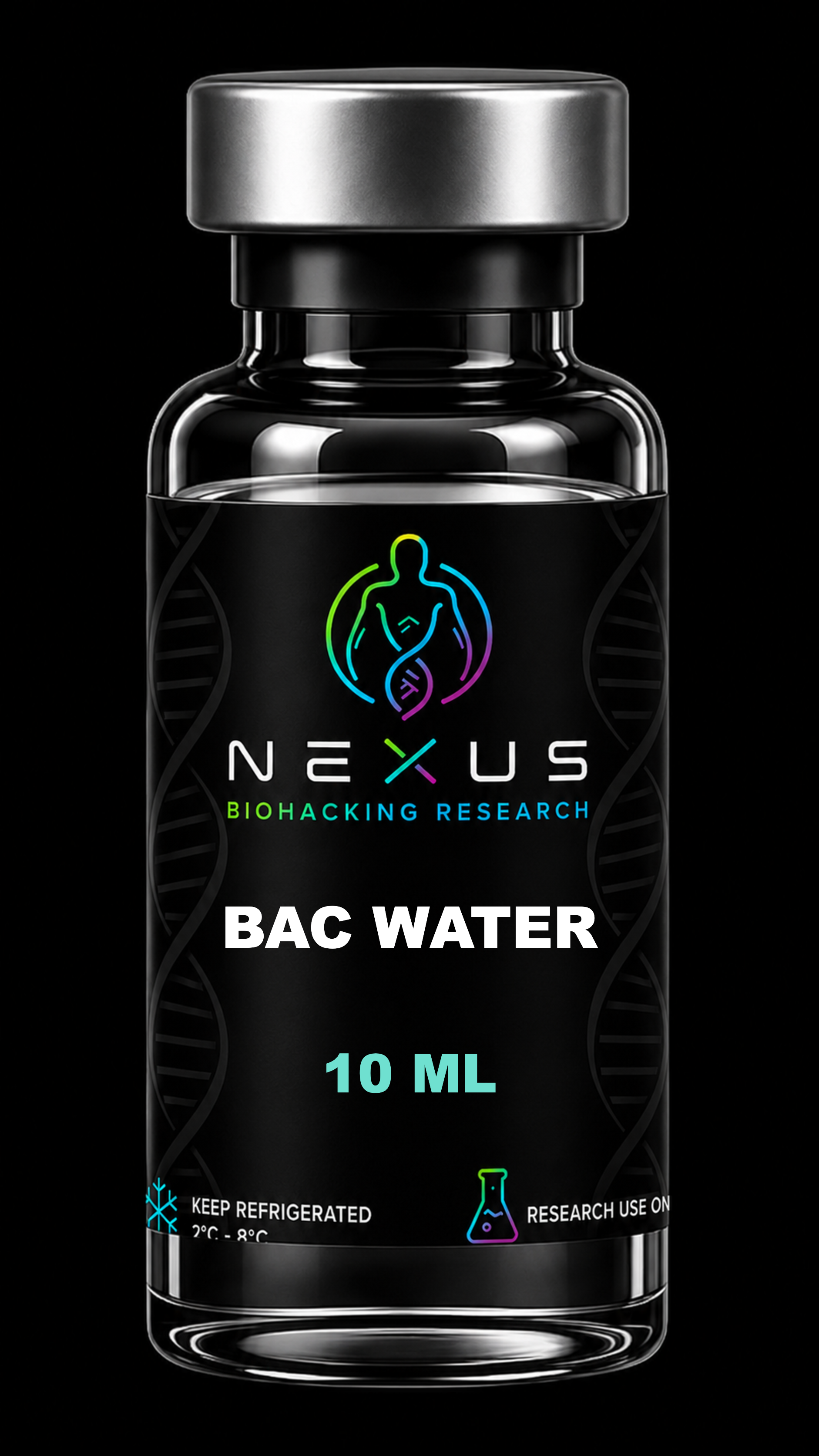
Water with 0.9% benzyl alcohol, used as a reconstitution solvent for lyophilized peptides in the laboratory. The bacteriostatic preservative is what allows the stopper to be pierced several times, and therefore several withdrawals from the same vial. 10 ml multi-dose vial. Laboratory use only.
Research areas
- Reconstitution of lyophilized peptides
- General-purpose laboratory solvent
- Storage of research solutions
Technical data
| Field | Value |
|---|---|
| Name | Bacteriostatic water (BAC Water) |
| Dosage | 10 ml |
| Sequence / composition | Water + 0.9% benzyl alcohol |
| Molecular weight | — |
| CAS no. | 100-51-6 (benzyl alcohol) |
| Target / mechanism | Reconstitution solvent (laboratory use) |
| Form | Sterile solution in a multi-dose vial |
| Preservative | 0.9% benzyl alcohol |
Bacteriostatic or sterile water: the difference that matters
This is the costliest confusion in the laboratory, because nothing about it is visible: both liquids are clear, both come in a vial, both are labelled sterile. One line of composition separates them.
Sterile water for injection contains no preservative. It is sterile while the vial is sealed, and stays so only until the stopper is pierced. From that first puncture, nothing prevents a contaminant introduced by the needle from multiplying. Such water therefore permits a single withdrawal, the remainder being discarded.
Bacteriostatic water contains 0.9% benzyl alcohol. This agent is not a steriliser: it does not destroy what is already present, it inhibits the multiplication of micro-organisms introduced during handling. That is what makes the vial multi-dose — the stopper can be pierced repeatedly, over several days, without each puncture compromising what remains.
The rule that follows is simple. A lyophilized peptide vial intended for repeated withdrawals is reconstituted with bacteriostatic water. Plain sterile water is only appropriate when the whole reconstituted vial is used at once — rare in research practice, where a 5 mg vial commonly yields twenty draws.
How to reconstitute a lyophilizate
The trap here is not the solvent, it is the gesture. A correctly reconstituted lyophilizate dissolves on its own, with no mechanical help.
1. Wipe the stopper of both vials and let them dry before any puncture.
2. Draw the intended volume with a fresh syringe, purging bubbles before withdrawing the needle.
3. Add the solvent slowly, down the inner wall of the tilted peptide vial — the liquid should run along the glass, never fall as a jet onto the powder.
4. Let it run, then rest one to two minutes. Most of the lyophilizate dissolves unaided.
5. Swirl gently if residue remains. No shaking, no vortex: shear denatures peptides, and foaming is the visible sign the structure has been mistreated.
At 2 ml per 5 mg vial, one 10 ml vial of solvent covers five reconstitutions.
A worked example
The solvent volume does not determine how much peptide is available — it determines the concentration, and therefore the volume to draw.
With 2 ml of bacteriostatic water in a 5 mg vial:
- concentration: 5 mg ÷ 2 ml = 2.5 mg/ml, i.e. 2,500 mcg/ml;
- on a U-100 syringe, 1 ml is 100 IU of graduation, so 10 IU = 0.1 ml = 250 mcg;
- the vial yields 20 draws of 10 IU.
The most common trap: the volume of water never changes the mass of peptide in the vial. Reconstituting the same 5 mg with 1 ml instead of 2 ml gives 5 mg/ml — the same total mass in half the volume. Only the graduation to draw changes; it is halved. Our reconstitution calculator computes any other combination live.
Storage
Unopened vial: room temperature, away from direct light and marked temperature swings. No refrigeration is required while the septum is intact.
After the first puncture: refrigeration at 2–8 °C is recommended, vial upright, stopper wiped before each new puncture. Benzyl alcohol inhibits microbial growth, it does not suppress it indefinitely — an opened vial is used over a short window, and any vial showing cloudiness, discolouration or suspended particles is discarded. These indications concern the solvent itself; how long a peptide keeps once reconstituted is covered by that peptide's own product page.
Common mistakes
- Reconstituting a multi-dose vial with sterile water. Without a preservative the solution is unprotected from the second puncture onward.
- Pouring the solvent as a jet onto the powder. The lyophilizate should be wetted gradually down the wall.
- Vortexing or shaking to speed up dissolution. Shear denatures peptides; foam is the visible signal.
- Reusing the same syringe to draw solvent. Each withdrawal uses a fresh needle on a wiped septum.
- Leaving an opened vial at room temperature. Refrigeration after opening remains the rule.
Frequently asked questions
What is the difference between bacteriostatic water and sterile water?
Bacteriostatic water contains 0.9% benzyl alcohol, a preservative that inhibits microbial multiplication and therefore allows the stopper to be pierced several times. Sterile water for injection contains no preservative: it permits a single withdrawal, with the remainder of the vial discarded.
Why is it called a multi-dose vial?
Because the preservative protects what remains after each puncture of the septum. That property, and only that property, is what makes repeated withdrawals over several days possible from one vial.
Does benzyl alcohol sterilise the solution?
No, and the distinction matters. A bacteriostatic agent prevents micro-organisms from multiplying; it does not destroy those already present. It complements aseptic technique, it does not replace it.
How many peptide vials can a 10 ml vial reconstitute?
That depends on the volume chosen per vial. At 2 ml per 5 mg vial, a 10 ml vial covers five reconstitutions.
What concentration does 2 ml give in a 5 mg vial?
2.5 mg/ml, i.e. 2,500 mcg/ml. On a U-100 syringe, 10 IU of graduation then corresponds to 0.1 ml and 250 mcg, giving 20 draws per vial.
Does the volume of water change how much peptide is available?
No. The mass in the vial is fixed by the lyophilizate, not by the solvent. A smaller volume gives a higher concentration and a smaller graduation to draw, for the same total mass.
How should the solvent be added without degrading the peptide?
By letting it run slowly down the inner wall of the tilted vial, then resting for one to two minutes. If residue remains, a gentle swirl is enough — no vigorous shaking, no vortex, since shear denatures peptides.
Does the bacteriostatic water vial need refrigeration?
An unopened vial keeps at room temperature, away from light. After the first puncture, refrigeration at 2–8 °C is recommended and the vial is used over a short window.
What if the solution turns cloudy or discoloured?
The vial is discarded. Cloudiness, discolouration or suspended particles indicate the contents are no longer usable, whatever time has passed since opening.
In what context may this product be used?
Exclusively for laboratory and in vitro research. It is not intended for human or animal consumption, nor for diagnostic or therapeutic use.
NEXUS Quality Standard
Every NEXUS research compound is produced under strict quality control procedures. Each batch undergoes independent analytical testing to verify identity, assay accuracy, purity, microbial safety, endotoxin levels, heavy metal screening, and full batch traceability.
For laboratory research only. BAC Water 10ml is not suitable for human or animal consumption. Not a drug, food or cosmetic. To be handled by qualified personnel in accordance with applicable regulations.