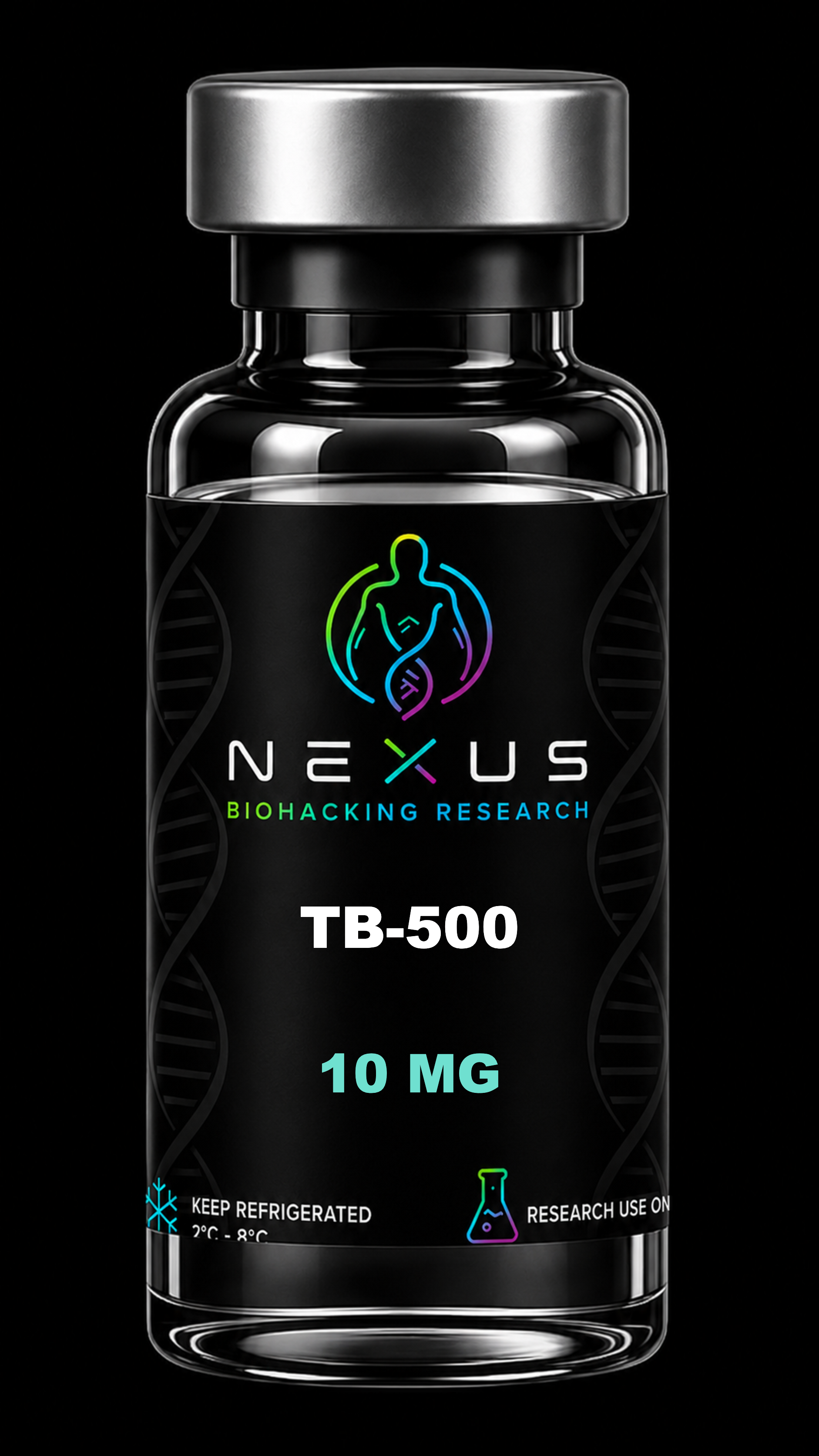
Full-length thymosin β4, a 43-amino-acid protein studied for its role in actin regulation, cell migration and tissue-remodelling models. Frequently paired with BPC-157 in recovery-focused research protocols. 10 mg vial, lyophilized, ≥99% HPLC purity verified by third-party analysis. Laboratory research use only.
Research areas
- G-actin regulation
- Cell migration and differentiation
- Angiogenesis and remodelling (models)
Technical data
| Field | Value |
|---|---|
| Name | TB-500 (Thymosin β4) |
| Dosage | 10 mg |
| Sequence / composition | Full-length thymosin β4, 43 amino acids (active LKKTET motif, residues 17-22) |
| Molecular weight | ≈ 4,963 Da |
| CAS no. | 77591-33-4 |
| Target / mechanism | Actin regulation, cell migration |
| Form | Lyophilized powder (unless stated otherwise) |
| Purity | ≥ 99% (HPLC) — see batch COA |
TB-500: short fragment or full-length thymosin β4?
The name "TB-500" originally referred to a short peptide reproducing the LKKTET motif — residues 17 to 22 of thymosin β4, identified as the main actin-binding region. In practice, much of what circulates under that label on the research market is the full 43-amino-acid protein.
Molecular weight settles it immediately: a 7-residue fragment weighs roughly 900 Da, whereas full-length thymosin β4 weighs ≈ 4,963 Da. This reference is the full-length protein, as its molecular weight and CAS number 77591-33-4 confirm. It is also the molecule the literature actually covers — cardiac, corneal and muscle models all used the complete protein, not the isolated fragment.
Mechanism studied
The best-characterised mechanism is sequestration of monomeric G-actin. By binding these monomers, thymosin β4 forms a mobilisable pool and modulates the balance between free actin and polymerised filaments (F-actin), governing cytoskeletal reorganisation — and therefore cell migration. Increased mobility has been associated with keratinocytes, endothelial cells and myoblasts in vitro. Angiogenesis is a third axis: several models report enhanced endothelial migration and vascular structure formation.
What the literature shows
Almost all data is preclinical. Bock-Marquette et al. (Nature, 2004) reported improved cardiomyocyte survival and coronary vascular growth in mice after experimental infarction. Sosne et al. documented accelerated corneal epithelial healing and reduced inflammation in rodents after chemical injury. Thymosin β4 has also been described as a myoblast chemoattractant after muscle injury.
The full-length molecule has been evaluated in human trials as an eye drop for dry eye and neurotrophic keratopathy. Those trials do not constitute therapeutic validation of the product sold here, which remains a laboratory reagent.
Reconstitution: a worked example
With 2 mL of bacteriostatic water in a 10 mg vial: 10 mg ÷ 2 mL = 5 mg/mL, i.e. 5,000 mcg/mL. On a U-100 syringe, 10 IU = 0.1 mL = 500 mcg, giving 20 draws of 10 IU per vial.
The most common trap: the volume of water never changes how much peptide is in the vial. Reconstituting with 5 mL instead of 2 mL gives 2 mg/mL instead of 5 mg/mL — the same total mass in a larger volume. Only the volume to draw changes. Our reconstitution calculator computes any other combination live.
Add the solvent slowly down the vial wall, then swirl gently. No vigorous shaking, no vortex — shear denatures peptides.
Storage
Lyophilized powder: -20 °C or below, protected from light and moisture; stable for years when unopened. After reconstitution: 2–8 °C, protected from light, with a reference shelf life of 28 days. For longer storage, frozen aliquots are preferable to repeated freeze-thaw cycles.
Common laboratory mistakes
- Comparing two "TB-500" vials without checking molecular weight. A fragment (~900 Da) and the full protein (≈ 4,963 Da) are not the same molecule, and the literature does not carry over from one to the other.
- Using plain sterile water for a multi-draw vial. Without a preservative, the solution is no longer protected once the stopper has been pierced more than once.
- Vortexing the vial. Vigorous agitation denatures peptides. Gentle swirling is enough, even if dissolution takes a minute.
- Repeatedly refreezing the reconstituted solution. Each cycle degrades a fraction of the peptide. Aliquot at reconstitution.
- Reconstituting a 10 mg vial like a 5 mg one. At equal water volume the concentration doubles — and the volume to draw is halved.
Frequently asked questions
Is TB-500 a fragment or full-length thymosin β4?
Both circulate under that name. This reference is full-length thymosin β4, 43 amino acids, as confirmed by its molecular weight of roughly 4,963 Da and CAS number 77591-33-4. A short LKKTET-type fragment would weigh about 900 Da.
Why does the distinction matter?
Because the scientific literature — cardiac, corneal and muscle models — overwhelmingly used the full protein. Comparing results obtained with the isolated fragment against those obtained with the complete protein leads to wrong conclusions.
What is the mechanism studied?
Sequestration of monomeric G-actin. By binding G-actin, thymosin β4 modulates the balance between free actin and actin filaments, which governs cytoskeletal reorganisation and therefore cell migration.
What should this peptide be reconstituted with?
Bacteriostatic water, which contains benzyl alcohol and allows multiple draws. Plain sterile water is unsuitable once the vial is pierced more than once.
What concentration does 2 mL of bacteriostatic water give?
5 mg/mL, i.e. 5,000 mcg/mL. On a U-100 syringe, 10 IU then corresponds to 0.1 mL and 500 mcg, giving 20 draws per vial.
How long does the reconstituted solution keep?
28 days at 2–8 °C, protected from light — the reference shelf life for a reconstituted vial. Beyond that, frozen aliquots are preferable to repeated freeze-thaw cycles.
Can it be combined with BPC-157?
It is a common pairing in tissue-recovery research protocols, the two peptides being studied on distinct pathways. Combined BPC-157 + TB-500 vials are available in our catalogue.
What is the purity and how is it verified?
Purity ≥ 99% verified by HPLC. A third-party certificate of analysis is available for every batch, stating compound identity, assay, purity and microbial safety controls.
Do you ship to Europe?
Yes. Shipping from Europe to France, Belgium, Luxembourg and Switzerland, with a tracking number. Times and rates are listed on the shipping page.
In what context may this product be used?
Exclusively for laboratory and in vitro research. It is not intended for human or animal consumption, nor for diagnostic or therapeutic use.
NEXUS Quality Standard
Every NEXUS research compound is produced under strict quality control procedures. Each batch undergoes independent analytical testing to verify identity, assay accuracy, purity, microbial safety, endotoxin levels, heavy metal screening, and full batch traceability.
For laboratory research only. TB500 10mg is not suitable for human or animal consumption. Not a drug, food or cosmetic. To be handled by qualified personnel in accordance with applicable regulations.