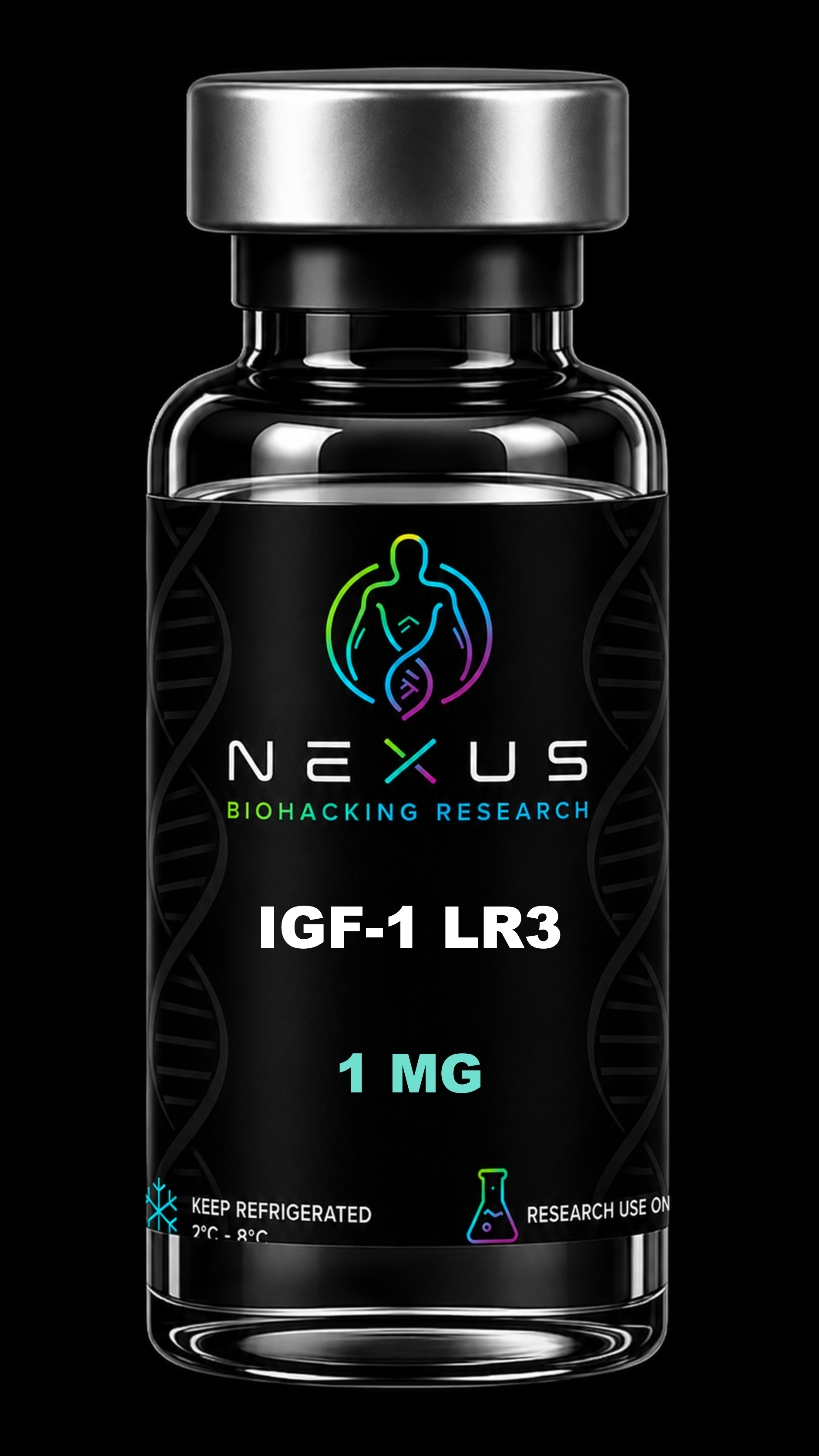
A long-acting analogue of human IGF-1 (83 amino acids) with sharply reduced affinity for IGFBP binding proteins, used as a cell-culture tool for studying IGF-1R signalling, proliferation and survival. 1 mg vial, lyophilized powder, ≥99% HPLC purity verified by third-party analysis. A reagent for laboratory research use only, excluding any human or veterinary use.
Research areas
- Cell proliferation and differentiation
- IGF-1R signalling (PI3K/Akt, MAPK)
- Cell culture in defined media
Technical data
| Field | Value |
|---|---|
| Name | IGF-1 LR3 |
| Dosage | 1 mg |
| Sequence / composition | Long R3 analogue of IGF-1 (83 aa) |
| Molecular weight | ≈ 9,111 Da |
| CAS no. | 946870-92-4 |
| Target / mechanism | IGF-1 receptor (IGF-1R) |
| Form | Lyophilized powder (unless stated otherwise) |
| Purity | ≥ 99% (HPLC) — see batch COA |
What "Long R3" actually changes
The name is not marketing: it describes two precise modifications.
Native human IGF-1 is 70 amino acids, about 7.6 kDa. The Long R3 version is 83: a thirteen-residue N-terminal extension, hence "Long", plus the substitution of the position-3 glutamate by an arginine, hence "R3".
The decisive criterion is verifiable on a certificate of analysis: ≈ 9,111 Da here against ≈ 7,649 Da for native recombinant IGF-1. A gap that size is not batch variation — it is a different molecule.
Both modifications produce a collapse in affinity for the six IGFBP binding proteins, described in the literature as a reduction of roughly two orders of magnitude. In serum-containing medium, or where cultured cells secrete IGFBPs themselves, native IGF-1 is heavily sequestered and the free, receptor-active fraction drops. Long R3 largely escapes that capture.
The point usually left out: affinity for IGF-1R itself is not increased — it is described as slightly lower than that of the native peptide. The apparent gain is conditional on binding proteins being present. In a purified IGFBP-free system, Long R3 is not more potent than native IGF-1.
Mechanism studied
The target is the IGF-1 receptor (IGF-1R), a heterotetrameric α₂β₂ receptor tyrosine kinase. Binding to the extracellular α subunits triggers autophosphorylation of the intracellular β subunits and recruitment of adaptor proteins.
Two downstream branches are described: IRS-1/2 → PI3K → Akt → mTORC1, associated in models with protein synthesis and survival, and Shc → Ras → Raf → MEK → ERK1/2, associated with proliferative responses. At high concentrations, cross-binding to the insulin receptor and to IR/IGF-1R hybrids is described — a classic artefact source, and a reason to run a full dose-response curve.
What the literature shows
Long R3 is described above all as a cell-culture tool: in serum-free defined media it serves as a growth supplement where native IGF-1 would be neutralised by IGFBPs, showing greater activity at equal mass — precisely because binding proteins are present.
What the literature does not show:
- No human clinical trial programme covers IGF-1 LR3. It is neither evaluated nor approved as a medicine in any jurisdiction, and no human efficacy or safety data exist.
- A recombinant IGF-1 medicine does exist — mecasermin, authorised for severe primary IGF-1 deficiency under strict medical supervision. It is native 70-amino-acid human IGF-1, distinct from this reagent: its data do not transfer to the product sold here, which is not a medicine.
- The IGF-1R axis is studied in experimental oncology as a proliferative pathway, warranting qualified handling and no applicative extrapolation.
- Circulating half-life is described as longer than that of free native IGF-1, but published values vary by species and no consensus figure exists.
Reconstitution: a worked example
With 2 mL of bacteriostatic water in a 1 mg vial: 1 mg ÷ 2 mL = 0.5 mg/mL, i.e. 500 mcg/mL. On a U-100 syringe, 1 mL is 100 IU of graduation, so 10 IU of graduation = 0.1 mL = 50 mcg, giving 20 draws per vial.
The most common trap: the volume of water never changes how much product is in the vial. Only the volume to draw changes. Our reconstitution calculator computes any other combination live.
Add the solvent slowly down the vial wall, then swirl gently. No vigorous shaking, no vortex — shear denatures proteins. Some in vitro protocols specify a different vehicle, such as a dilute acid buffer; the protocol sheet then takes precedence.
Storage
Lyophilized powder: -20 °C or below, protected from light and moisture; stable for years when unopened. After reconstitution: 2–8 °C, protected from light, with a reference shelf life of 28 days. For longer storage, frozen aliquots are preferable to repeated freeze-thaw cycles.
Common laboratory mistakes
- Treating Long R3 as a universally "stronger IGF-1". The advantage exists only where IGFBPs are present.
- Confusing it with native recombinant IGF-1. 83 amino acids against 70, ≈ 9,111 Da against ≈ 7,649 Da; the COA mass settles it.
- Working at high concentration without a dose-response curve. Cross-binding to the insulin receptor makes attribution to IGF-1R alone unreliable.
- Diluting heavily without a carrier protein. A ~9 kDa protein adsorbs to plastic and glass, causing silent titre loss.
- Using plain sterile water for a multi-draw vial, vortexing, or repeatedly refreezing. Each degrades a fraction of the material.
Frequently asked questions
What is the difference between IGF-1 LR3 and native IGF-1?
Native IGF-1 has 70 amino acids and a mass of about 7,649 Da; Long R3 has 83 and about 9,111 Da, owing to a thirteen-residue N-terminal extension and the replacement of the position-3 glutamate by arginine. These changes sharply reduce IGFBP affinity without increasing affinity for the receptor.
What exactly does "Long R3" mean?
"Long" refers to the thirteen-amino-acid extension added at the N-terminus; "R3" refers to the substitution of the position-3 glutamic acid by an arginine. Both serve the same purpose: reducing capture by binding proteins.
Is IGF-1 LR3 more potent than native IGF-1 in every system?
No, and this is the most widespread misconception. The gain exists only where binding proteins are present — serum, or IGFBPs secreted by the cultured cells. In a purified IGFBP-free system, the analogue's affinity for IGF-1R is described as slightly lower than that of the native peptide.
Which receptor is targeted?
The IGF-1 receptor (IGF-1R), a heterotetrameric α₂β₂ receptor tyrosine kinase. Activation triggers β-subunit autophosphorylation, then the IRS/PI3K/Akt/mTORC1 and Shc/Ras/ERK1/2 pathways. Cross-binding to the insulin receptor is described at high concentrations.
Are there clinical trials on IGF-1 LR3?
No. No human clinical trial programme covers this analogue and it is approved as a medicine nowhere. A recombinant IGF-1 medicine exists, mecasermin, but it is native 70-amino-acid human IGF-1 — a distinct molecule whose data do not transfer to the reagent sold here.
What should this product be reconstituted with?
Bacteriostatic water, which contains benzyl alcohol and allows multiple draws. Plain sterile water is unsuitable once the vial is pierced more than once. Some in vitro protocols specify a different vehicle, such as a dilute acid buffer, in which case the protocol takes precedence.
What concentration does 2 mL of bacteriostatic water give?
0.5 mg/mL, i.e. 500 mcg/mL. On a U-100 syringe, 10 IU of graduation then corresponds to 0.1 mL and 50 mcg, giving 20 draws per vial.
How long does the reconstituted solution keep?
28 days at 2–8 °C, protected from light — the reference shelf life for a reconstituted vial. Beyond that, frozen aliquots are preferable to repeated freeze-thaw cycles.
What purity is stated, and in what context may the product be used?
Purity is ≥ 99% verified by HPLC, with a third-party certificate of analysis per batch reporting the measured mass, which confirms Long R3 (≈ 9,111 Da) rather than native IGF-1. The product is for laboratory and in vitro research only, by qualified personnel: not for human or animal consumption, nor for diagnostic or therapeutic use.
NEXUS Quality Standard
Every NEXUS research compound is produced under strict quality control procedures. Each batch undergoes independent analytical testing to verify identity, assay accuracy, purity, microbial safety, endotoxin levels, heavy metal screening, and full batch traceability.
For laboratory research only. IGF-lr3 1mg is not suitable for human or animal consumption. Not a drug, food or cosmetic. To be handled by qualified personnel in accordance with applicable regulations.