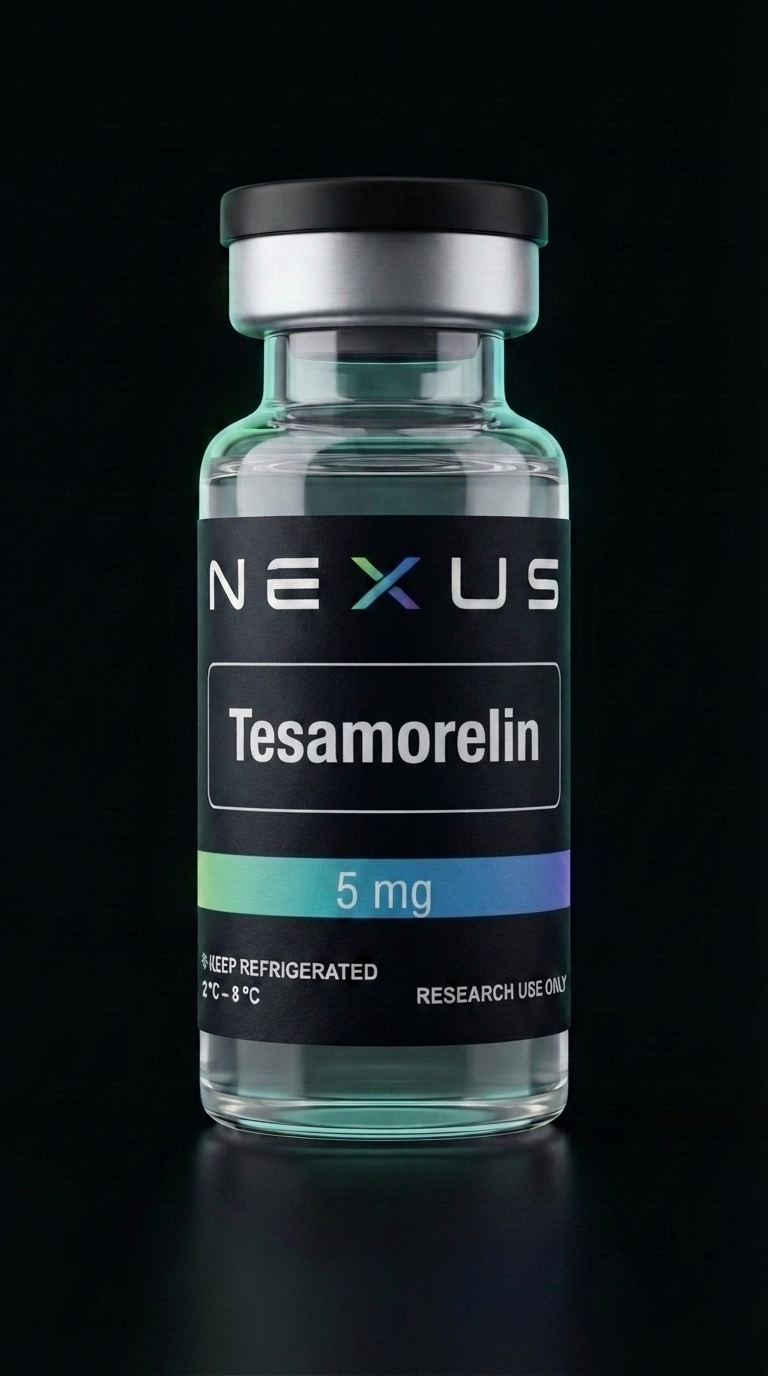
A stabilized synthetic analogue of human GHRH (1-44), carrying an N-terminal trans-3-hexenoyl group that slows its enzymatic degradation. Studied as a tool for selective GHRH-R activation and for investigating pulsatile GH secretion in preclinical models. 5 mg vial, lyophilized powder, ≥99% HPLC purity verified by third-party analysis. A reagent for laboratory research use only, excluding any human or veterinary use.
Research areas
- Stabilised GHRH-R signalling
- GH / IGF-1 axis (models)
- Lipid metabolism (models)
Technical data
| Field | Value |
|---|---|
| Name | Tesamorelin |
| Dosage | 5 mg |
| Sequence | Human GHRH (1-44) analogue, N-terminal trans-3-hexenoyl |
| Molecular weight | ≈ 5,135.9 Da |
| CAS no. | 218949-48-5 |
| Target / mechanism | GHRH receptor (GHRH-R) |
| Form | Lyophilized powder (unless stated otherwise) |
| Purity | ≥ 99% (HPLC) — see batch COA |
What the trans-3-hexenoyl group changes against other GHRH analogues
These compounds all target the same receptor, which does not make them interchangeable. Two verifiable criteria separate them: sequence length and stabilisation method.
Endogenous human GHRH is 44 amino acids, but its activity resides in the 1-29 fragment — hence the truncated analogues: sermorelin is GHRH(1-29), CJC-1295 a GHRH(1-29) analogue with four substitutions. Tesamorelin keeps the full 1-44 sequence, and mass settles it at a glance: ≈ 5,136 Da here against roughly 3.4 kDa for the 1-29 analogues.
Native GHRH is degraded within minutes by dipeptidyl peptidase 4 (DPP-4), which cleaves the bond between tyrosine 1 and alanine 2 and releases an inactive 3-44 fragment. Two protection strategies exist: substituting residue 2 with D-alanine (CJC-1295, Mod GRF 1-29), or acylating tyrosine 1 — tesamorelin's trans-3-hexenoyl group.
That group is therefore a chemical shield over the cleavage site, not a circulatory retention system. It is the nuance the CJC-1295 comparison loses: tesamorelin resists DPP-4 far better than native GHRH, but its plasma half-life stays in the tens of minutes — nothing like the 5.8 to 8.1 days reported for an albumin-conjugated DAC analogue (Teichman et al., 2006).
Mechanism studied
The target is the GHRH receptor (GHRH-R), a class B G-protein-coupled receptor expressed by anterior pituitary somatotrophs. Binding activates Gαs → adenylate cyclase → cAMP → protein kinase A, with CREB phosphorylation, calcium influx and exocytosis of GH granules.
The experimentally important point is position in the cascade: a GHRH-R agonist acts upstream of the pituitary, so the secretion it triggers remains subject to somatostatin tone and IGF-1 negative feedback, and keeps its pulsatile character in models — unlike direct exogenous GH.
What the literature shows
Tesamorelin has been through a genuine clinical trial programme — but those trials concern an approved pharmaceutical product, distinct from the reagent sold here. A randomised trial published by Falutz et al. in the New England Journal of Medicine in 2007 evaluated that medicine in patients with HIV-associated lipodystrophy, reporting a reduction in visceral adipose tissue on imaging, and led to a marketing authorisation in that indication.
The distinction is not a formality: that medicine is manufactured and controlled to pharmaceutical standards, for a medically supervised patient population. None of that applies to the product on this page, a laboratory reagent with no medicinal status and no human use.
What the literature does not show:
- No benefit persisting after discontinuation: in the published trials on the medicine, the visceral adipose tissue effect regressed once administration stopped.
- No data outside the supervised clinical setting, and no evaluation of the research reagent as such.
- A documented rise in IGF-1, requiring laboratory monitoring in the clinical setting — a limit of the data, not a parameter applying to the reagent.
- Preclinical work is largely rodent-based, with species differences in the somatotropic axis that call for caution.
Reconstitution: a worked example
With 2 mL of bacteriostatic water in a 5 mg vial: 5 mg ÷ 2 mL = 2.5 mg/mL, i.e. 2,500 mcg/mL. On a U-100 syringe, 1 mL is 100 IU of graduation, so 10 IU of graduation = 0.1 mL = 250 mcg, giving 20 draws per vial.
The most common trap: the volume of water never changes how much product is in the vial. Only the volume to draw changes. Our reconstitution calculator computes any other combination live.
Add the solvent slowly down the vial wall, then swirl gently. No vigorous shaking, no vortex — shear denatures peptides.
Storage
Lyophilized powder: -20 °C or below, protected from light and moisture; stable for years when unopened. After reconstitution: 2–8 °C, protected from light, with a reference shelf life of 28 days. For longer storage, frozen aliquots are preferable to repeated freeze-thaw cycles.
Common laboratory mistakes
- Treating tesamorelin, sermorelin and CJC-1295 as equivalent. 1-44 against 1-29, ≈ 5,136 Da against ≈ 3.4 kDa, acylation against position-2 substitution.
- Expecting a DAC-like duration. The trans-3-hexenoyl protects against DPP-4; it creates no albumin binding.
- Reading the clinical trial results across to the reagent. Those trials concern an approved medicine, distinct from this product.
- Using plain sterile water for a multi-draw vial. Without a preservative, the solution is unprotected once the stopper has been pierced several times.
- Vortexing the vial or repeatedly refreezing. Shear denatures the peptide and each freeze-thaw cycle degrades a fraction of it.
Frequently asked questions
What distinguishes tesamorelin from sermorelin and CJC-1295?
Tesamorelin keeps the full human GHRH 1-44 sequence, whereas sermorelin and CJC-1295 are truncated GHRH 1-29 analogues. Mass makes it verifiable: about 5,136 Da against roughly 3.4 kDa. The stabilisation method differs too.
What is the trans-3-hexenoyl group for?
It acylates the tyrosine at position 1 and shields the site where dipeptidyl peptidase 4 normally cleaves native GHRH, between residues 1 and 2. It is a chemical shield over the cleavage point, slowing degradation without altering the 44-amino-acid sequence.
Which receptor is targeted?
The GHRH receptor (GHRH-R), a class B G-protein-coupled receptor expressed by anterior pituitary somatotrophs. Activation runs through Gαs, adenylate cyclase, cAMP and protein kinase A, with CREB phosphorylation and calcium influx.
Does tesamorelin last as long as a DAC analogue?
No, and this is a frequent confusion. The trans-3-hexenoyl protects against DPP-4 but creates no albumin binding: the described plasma half-life remains in the tens of minutes, against the 5.8 to 8.1 days reported for CJC-1295 with DAC by Teichman et al. in 2006.
Are there clinical trials on tesamorelin?
Yes, but they concern an approved medicine, distinct from the reagent sold here. A randomised trial published by Falutz et al. in the New England Journal of Medicine in 2007 evaluated that product in patients with HIV-associated lipodystrophy, under medical supervision. Those results do not validate the product on this page, which is not a medicine.
What does the available literature not show?
It shows no benefit persisting after discontinuation — the documented effect regressed once administration stopped — and no data outside the clinical populations and protocols studied. A rise in IGF-1 is also documented, requiring monitoring in that setting.
What should this peptide be reconstituted with?
Bacteriostatic water, which contains benzyl alcohol and allows multiple draws. Plain sterile water is unsuitable once the vial is pierced more than once.
What concentration does 2 mL of bacteriostatic water give?
2.5 mg/mL, i.e. 2,500 mcg/mL. On a U-100 syringe, 10 IU of graduation then corresponds to 0.1 mL and 250 mcg, giving 20 draws per vial.
How long does the reconstituted solution keep?
28 days at 2–8 °C, protected from light — the reference shelf life for a reconstituted vial. Beyond that, frozen aliquots are preferable to repeated freeze-thaw cycles.
What purity is stated, and in what context may the product be used?
Purity is ≥ 99% verified by HPLC, with a third-party certificate of analysis per batch reporting the measured mass. The product is for laboratory and in vitro research only, by qualified personnel: not for human or animal consumption, nor for diagnostic or therapeutic use.
NEXUS Quality Standard
Every NEXUS research compound is produced under strict quality control procedures. Each batch undergoes independent analytical testing to verify identity, assay accuracy, purity, microbial safety, endotoxin levels, heavy metal screening, and full batch traceability.
For laboratory research only. Tesamorelin 5mg is not suitable for human or animal consumption. Not a drug, food or cosmetic. To be handled by qualified personnel in accordance with applicable regulations.