In the field of research on the somatotropic axis, two peptide families come up constantly: GHRH (growth hormone-releasing hormone) analogs and GHRP-type secretagogues. CJC-1295 belongs to the first family, Ipamorelin to the second. Their combination has become a recurring subject of study because it makes it possible to act on two distinct levers of growth hormone (GH) secretion. This article summarizes, in our own words, what the scientific literature describes. It falls strictly within a research use only framework: no medical claims, and no protocol or dosage intended for human use, appear here.
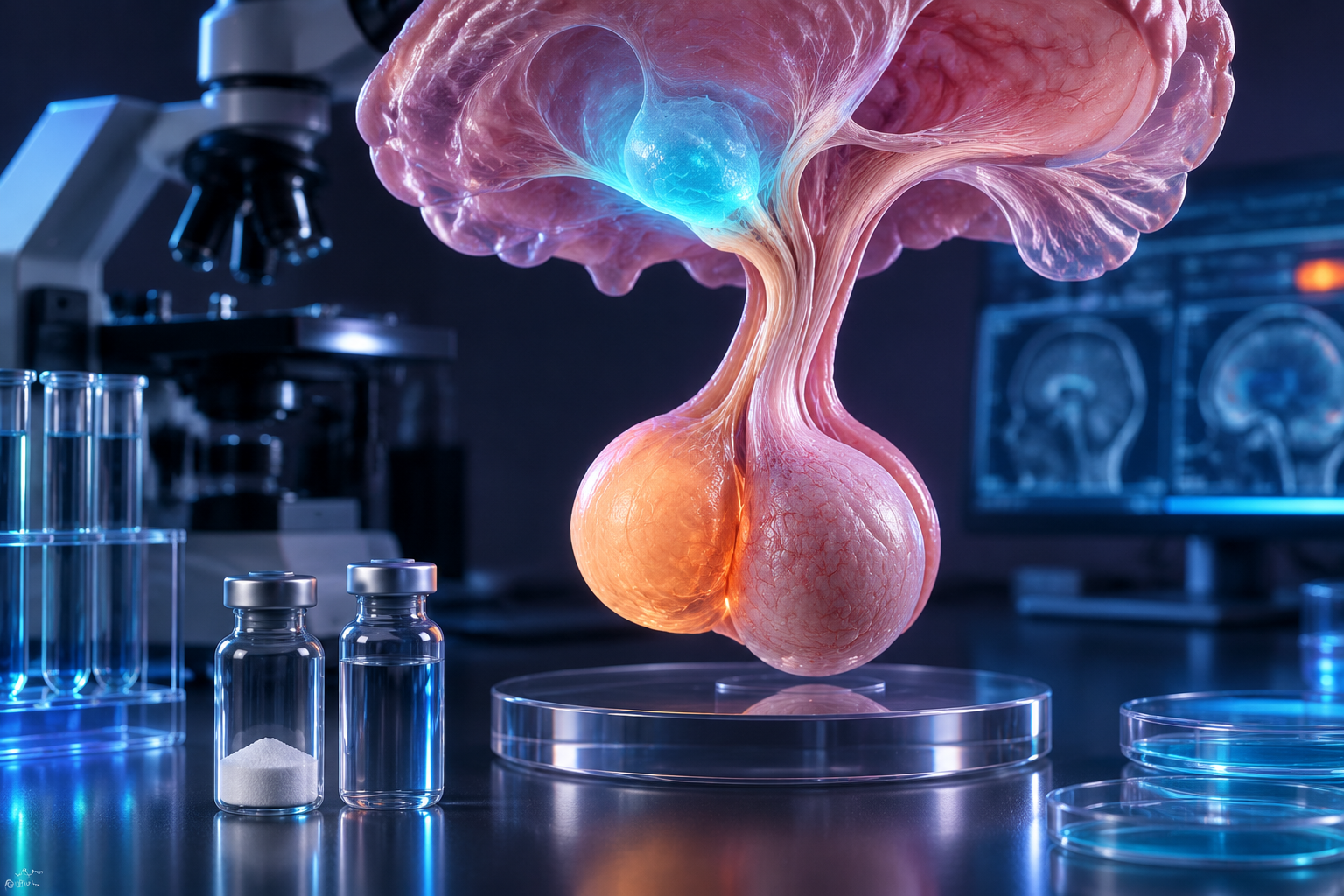
CJC-1295: without DAC vs. with DAC
CJC-1295 is derived from the first 29 amino acids of human GHRH, the minimal portion retaining biological activity. In its "without DAC" version, often called Mod GRF 1-29, a few amino acid substitutions stabilize the molecule against rapid enzymatic degradation (notably by DPP-IV), without, however, substantially extending its circulation time. Its half-life remains short, on the order of a few dozen minutes in the models described.
The key difference lies in the DAC (Drug Affinity Complex). This is a reactive chemical group (a maleimide) grafted onto the peptide, capable of binding covalently to serum albumin once in the biological medium. Since albumin is a highly abundant, long-lived transport protein, this binding protects the peptide from rapid elimination. The result observed in the clinical literature: an estimated half-life of 5.8 to 8.1 days for the DAC-conjugated form (Teichman et al., 2006, early-phase trial in healthy adults), versus a brief, pulsatile action for Mod GRF 1-29. In summary, the DAC converts a short stimulus into prolonged exposure over several days.
Ipamorelin (selective GHRP) and the rationale for combining it
Ipamorelin is a pentapeptide that does not act on the GHRH receptor but on the GH secretagogue receptor (GHS-R), the same one targeted by ghrelin. Described by Raun et al. (1998) as one of the first selective GH secretagogues, it stands apart from older GHRPs (GHRP-6, GHRP-2) through its specificity: in animal models, even at doses far exceeding those producing GH release, it did not induce a notable increase in ACTH, cortisol, or prolactin, unlike GHRP-6.
The rationale for combining it with CJC-1295 rests on the complementarity of pathways: GHRH and GHS-R activate different intracellular cascades in the pituitary somatotroph cell. Studies on GHRPs also show an additional effect — attenuation of somatostatin, the physiological brake on GH. Combining the two therefore amounts to pressing the accelerator (GHRH) while releasing the brake (GHS pathway), which in the models produces a response greater than the sum of the two isolated stimuli.
Mechanism of action studied
Mechanistically, CJC-1295 binds to the GHRH receptor, which is coupled to a Gs protein, raising intracellular cyclic AMP and triggering the release of stored GH. Ipamorelin acts in parallel via the GHS-R, coupled to a Gq protein, mobilizing the phospholipase C / calcium pathway. A point highlighted by the research (Ionescu & Frohman, 2006) is that pulsatile GH secretion persists even under continuous stimulation by a long-acting GHRH analog: the physiological spike pattern is not entirely flattened. This observation is central to understanding why the DAC form maintains a secretion architecture relatively close to the natural rhythm.
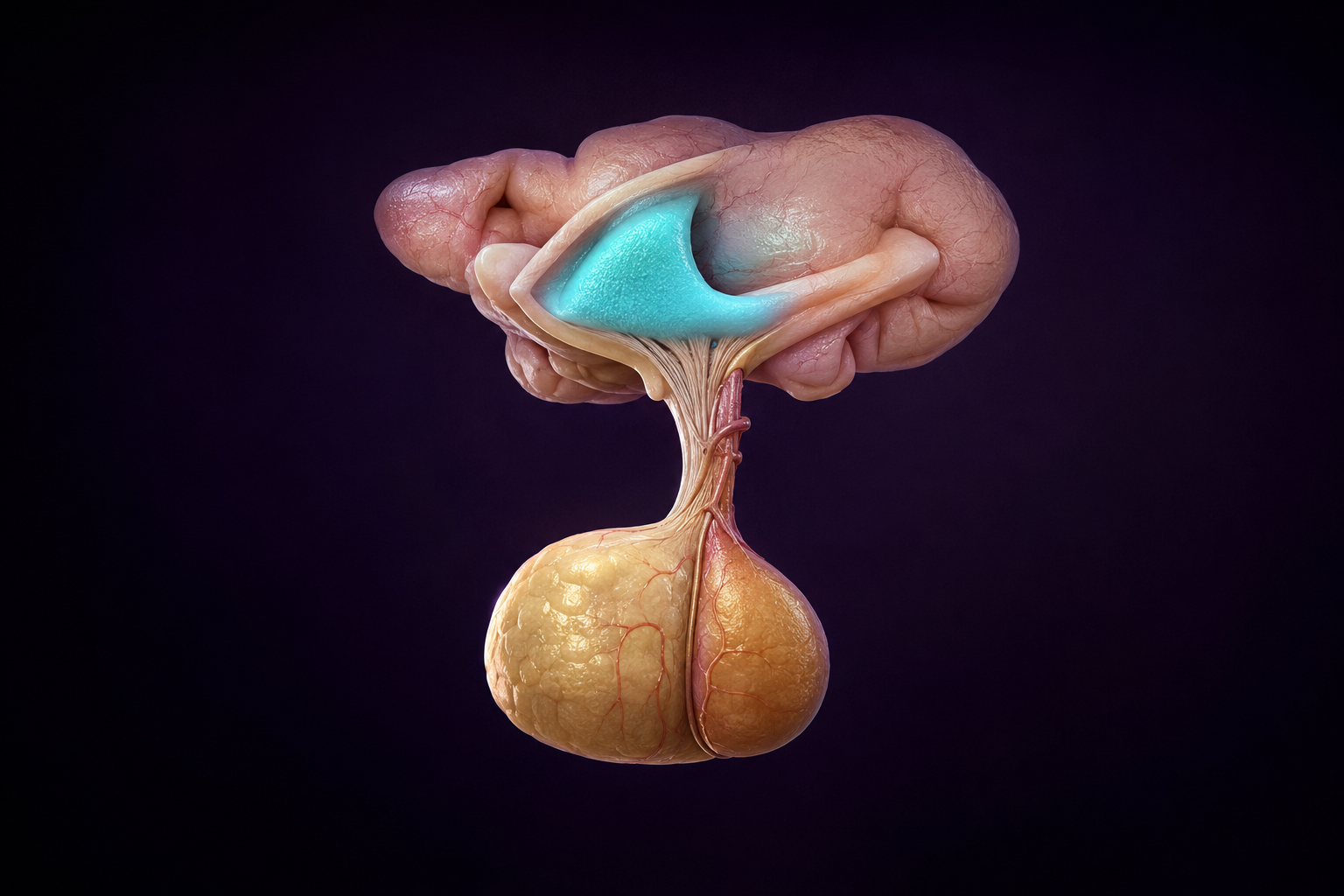
Research areas
The literature explores these molecules as pharmacological tools for dissecting the hypothalamic-pituitary axis: mapping of GHRH and GHS-R receptors, study of cross-regulation with somatostatin, modeling of GH pulsatility, and evaluation of albumin binding kinetics as a vehicle for extended half-life (the DAC concept having relevance beyond this single peptide). The GH/IGF-1 axis also serves as a model for studying metabolism and tissue repair in preclinical systems.
What the literature shows
Raun et al. (1998) — in vitro studies (rat pituitary cells) and in vivo studies (conscious rats and pigs) — established the selectivity of Ipamorelin, with a GH response peaking around 15 minutes. Teichman et al. (2006) — randomized, double-blind, placebo-controlled, ascending-dose clinical trials in healthy adults — reported that DAC-conjugated CJC-1295 induces increases in GH (2 to 10-fold) for approximately 6 days and in IGF-1 (1.5 to 3-fold) for 9 to 11 days after a single injection. Ionescu & Frohman (2006) documented the maintenance of GH pulsatility under continuous stimulation.
This work falls within basic and early clinical research; it does not constitute therapeutic validation.
Effects and limitations observed in research
The data describe a robust, dose-dependent elevation of GH and IGF-1, with good tolerability of the dose levels studied in early trials of the DAC form. The limitations are notable: small sample sizes, short observation periods, absence of long-term safety data, and virtually no human data for Ipamorelin (predominantly preclinical). The academic literature on the precise CJC-1295 + Ipamorelin combination also remains limited to the separate mechanisms rather than trials dedicated to the pair.
Reconstitution & storage
The lyophilized powder is typically stored at -20 °C or below. Reconstitution is performed with bacteriostatic water (benzyl alcohol), suited to multiple withdrawals: add the solvent along the wall of the vial, then swirl gently without vigorous shaking or vortexing. After reconstitution, store at 2–8 °C, protected from light, with typical stability on the order of a few weeks; frozen aliquoting is preferred for the long term. Specific precaution for the DAC-conjugated form: avoid media containing free thiols (cysteine), as the maleimide reacts with them.
Doses used in studies
Purely for documentary purposes, the doses reported in the literature include, for Ipamorelin, intravenous boluses on the order of nmol/kg in animals (Raun et al., preclinical); and for DAC-conjugated CJC-1295, subcutaneous doses on the order of 30 to 60 µg/kg described as well tolerated in healthy adults (Teichman et al., early clinical trials).
Disclaimer: these values are doses studied in the scientific literature, cited for informational purposes only. They do not constitute a recommendation, a protocol, or a dosage intended for human use. Product for research use only.
Summary
The CJC-1295 / Ipamorelin pairing illustrates a dual-pathway research rationale: a GHRH analog (short half-life without DAC, or extended over several days with DAC) combined with a selective GHS-R secretagogue. The literature documents complementary mechanisms and marked GH/IGF-1 responses, while also noting real methodological limitations. These peptides remain laboratory research tools, to be handled according to strict standards and without clinical extrapolation.