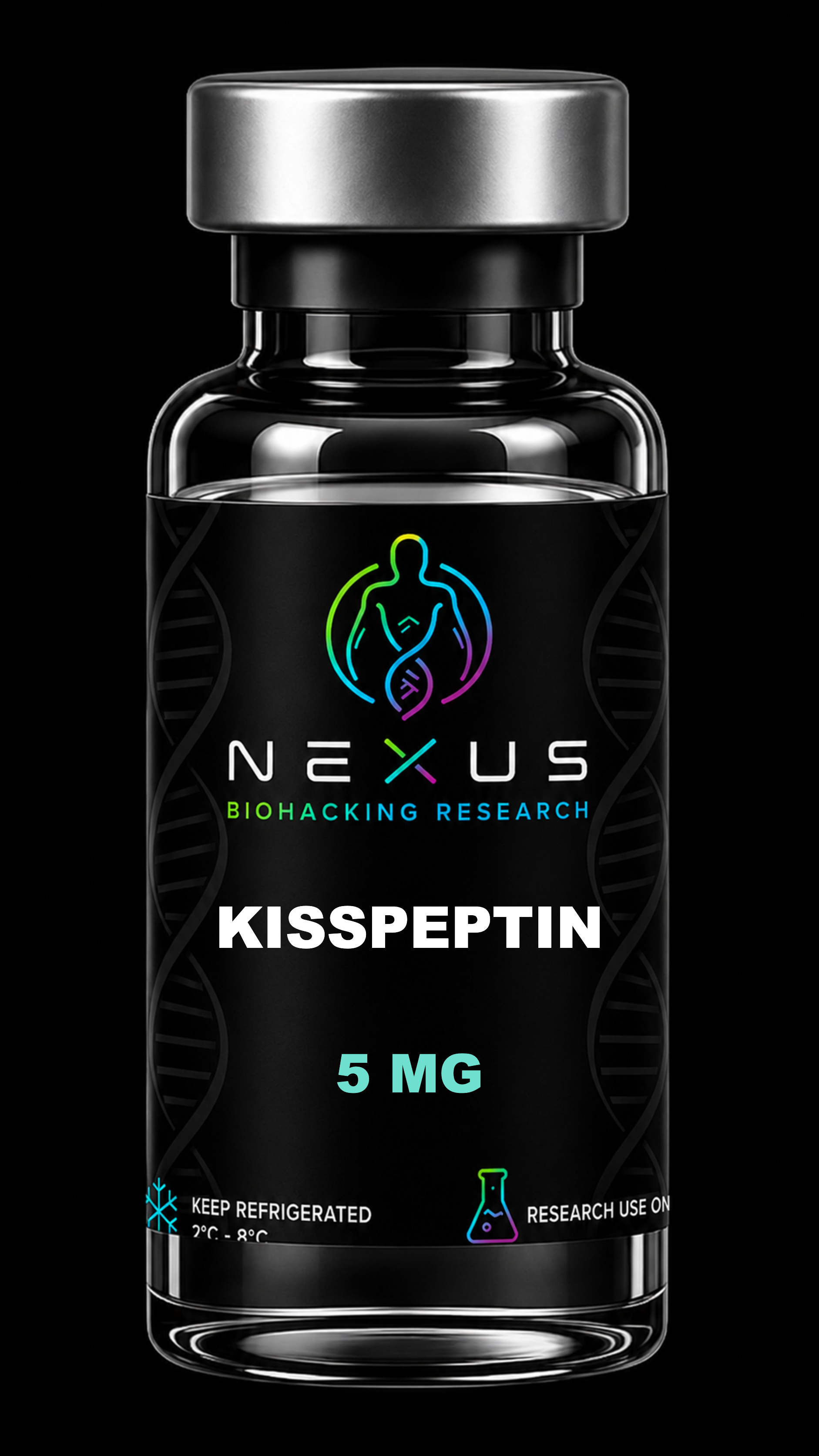
A decapeptide agonist of the KISS1 (GPR54) receptor, studied in neuroendocrine models of reproductive-axis regulation and GnRH secretion. 5 mg vial, lyophilized powder, ≥99% HPLC purity verified by third-party analysis. For laboratory research use only.
Research areas
- Reproductive axis / GnRH (models)
- GPR54 signalling in vitro
- Neuroendocrinology
Technical data
| Field | Value |
|---|---|
| Name | Kisspeptin-10 |
| Dosage | 5 mg |
| Sequence / composition | Tyr-Asn-Trp-Asn-Ser-Phe-Gly-Leu-Arg-Phe-NH₂ |
| Molecular weight | ≈ 1,302.5 Da |
| CAS no. | 374675-21-5 |
| Target / mechanism | KISS1 receptor (GPR54) |
| Form | Lyophilized powder (unless stated otherwise) |
| Purity | ≥ 99% (HPLC) — see batch COA |
KP-10 or KP-54: which form to choose
The KISS1 gene encodes a 145-amino-acid precursor which, once cleaved, releases several active fragments: Kisspeptin-54 (KP-54, the predominant form) and shorter 14, 13 and 10-amino-acid versions.
What surprises most: the shortest form is not the weakest. KP-10 is the ten C-terminal amino acids common to every form, and that region alone is enough to activate the receptor. A controlled investigation in male volunteers, using a 3-hour continuous intravenous infusion, compared KP-10, KP-54 and GnRH: KP-10 and KP-54 produced comparable gonadotropin secretion despite far higher plasma concentrations for KP-54.
The real difference is pharmacokinetic, not pharmacodynamic: a described plasma half-life of roughly 4 minutes for KP-10 against about 27 minutes for KP-54. This reference is KP-10 — the form chosen when a protocol calls for a short, well-bounded stimulus.
Mechanism studied
Binding to the KISS1R receptor (also called GPR54, a seven-transmembrane G-protein-coupled receptor) activates the Gαq/11 pathway, stimulating phospholipase C. The enzyme generates inositol trisphosphate (IP3) and diacylglycerol (DAG), mobilising intracellular calcium and activating MAPK kinases such as ERK1/2 and p38.
In experimental models this signalling stimulates GnRH neurons. Kisspeptin therefore acts upstream of the hypothalamic-pituitary-gonadal axis, triggering pituitary LH and FSH release. Kisspeptin neurons of the arcuate nucleus — KNDy neurons, so named because they also co-express neurokinin B and dynorphin — integrate sex-steroid feedback.
What the literature shows
Unusually for a research compound, published human clinical studies exist. Beyond the KP-10 / KP-54 / GnRH comparison above, a proof-of-concept study and then a randomised phase 2 trial evaluated KP-54 as a trigger for oocyte maturation in IVF, in a strictly supervised hospital setting.
The research also highlights clear limits. Desensitisation (tachyphylaxis) has been observed with repeated administration: the LH response declined after several weeks of intermittent dosing, whereas low-rate continuous infusion showed no such decline. Another documented gap between measurable hormonal effect and phenotypic effect: in patients with hypothalamic amenorrhoea, kisspeptin restored LH pulsatility without changing follicle size or endometrial thickness. Much of the remaining data comes from rodent and primate models, with species differences that call for caution.
Reconstitution: a worked example
With 2 mL of bacteriostatic water in a 5 mg vial: 5 mg ÷ 2 mL = 2.5 mg/mL, i.e. 2,500 mcg/mL. On a U-100 syringe, 10 IU = 0.1 mL = 250 mcg, giving 20 draws per vial.
The most common trap: the volume of water never changes how much peptide is in the vial. Only the volume to draw changes. Our reconstitution calculator computes any other combination live.
Add the solvent slowly down the vial wall, then swirl gently. No vigorous shaking, no vortex — shear denatures peptides.
Storage
Lyophilized powder: -20 °C or below, protected from light and moisture; stable for years when unopened. After reconstitution: 2–8 °C, protected from light, with a reference shelf life of 28 days. For longer storage, frozen aliquots are preferable to repeated freeze-thaw cycles.
Common laboratory mistakes
- Assuming KP-54 is "stronger" than KP-10. At the receptor, both produce comparable responses; half-life is what separates them.
- Ignoring tachyphylaxis in a repeated protocol. The literature describes a declining response after repeated intermittent administration, absent under low-rate continuous infusion.
- Using plain sterile water for a multi-draw vial. Without a preservative, the solution is no longer protected once the stopper has been pierced several times.
- Vortexing the vial. Vigorous agitation denatures peptides.
- Repeatedly refreezing the reconstituted solution. Each cycle degrades a fraction of the peptide.
Frequently asked questions
What is the difference between Kisspeptin-10 and Kisspeptin-54?
KP-10 is the ten C-terminal amino acids common to every kisspeptin form; KP-54 is the long form. Both activate the same receptor with comparable potency — the difference is pharmacokinetic: a plasma half-life of roughly 4 minutes for KP-10 against about 27 minutes for KP-54.
Why is the short form as active as the long one?
Because the C-terminal region alone is sufficient to activate the KISS1R receptor. KP-54's additional amino acids influence how long it stays in circulation, not its receptor affinity.
Which receptor is targeted?
KISS1R, also known as GPR54: a seven-transmembrane G-protein-coupled receptor. Activation runs through the Gαq/11 pathway, phospholipase C, intracellular calcium mobilisation and the MAPK kinases ERK1/2 and p38.
What are KNDy neurons?
The kisspeptin neurons of the arcuate nucleus, so named because they co-express kisspeptin, neurokinin B and dynorphin. They integrate sex-steroid feedback on the reproductive axis.
Is there human clinical data?
Yes, which sets this molecule apart from many research compounds. Controlled studies in volunteers compared KP-10, KP-54 and GnRH, and supervised trials evaluated KP-54 in IVF. This work belongs to clinical research and does not constitute therapeutic validation of the reagent sold here.
What is the desensitisation observed in research?
Tachyphylaxis: the LH response declines after several weeks of repeated intermittent administration. Low-rate continuous infusion showed no such decline in published work.
What should this peptide be reconstituted with?
Bacteriostatic water, which contains benzyl alcohol and allows multiple draws. Plain sterile water is unsuitable once the vial is pierced more than once.
What concentration does 2 mL of bacteriostatic water give?
2.5 mg/mL, i.e. 2,500 mcg/mL. On a U-100 syringe, 10 IU then corresponds to 0.1 mL and 250 mcg, giving 20 draws per vial.
How long does the reconstituted solution keep?
28 days at 2–8 °C, protected from light — the reference shelf life for a reconstituted vial. Beyond that, frozen aliquots are preferable to repeated freeze-thaw cycles.
In what context may this product be used?
Exclusively for laboratory and in vitro research. It is not intended for human or animal consumption, nor for diagnostic or therapeutic use.
NEXUS Quality Standard
Every NEXUS research compound is produced under strict quality control procedures. Each batch undergoes independent analytical testing to verify identity, assay accuracy, purity, microbial safety, endotoxin levels, heavy metal screening, and full batch traceability.
For laboratory research only. Kisspeptin 5mg is not suitable for human or animal consumption. Not a drug, food or cosmetic. To be handled by qualified personnel in accordance with applicable regulations.