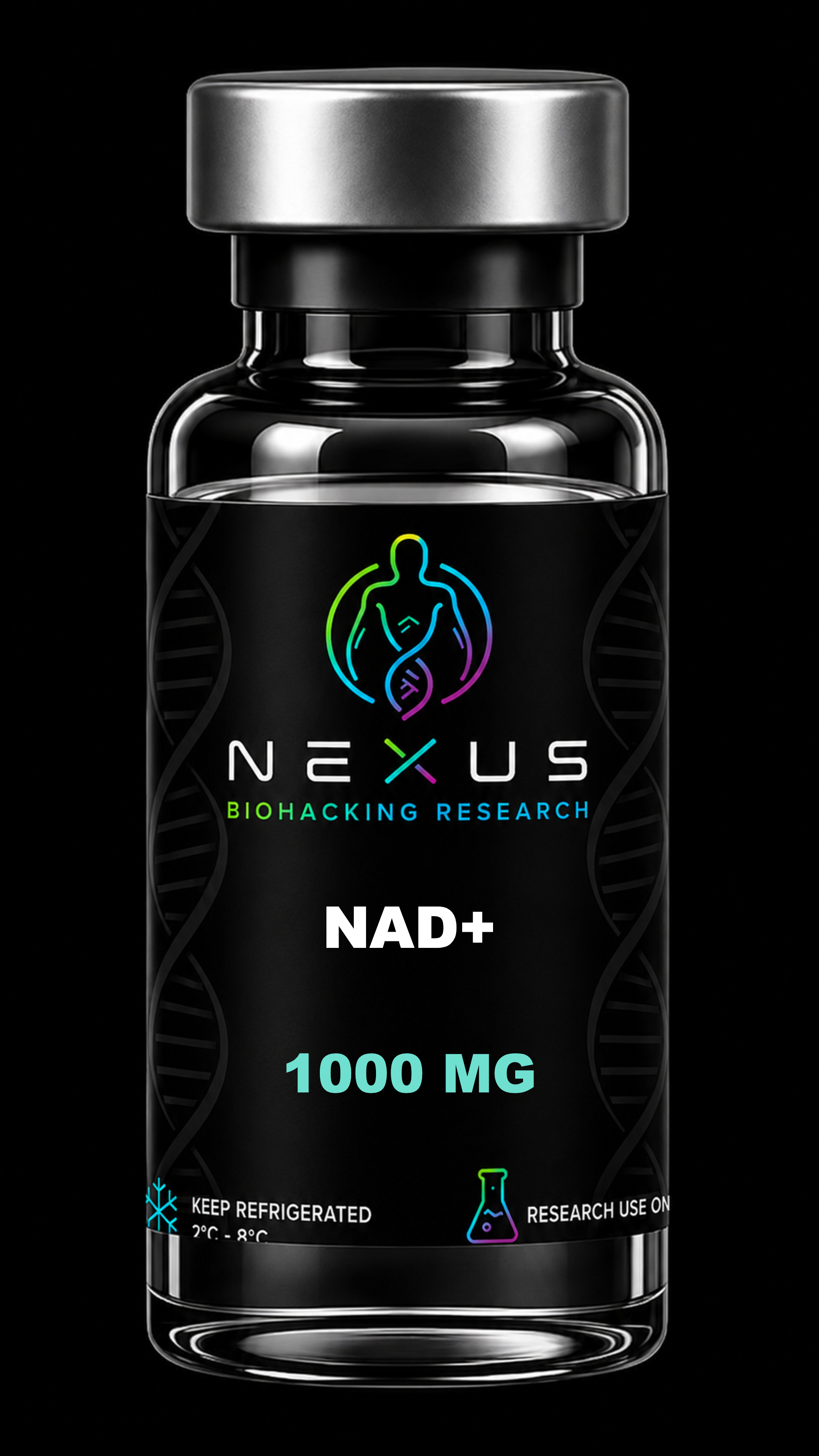
A central coenzyme of cellular energy metabolism, used as a reference compound in in-vitro models studying sirtuin pathways and mitochondrial function. 1000 mg vial, high-purity lyophilized powder, ≥99% HPLC purity verified by third-party analysis. Research use only.
Research areas
- In-vitro energy metabolism
- Sirtuin pathways
- Mitochondrial function
Technical data
| Field | Value |
|---|---|
| Name | NAD+ |
| Dosage | 1000 mg |
| Sequence / composition | Nicotinamide adenine dinucleotide |
| Molecular weight | ≈ 663.4 Da |
| CAS no. | 53-84-9 |
| Target / mechanism | Coenzyme of cellular energy metabolism |
| Form | Lyophilized powder (unless stated otherwise) |
| Purity | ≥ 99% (HPLC) — see batch COA |
NAD+, NMN or NR: what the choice of compound changes
First point of order: NAD+ is not a peptide. It is a coenzyme — a dinucleotide made of a nicotinamide nucleotide and an adenine nucleotide joined by a pyrophosphate bridge. Peptide vocabulary (sequence, amino acids, denaturation) does not apply; lyophilisation, reconstitution and cold chain do.
Three compounds of the same pathway are routinely confused. NR is a nucleoside with no phosphate (≈ 255.3 g/mol as the free base), NMN a nucleotide with one phosphate (≈ 334.2 g/mol), NAD+ a dinucleotide with two (≈ 663.4 Da). The salvage pathway orders them: NR is phosphorylated to NMN by the NRK1/NRK2 kinases, then NMN is adenylylated to NAD+ by the NMNAT enzymes; free nicotinamide joins through NAMPT, the rate-limiting step.
The intuitive reasoning — "supplying the end product directly must be more efficient" — is exactly the trap. NAD+ is bulky and doubly charged, with poor plasma-membrane permeability described in the literature: extracellular NAD+ is largely hydrolysed to NMN then NR by ectoenzymes (CD38, CD73, NPP1) before any uptake. Adding NAD+ to a culture medium therefore often delivers its own precursors. A direct NMN transporter, Slc12a8, has been described in murine intestine, but the finding remains debated.
A molar reference for this vial: 1000 mg of NAD+ = 1.51 mmol, the equivalent of roughly 504 mg of NMN or 385 mg of NR as the free base. Comparing the three by mass is meaningless — they compare in moles.
Mechanism studied
Redox role. NAD+ is a hydride acceptor, reduced to NADH and reoxidised without being consumed, a cycle that feeds glycolysis (at GAPDH), the Krebs cycle and complex I of the respiratory chain. What matters is not the absolute amount but the NAD+/NADH ratio.
Consuming role. Three enzyme families actually cleave NAD+. Sirtuins (SIRT1-SIRT7) catalyse NAD+-dependent deacylations, releasing nicotinamide — a product inhibitor — and O-acetyl-ADP-ribose. PARPs consume it for poly-ADP-ribosylation in the DNA damage response. CD38, described as a major consumer, generates cyclic ADP-ribose and NAADP, with expression reported to rise with age in several tissues.
Compartmentation. Nuclear, cytosolic and mitochondrial pools do not equilibrate freely; the NMNAT isoform of each compartment produces NAD+ locally, so a whole-lysate measurement masks local variation. A more recent strand concerns SARM1, an NADase activated during axonal degeneration.
What the literature shows
The literature describes a decline in tissue NAD+ with age across several animal models and some human tissues — the observation that structures the field. Its magnitude varies strongly by tissue and, often overlooked, by assay method: LC-MS quantification and enzymatic cycling do not return the same values, which makes cross-study comparison fragile.
What the literature does not show. Published human trials overwhelmingly concern the precursors (NR, NMN), not NAD+ itself. They fairly consistently establish a rise in blood NAD+, but functional endpoints are inconsistent between studies, with small samples and short durations, and no large randomised trial establishes clinical benefit. Direct NAD+ administration in humans is barely characterised pharmacokinetically, and the premise that "more NAD+ is uniformly desirable" is itself contested.
Reconstitution: a worked example
With 2 mL of bacteriostatic water in a 1000 mg vial: 1000 mg ÷ 2 mL = 500 mg/mL, i.e. 500,000 mcg/mL. On a U-100 syringe, 10 IU = 0.1 mL = 50,000 mcg (50 mg), giving 20 draws per vial. That is very high for a 1000 mg vial, close to the practical limits of dissolution, so a larger solvent volume is usually chosen: with 10 mL, 1000 mg ÷ 10 mL = 100 mg/mL, i.e. 100,000 mcg/mL, 10 IU = 0.1 mL = 10,000 mcg (10 mg), and 100 draws per vial.
The most common trap: the volume of water never changes how much compound is in the vial. Only the volume to draw changes. Our reconstitution calculator computes any other combination live.
Add the solvent slowly down the vial wall, then swirl gently — no vigorous shaking, no vortex. Specific to this compound: NAD+ in solution is pH-sensitive, described as stable in mildly acidic conditions and degraded in alkaline media, the opposite of NADH.
Storage
Lyophilized powder: -20 °C or below, protected from light and moisture; stable for years when unopened. After reconstitution: 2–8 °C, protected from light, with a reference shelf life of 28 days. For longer storage, frozen aliquots are preferable to repeated freeze-thaw cycles.
Common laboratory mistakes
- Treating NAD+ as a peptide. It is a dinucleotide coenzyme: degradation in solution is hydrolysis and pH, not denaturation of an amino-acid chain.
- Comparing NAD+, NMN and NR by mass. Their molar masses differ by up to a factor of 2.6; the comparison only makes sense in moles.
- Ignoring extracellular degradation. In culture medium, the ectoenzymes CD38, CD73 and NPP1 hydrolyse added NAD+ before any cellular entry.
- Preparing the solution in an alkaline buffer. NAD+ is described as degraded in alkaline media, unlike NADH.
- Reading a whole-lysate assay as the active pool. Nuclear, cytosolic and mitochondrial compartments do not equilibrate freely.
Frequently asked questions
What is the difference between NAD+, NMN and NR?
NR is a nucleoside with no phosphate, NMN a nucleotide with one phosphate, NAD+ a dinucleotide with two. In the salvage pathway, NR is phosphorylated to NMN by NRK1/NRK2 kinases, then NMN is adenylylated to NAD+ by the NMNAT enzymes. NAD+ is the end product; the other two are precursors one and two steps upstream.
Is NAD+ a peptide?
No. It is a coenzyme — a nicotinamide and an adenine nucleotide joined by a pyrophosphate bridge. Peptide vocabulary such as sequence, amino acids or denaturation does not apply, whereas lyophilisation, reconstitution and cold chain do.
Why does NAD+ not readily enter cells?
Because it is bulky and doubly charged through its two phosphate groups, giving poor plasma-membrane permeability. The literature describes extracellular NAD+ being hydrolysed by the ectoenzymes CD38, CD73 and NPP1 into NMN then NR before any internalisation.
How much NMN does 1000 mg of NAD+ correspond to?
1000 mg of NAD+ is 1.51 mmol, the molar equivalent of roughly 504 mg of NMN or 385 mg of NR as the free base. Comparing these compounds by mass is misleading, since their molar masses range from about 255 to 663 g/mol.
What do published human trials show?
They overwhelmingly concern the precursors NR and NMN rather than NAD+ itself. They fairly consistently establish a rise in blood NAD+, but functional endpoints are inconsistent, samples small and durations short. No large randomised trial establishes clinical benefit.
What should this compound be reconstituted with?
Bacteriostatic water, which contains benzyl alcohol and allows multiple draws. Plain sterile water is unsuitable once the vial is pierced more than once. NAD+ in solution is described as stable in mildly acidic conditions and degraded in alkaline media.
What concentration does 10 mL of bacteriostatic water give?
100 mg/mL, i.e. 100,000 mcg/mL. On a U-100 syringe, 10 IU then corresponds to 0.1 mL and 10 mg, giving 100 draws per vial. With only 2 mL the result is 500 mg/mL and 20 draws of 50 mg — a concentration that is awkward to dilute.
How long does the reconstituted solution keep?
28 days at 2–8 °C, protected from light — the reference shelf life for a reconstituted vial. Beyond that, frozen aliquots are preferable to repeated freeze-thaw cycles.
Is purity verified by a certificate of analysis?
Yes. Every batch is HPLC-tested at ≥ 99% purity and covered by a third-party COA available for the batch shipped.
In what context may this product be used?
Exclusively for laboratory and in vitro research. It is not intended for human or animal consumption, nor for diagnostic or therapeutic use.
NEXUS Quality Standard
Every NEXUS research compound is produced under strict quality control procedures. Each batch undergoes independent analytical testing to verify identity, assay accuracy, purity, microbial safety, endotoxin levels, heavy metal screening, and full batch traceability.
For laboratory research only. NAD+ 1000mg is not suitable for human or animal consumption. Not a drug, food or cosmetic. To be handled by qualified personnel in accordance with applicable regulations.