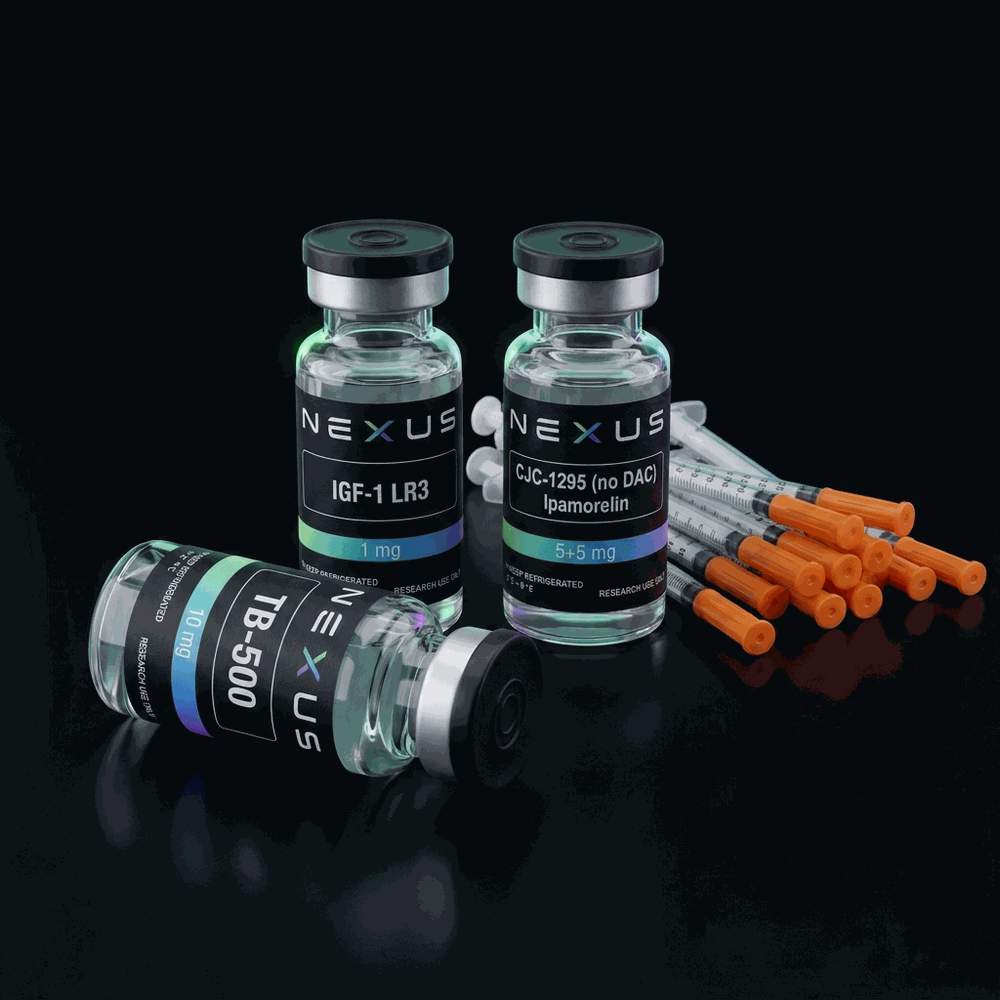
An assortment of three research references shipped with handling supplies: one CJC-1295 (without DAC) + Ipamorelin 5 + 5 mg vial, one IGF-1 LR3 1 mg vial, one TB-500 (full-length thymosin β4) 10 mg vial, and two boxes of 10 needles. Three separate reagents, three pathways documented individually. Lyophilized powders, ≥99% HPLC purity verified by third-party analysis. Laboratory research use only.
Research areas
- GHRH / GHS-R axis and GH pulsatility (models)
- IGF-1R signalling in cell culture (PI3K/Akt, MAPK)
- Actin regulation and cell migration (models)
Technical data
| Field | Value |
|---|---|
| Name | BLK Pack |
| Composition | CJC-1295 + Ipamorelin · IGF-1 LR3 · TB-500 |
| Supplies included | 2 boxes of 10 needles |
| Form | Lyophilized powders (unless stated otherwise) |
| Purity | ≥ 99% (HPLC) — see COA for each batch |
What the pack contains, reference by reference
A pack is not a molecule: it is a set of separate vials, each with its own mass, COA and literature.
CJC-1295 without DAC + Ipamorelin — 5 + 5 mg. One vial, two compounds at 5 mg each. CJC-1295 without DAC, or Mod-GRF 1-29 (≈ 3,368 Da), reproduces the first 29 amino acids of human GHRH and binds the Gs-coupled GHRH receptor; Ipamorelin (≈ 711.9 Da) is a selective pentapeptide agonist of the Gq-coupled GHS-R. The vial therefore serves to study two distinct intracellular pathways in the same somatotroph cell. This is the no-DAC form, described as a short stimulus, unlike the DAC form whose published half-life spans days.
IGF-1 LR3 — 1 mg. The Long R3 analogue of human IGF-1: 83 amino acids, ≈ 9,111 Da, against 70 amino acids and ≈ 7,649 Da for native recombinant IGF-1. A thirteen-residue N-terminal extension and a position-3 arginine sharply reduce affinity for the six IGFBP binding proteins, making it a cell-culture tool for IGF-1R signalling. Rarely stated: affinity for IGF-1R itself is not increased — the apparent gain exists only where binding proteins are present.
TB-500 — 10 mg. Full-length thymosin β4, a 43-amino-acid protein, ≈ 4,963 Da, CAS 77591-33-4 — not the short LKKTET fragment (~900 Da) the same trade name sometimes designates; molecular weight settles it. Its best-characterised mechanism is sequestration of monomeric G-actin, which governs cytoskeletal reorganisation and therefore cell migration.
Two boxes of 10 needles. Handling supplies. Bacteriostatic water is not included: see bacteriostatic water.
Why these references are grouped
The three vials do not act on the same lever. CJC-1295 + Ipamorelin sits upstream, on pituitary secretion in neuroendocrine models; IGF-1 LR3 interrogates the receptor directly in culture; TB-500 belongs to another register entirely, the actin cytoskeleton, with no mechanistic link to the first two. Together they cover one experimental question through three independent entry points.
No study covers the combination itself. Everything above was obtained compound by compound, in isolation; no publication evaluates the interactions between these three reagents used together. Pathway complementarity is a catalogue rationale, not a documented result: a pack groups independent reagents, it describes no sequence and implies none.
Reconstitution: volumes to plan for
Each vial is reconstituted separately, with bacteriostatic water, which contains benzyl alcohol and allows multiple draws.
| Vial | Mass | Bacteriostatic water | Concentration | 10 IU (0.1 mL) |
|---|---|
| CJC-1295 no DAC + Ipamorelin | 5 + 5 mg | 2 mL | 2.5 mg/mL of each compound | 250 mcg of each |
| IGF-1 LR3 | 1 mg | 2 mL | 0.5 mg/mL | 50 mcg |
| TB-500 (thymosin β4) | 10 mg | 2 mL | 5 mg/mL | 500 mcg |
At these volumes each vial gives 20 draws of 10 IU. On the combined vial, concentration is computed per compound: 5 mg each, not 10 mg of one.
The most common trap: the volume of water never changes how much peptide is in the vial. Reconstituting the TB-500 with 5 mL instead of 2 mL gives 2 mg/mL instead of 5 mg/mL — the same total mass in a larger volume; only the graduation changes. Our reconstitution calculator computes any other combination live.
Add the solvent slowly down the vial wall, then swirl gently. No vigorous shaking, no vortex — shear denatures peptides and proteins.
Storage
Lyophilized powder: -20 °C or below, protected from light and moisture; stable for years when unopened. After reconstitution: 2–8 °C, protected from light, with a reference shelf life of 28 days. For longer storage, frozen aliquots are preferable to repeated freeze-thaw cycles.
On a pack, one extra precaution: reconstitute each vial only when it is about to be used, so the others stay lyophilized instead of starting their 28-day window for nothing.
Common laboratory mistakes
- Reconstituting all three vials at once. Every opened vial starts its own 28-day clock, while sealed lyophilizate keeps for years.
- Applying the same water volume to every vial without recalculating. 2 mL gives 0.5 mg/mL on IGF-1 LR3 and 5 mg/mL on TB-500: at the same graduation, a factor of ten separates the masses drawn.
- Computing the combined vial's concentration on its total. CJC-1295 and Ipamorelin are 5 mg each, not 10 mg of one compound.
- Comparing this TB-500 with data obtained on the LKKTET fragment. Two distinct molecules, ~900 Da against ≈ 4,963 Da.
- Using plain sterile water, vortexing, or repeatedly refreezing. Each degrades a fraction of the material.
Frequently asked questions
What exactly is in the BLK Pack?
Three separate vials plus handling supplies: one CJC-1295 without DAC + Ipamorelin 5 mg + 5 mg vial, one IGF-1 LR3 1 mg vial, one TB-500 (full-length thymosin β4) 10 mg vial, and two boxes of 10 needles. The peptides ship as lyophilized powders, each with its own batch certificate of analysis.
Why are these three references grouped together?
Because they approach one experimental question through three independent routes: the GHRH / GHS-R axis upstream, the IGF-1R receptor directly, and actin regulation and cell migration. It is a coherence of studied pathways, not a sequence to follow.
Are there studies on this three-compound combination?
No. All available literature covers each compound in isolation, and no publication evaluates the interactions between these three reagents used together.
Can the components be bought separately?
Yes, all three exist individually in the catalogue: CJC-1295 without DAC + Ipamorelin, IGF-1 LR3 and TB-500. The pack contains nothing but those same vials plus the needles.
Is the pack's TB-500 the short fragment or full-length thymosin β4?
Full-length thymosin β4, 43 amino acids, ≈ 4,963 Da, CAS 77591-33-4. A short LKKTET-type fragment would weigh about 900 Da: the COA mass settles it, and the available literature mostly covers the full-length protein.
What volumes of bacteriostatic water should be planned per vial?
At 2 mL per vial: 2.5 mg/mL of each compound on CJC-1295 + Ipamorelin, 0.5 mg/mL on IGF-1 LR3 and 5 mg/mL on TB-500. On a U-100 syringe, 10 IU is then 250 mcg of each compound, 50 mcg and 500 mcg respectively, giving 20 draws per vial.
Should all three vials be reconstituted at the same time?
No, and this is the main mistake on a pack. Each reconstituted vial starts its own 28-day window, whereas sealed lyophilizate stays stable for years.
How long does the reconstituted solution keep?
28 days at 2–8 °C, protected from light — the reference shelf life for a reconstituted vial. Beyond that, frozen aliquots are preferable to repeated freeze-thaw cycles.
What is the purity and how is it verified?
Purity ≥ 99% verified by HPLC, with a third-party certificate of analysis per batch and per reference: the pack has no single COA, each vial has its own. It states identity, assay, purity, microbial controls and the measured mass, which confirms Long R3 (≈ 9,111 Da) and full-length thymosin β4 (≈ 4,963 Da).
In what context may this pack be used?
Exclusively for laboratory and in vitro research, by qualified personnel. It is not intended for human or animal consumption, nor for diagnostic or therapeutic use, and it constitutes neither a protocol nor an administration programme.
NEXUS Quality Standard
Every NEXUS research compound is produced under strict quality control procedures. Each batch undergoes independent analytical testing to verify identity, assay accuracy, purity, microbial safety, endotoxin levels, heavy metal screening, and full batch traceability.
For laboratory research only. Pack BLK is not suitable for human or animal consumption. Not a drug, food or cosmetic. To be handled by qualified personnel in accordance with applicable regulations.