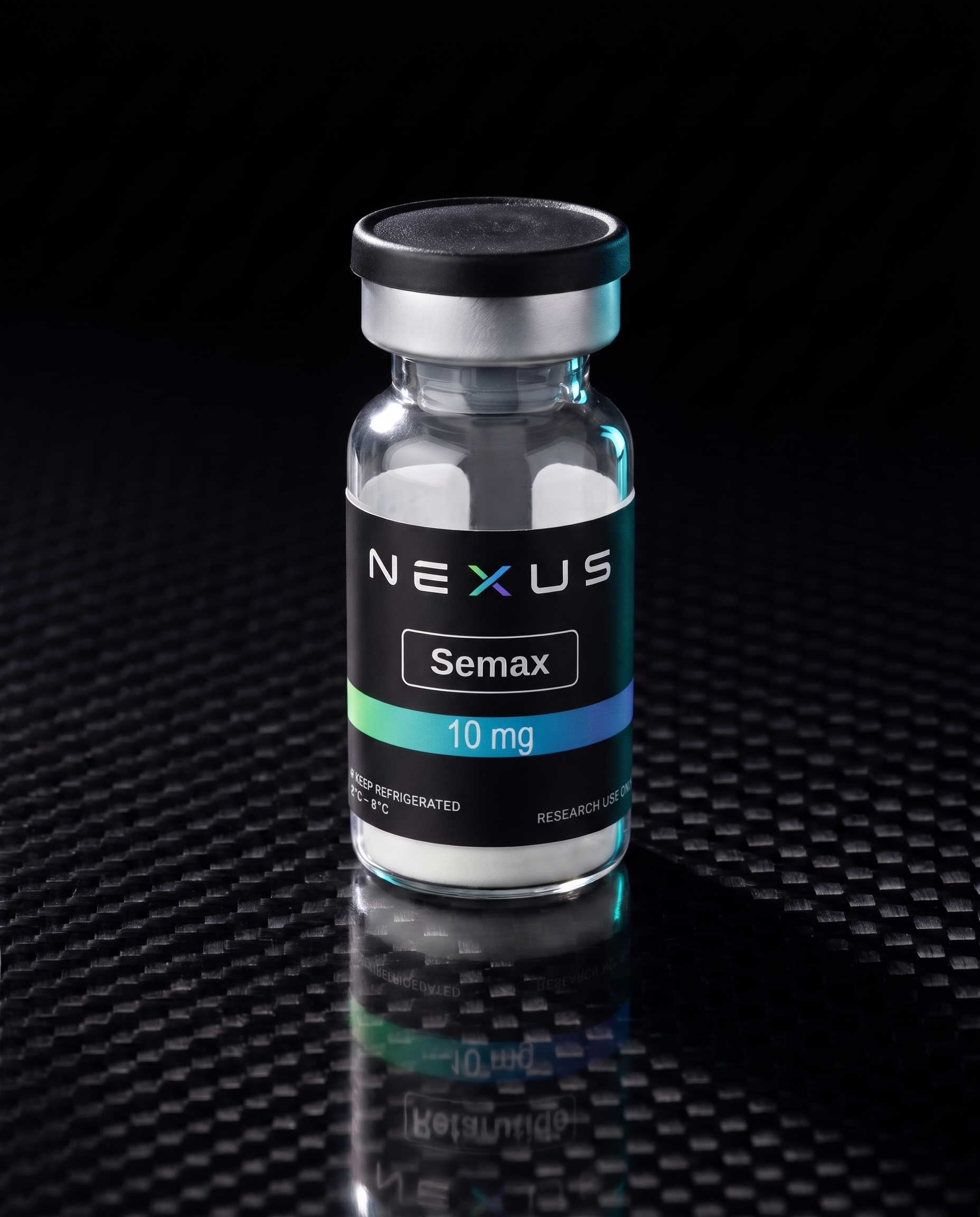
A synthetic short peptide of 7 amino acids ending in the Pro-Gly-Pro motif. It is used in in-vitro work on proline-rich short peptides, their stability in solution and their analytical characterisation. 10 mg vial, lyophilized powder, ≥99% HPLC purity verified by third-party analysis. For laboratory research use only.
Research areas
- Synthetic short peptides
- Solution stability of proline-rich sequences
- Analytical characterisation (HPLC, mass spectrometry)
Technical data
| Field | Value |
|---|---|
| Quantity per vial | 10 mg |
| Class | Synthetic short peptide |
| Sequence | Met-Glu-His-Phe-Pro-Gly-Pro |
| Length | 7 amino acids |
| Molecular formula | C₃₇H₅₁N₉O₁₀S |
| Molecular weight | ≈ 813.9 Da |
| CAS number | 80714-61-0 |
| Form | Lyophilized powder |
| Purity | ≥ 99% (HPLC) — see batch COA |
| Shipped from | France, within 24 business hours |
Semax or N-acetyl Semax amidate: mass settles it
Two compounds circulate under almost identical names. The Semax offered here is the unmodified heptapeptide. The so-called N-acetyl Semax amidate carries an acetyl group at the N-terminus and an amide at the C-terminus. On a product page the difference is two words; on the certificate of analysis it shows at once:
| Compound | Molecular weight |
|---|---|
| Unmodified Semax (this product) | ≈ 813.9 Da |
| N-acetyl Semax amidate (N-terminal acetyl + C-terminal amide) | ≈ 855.0 Da |
| Selank (another Pro-Gly-Pro heptapeptide, different sequence) | ≈ 751.9 Da |
A gap of about 41 Da in the measured mass points to the other form. The trap most people fall into: the two forms do not share the same molar mass, so 10 mg of one does not hold the same number of molecules as 10 mg of the other — about 12.3 µmol for Semax versus 11.7 µmol for the acetylated amidated form. Comparing series run with one and then the other without correcting for this skews the comparison by about 5%.
Worked example: reconstituting a 10 mg vial
With 2 ml of bacteriostatic water added to the 10 mg vial:
- resulting concentration: 10 mg ÷ 2 ml = 5 mg/ml, i.e. 5,000 µg/ml;
- as a molar concentration: 5 g/l ÷ 813.9 g/mol ≈ 6.1 mmol/l;
- split into 0.5 ml aliquots, the solution gives 4 fractions of 2.5 mg, to be frozen separately.
The solvent volume never changes the mass of peptide in the vial: 1 ml gives 10 mg/ml, 4 ml gives 2.5 mg/ml. The total stays 10 mg; only the dilution changes. Our reconstitution calculator runs this calculation for any volume.
Why choose this NEXUS product
- Third-party verified purity: every batch is HPLC-tested by an independent laboratory, and the certificate of analysis (COA) can be consulted before ordering.
- Shipped from France: parcels prepared within 24 business hours, delivered in 2 to 5 business days in France and 8 European countries. Free shipping from €120.
- Consistent quality: same supplier, same controls, same packaging from one batch to the next.
- Verified reviews: our customers leave their feedback on Trustpilot; we do not edit it.
Reconstitution and handling
The lyophilisate is reconstituted with bacteriostatic water, which preserves the solution once the vial has been opened; the 3 ml vial covers the full reconstitution of this 10 mg vial. Add the solvent slowly down the vial wall, let it run, then swirl gently: no vigorous shaking and no vortexing, as shear denatures peptides.
Storage
The lyophilized powder keeps at -20 °C or below, protected from light and moisture; unopened and stored this way, the lyophilisate is stable for several years. After reconstitution, store at 2–8 °C, protected from light, with a reference shelf life of 28 days. For longer storage, freezing aliquots is preferable to repeated freeze–thaw cycles.
Common laboratory mistakes
- Confusing Semax with N-acetyl Semax amidate. The names look alike, the masses do not: 813.9 Da versus about 855.0 Da.
- Comparing masses instead of amounts of substance. At equal mass the two forms do not contain the same number of molecules (about 5% apart).
- Using plain sterile water for a vial that will be opened several times. Without a preservative the solution is unprotected once the stopper has been pierced several times.
- Vortexing the vial. Gentle swirling is enough, even if dissolution takes a minute.
- Repeatedly refreezing the reconstituted solution. Each cycle degrades a fraction of the peptide. Aliquot right after reconstitution.
Frequently asked questions
Are Semax and N-acetyl Semax amidate the same product?
No. The N-acetyl amidate form carries two chemical modifications and weighs about 855.0 Da, versus 813.9 Da for the unmodified Semax sold here. The molecular weight measured on the COA tells them apart.
How can the identity and purity of the batch be checked?
Every batch comes with a certificate of analysis (COA) issued by a third-party laboratory: HPLC purity of at least 99% and measured molecular weight, expected around 813.9 Da. It can be viewed from the Quality page and on request before ordering.
What concentration does 2 ml of solvent give?
5 mg/ml, i.e. 5,000 µg/ml, for the 10 mg vial. With 1 ml the concentration doubles (10 mg/ml); with 4 ml it is halved (2.5 mg/ml).
What should this vial be reconstituted with?
Bacteriostatic water, which preserves the solution once the vial has been opened. Plain sterile water is not suitable as soon as the vial is pierced more than once.
How long does the reconstituted solution keep?
28 days at 2–8 °C, protected from light. Beyond that, frozen aliquots are preferable to repeated freeze–thaw cycles.
Where is the order shipped from and how fast?
From France, within 24 business hours. Delivery to a pick-up point or to your door in 2 to 5 business days depending on the country. Free from €120.
In what context may this product be used?
Strictly for laboratory and in-vitro research. It is not intended for human or animal consumption, nor for diagnostic or therapeutic use.
NEXUS Quality Standard
Every NEXUS research compound is produced under strict quality control procedures. Each batch undergoes independent analytical testing to verify identity, assay accuracy, purity, microbial safety, endotoxin levels, heavy metal screening, and full batch traceability.
You may also like
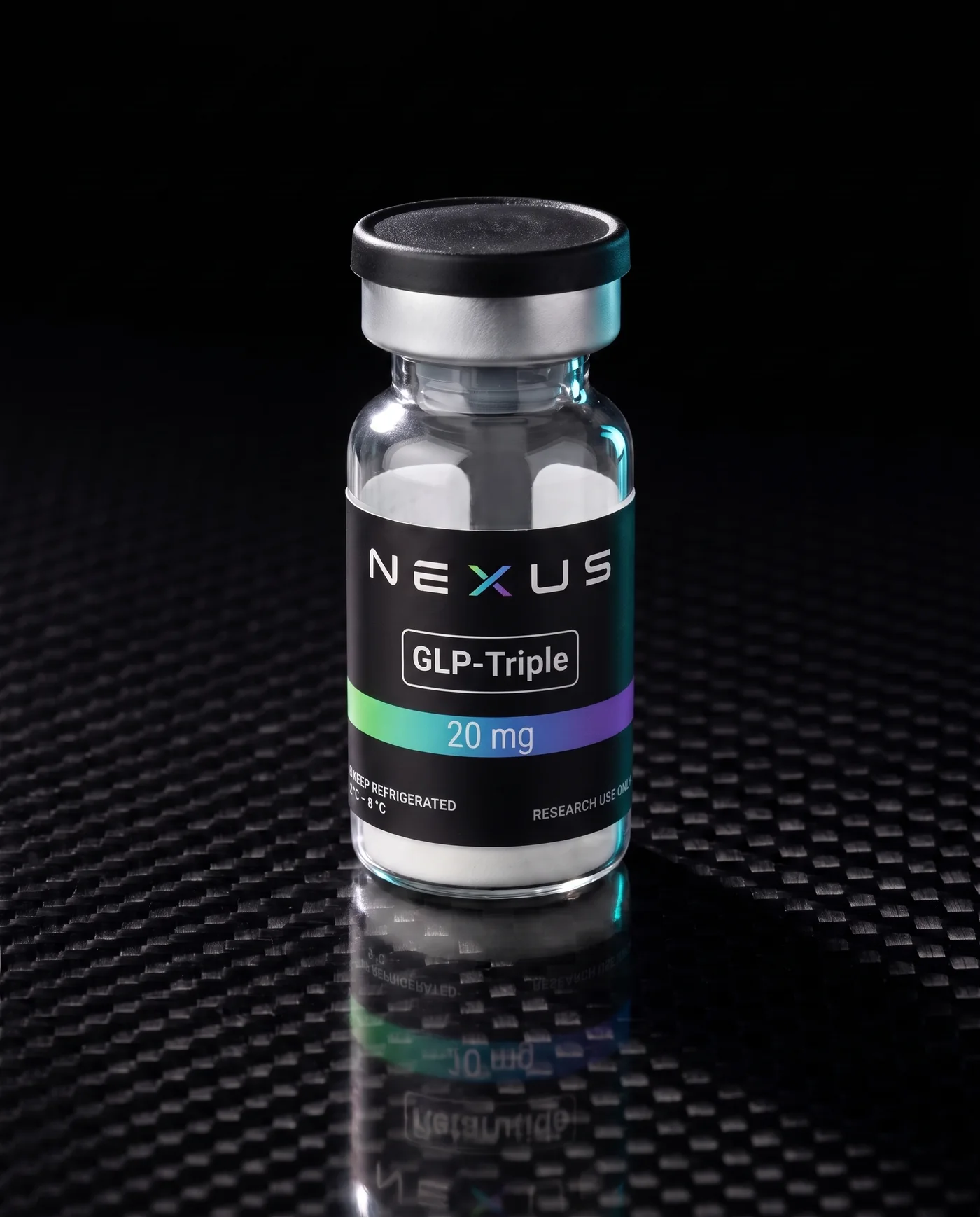
For laboratory research only. Semax 10mg is not suitable for human or animal consumption. Not a drug, food or cosmetic. To be handled by qualified personnel in accordance with applicable regulations.