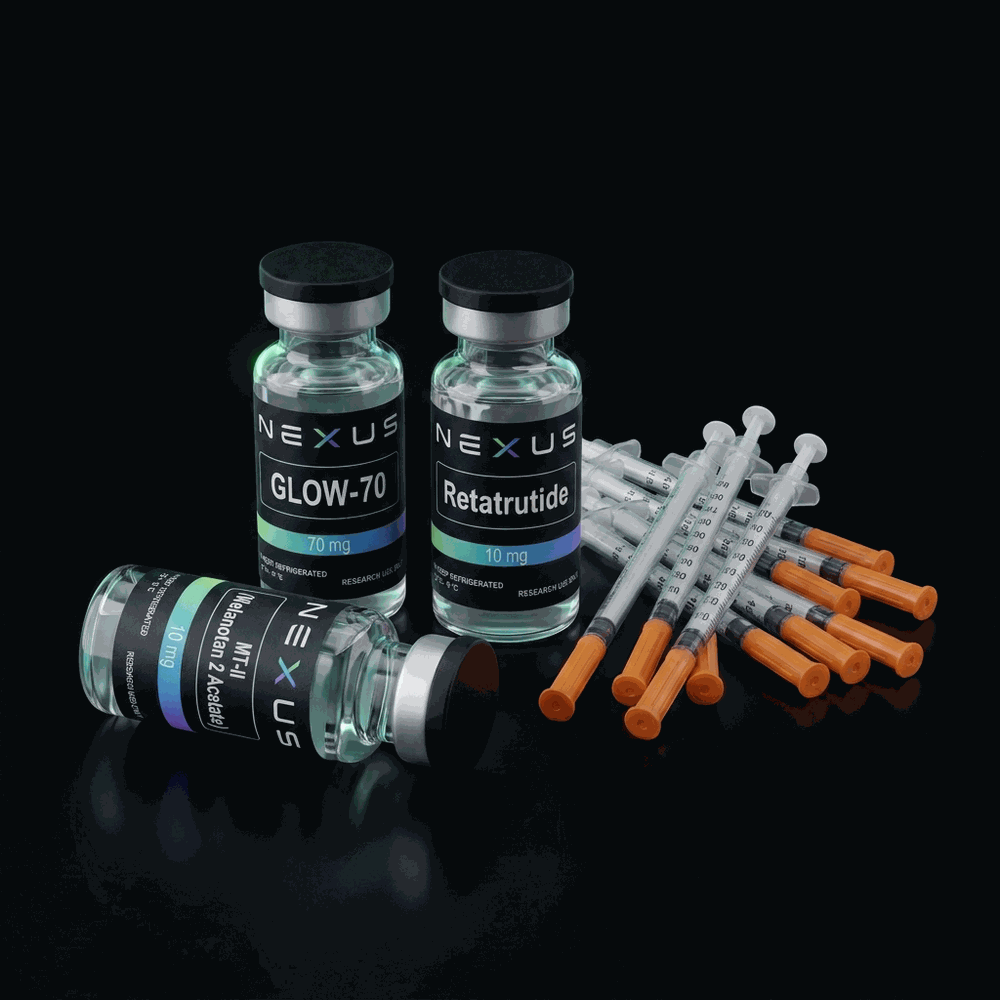
An assortment of three research references shipped with handling supplies: one GLP-Triple 10 mg vial, one GLOW-70 70 mg vial (a co-lyophilized GHK-Cu + BPC-157 + TB-500 blend) and one MT-2 10 mg vial, plus two boxes of 10 needles. Three vials, five peptides in total, three pathways documented separately. Lyophilized powders, ≥99% HPLC purity verified by third-party analysis. Laboratory research use only.
Research areas
- GIP / GLP-1 / glucagon incretin signalling (metabolic models)
- Extracellular-matrix remodelling and cell migration (in-vitro skin models)
- MC1R–MC5R melanocortin signalling and melanogenesis in culture
Technical data
| Field | Value |
|---|---|
| Name | GLW UP Pack |
| Composition | GLP-Triple 10 mg · GLOW-70 70 mg · MT-2 10 mg |
| Supplies included | 2 boxes of 10 needles |
| Form | Lyophilized powders (unless stated otherwise) |
| Purity | ≥ 99% (HPLC) — see COA for each batch |
What the pack contains, reference by reference
Three separate vials, each with its own mass, COA and literature. One of them is itself a blend, so the pack totals five distinct peptides.
GLP-Triple — 10 mg. A triple-agonist peptide at the GIP, GLP-1 and glucagon receptors, ≈ 4,731 Da, CAS 2381089-83-2, known in development as LY3437943. These three class B receptors classically converge on Gs / adenylate cyclase / cyclic AMP across different tissues. What separates it from dual agonists is not intensity but an additional target, the glucagon receptor, associated in preclinical models with a distinct mechanistic axis.
GLOW-70 — 70 mg. A co-lyophilized blend of three peptides: GHK-Cu 50 mg, BPC-157 10 mg and TB-500 10 mg. The number 70 is a sum, not the mass of a single molecule. GHK-Cu is the Gly-His-Lys tripeptide (≈ 340.8 Da) complexed with a copper(II) ion, described as a modulator of extracellular-matrix gene expression; BPC-157 a pentadecapeptide (≈ 1,419.5 Da) whose observed angiogenesis is indirect, associated in vivo with upregulated VEGF; the blend's TB-500 full-length thymosin β4, 43 amino acids (≈ 4,963 Da), a G-actin-binding protein — not the short LKKTET fragment.
MT-2 — 10 mg. A cyclic heptapeptide of ≈ 1,024.2 Da, CAS 121062-08-6, closed by a lactam bridge — distinct from MT-I / afamelanotide, a linear 13-amino-acid peptide of ≈ 1,646 Da; molecular mass settles it. Its defining feature is its lack of selectivity: it activates MC1R, MC3R, MC4R and MC5R with potencies of the same order, hence its documented role as a pan-melanocortin positive control in vitro, on the cAMP → PKA → CREB → MITF → tyrosinase pathway. Several health agencies have issued warnings against products of this family sold outside controlled channels outside a medical or laboratory setting.
Two boxes of 10 needles. Handling supplies. Bacteriostatic water is not included: see bacteriostatic water.
Why these references are grouped
Plainly stated: these three vials have no mechanistic link between them. GLP-Triple belongs to incretin-receptor pharmacology; GLOW-70 to matrix remodelling and cell migration in in-vitro skin models; MT-2 to melanocortin signalling as a comparator in culture. The pack groups three receptor families and three kinds of experimental read-out — not a shared axis.
No study covers the combination itself. The available data concern each compound in isolation, and the interactions between them have not been evaluated. That applies twice over: to the three vials, and already to the three peptides inside the GLOW-70 blend. A pack groups independent reagents; it describes no sequence and implies none.
Reconstitution: volumes to plan for
Each vial is reconstituted separately, with bacteriostatic water, which contains benzyl alcohol and allows multiple draws.
| Vial | Mass | Bacteriostatic water | Concentration | 10 IU (0.1 mL) |
|---|---|
| GLP-Triple | 10 mg | 2 mL | 5 mg/mL | 500 mcg |
| GLOW-70 (blend) | 70 mg | 2 mL | 35 mg/mL total peptides | 3,500 mcg total |
| MT-2 | 10 mg | 2 mL | 5 mg/mL | 500 mcg |
At these volumes each vial gives 20 draws of 10 IU. The GLOW-70 total is not homogeneous: applying the 50 / 10 / 10 split, a 10 IU draw holds roughly 2,500 mcg GHK-Cu, 500 mcg BPC-157 and 500 mcg thymosin β4, a ratio fixed at co-lyophilization. On so loaded a vial, 4 mL instead of 2 mL eases dissolution, bringing the concentration to 17.5 mg/mL.
The most common trap: the volume of water never changes how much peptide is in the vial. Doubling the solvent halves the concentration, not the available mass; only the graduation changes. Our reconstitution calculator computes any other combination live.
Add the solvent slowly down the vial wall, then swirl gently. No vigorous shaking, no vortex — shear denatures peptides. The copper in GHK-Cu gives the GLOW-70 solution a characteristic bluish tint: expected, not an anomaly.
Storage
Lyophilized powder: -20 °C or below, protected from light and moisture; stable for years when unopened. After reconstitution: 2–8 °C, protected from light, with a reference shelf life of 28 days. For longer storage, frozen aliquots are preferable to repeated freeze-thaw cycles.
On a pack, one extra precaution: reconstitute each vial only when it is about to be used, so the others stay lyophilized instead of starting their 28-day window for nothing.
Common laboratory mistakes
- Reconstituting all three vials at once. Every opened vial starts its own 28-day clock, while sealed lyophilizate keeps for years.
- Comparing GLOW-70's 70 mg with the 10 mg of the other two vials. The 70 mg covers three molecules; compare the per-component fraction.
- Assigning an MT-2 read-out to MC1R alone. It also activates MC3R, MC4R and MC5R; without a selective tool in parallel, no single-receptor conclusion holds.
- Mistaking GLOW-70's blue tint for contamination. It comes from the copper ion in GHK-Cu; persistent cloudiness or undissolved material, however, warrants discarding the vial.
- Using plain sterile water, vortexing, or repeatedly refreezing. Each degrades a fraction of the material.
Frequently asked questions
What exactly is in the GLW UP Pack?
Three separate vials plus handling supplies: GLP-Triple 10 mg, GLOW-70 70 mg — a co-lyophilized blend of GHK-Cu 50 mg, BPC-157 10 mg and TB-500 10 mg — and MT-2 10 mg, plus two boxes of 10 needles. That is five distinct peptides, shipped as lyophilized powders with a certificate of analysis per batch and per reference.
Why are these three references grouped together?
Because they cover three receptor families and three distinct read-outs: GIP / GLP-1 / glucagon incretin receptors, extracellular-matrix remodelling, and melanocortin receptors. These pathways have no mechanistic link; the pack is a grouping of reagents, not a single line of study.
Are there studies on this combination of compounds?
No. The available data concern each compound in isolation and the interactions between them have not been evaluated. No publication studies the interactions between the three peptides inside the GLOW-70 blend either.
Can the components be bought separately?
Yes: GLP-Triple, GLOW-70 and MT-2 all exist individually in the catalogue, as do the blend's peptides — GHK-Cu, BPC-157 and TB-500 — the only way to isolate one, since the blend cannot be drawn component by component.
What exactly is in the pack's GLOW-70 vial?
Three co-lyophilized peptides totalling 70 mg: GHK-Cu 50 mg, BPC-157 10 mg and TB-500 (full-length thymosin β4, 43 amino acids) 10 mg. The 50 / 10 / 10 ratio is fixed at co-lyophilization; since no standard governs the "GLOW-70" name, the batch COA should state the three masses separately.
What volumes of bacteriostatic water should be planned per vial?
At 2 mL per vial: 5 mg/mL for GLP-Triple, 35 mg/mL of total peptides for GLOW-70 and 5 mg/mL for MT-2. On a U-100 syringe, 10 IU is then 500 mcg, 3,500 mcg total — roughly 2,500 mcg GHK-Cu, 500 mcg BPC-157 and 500 mcg thymosin β4 — and 500 mcg respectively, giving 20 draws per vial.
Should all three vials be reconstituted at the same time?
No, and this is the main mistake on a pack. Each reconstituted vial starts its own 28-day window, whereas sealed lyophilizate stays stable for years.
How long does the reconstituted solution keep?
28 days at 2–8 °C, protected from light — the reference shelf life for a reconstituted vial. Beyond that, frozen aliquots are preferable to repeated freeze-thaw cycles.
What is the purity and how is it verified?
Purity ≥ 99% verified by HPLC, with a third-party certificate of analysis per batch and per reference: the pack has no single COA, each vial has its own. It states identity, assay, purity, microbial controls and the measured mass — decisive for confirming GLP-Triple (CAS 2381089-83-2) and for telling MT-2 (≈ 1,024 Da) apart from MT-I (≈ 1,646 Da).
In what context may this pack be used?
Exclusively for laboratory and in vitro research, by qualified personnel: not for human or animal consumption, nor for cosmetic, diagnostic or therapeutic use, and neither a protocol nor an administration programme. The restriction is all the stricter given that diverted use of MT-2 is the subject of health agency warnings.
NEXUS Quality Standard
Every NEXUS research compound is produced under strict quality control procedures. Each batch undergoes independent analytical testing to verify identity, assay accuracy, purity, microbial safety, endotoxin levels, heavy metal screening, and full batch traceability.
For laboratory research only. Pack GLW UP is not suitable for human or animal consumption. Not a drug, food or cosmetic. To be handled by qualified personnel in accordance with applicable regulations.