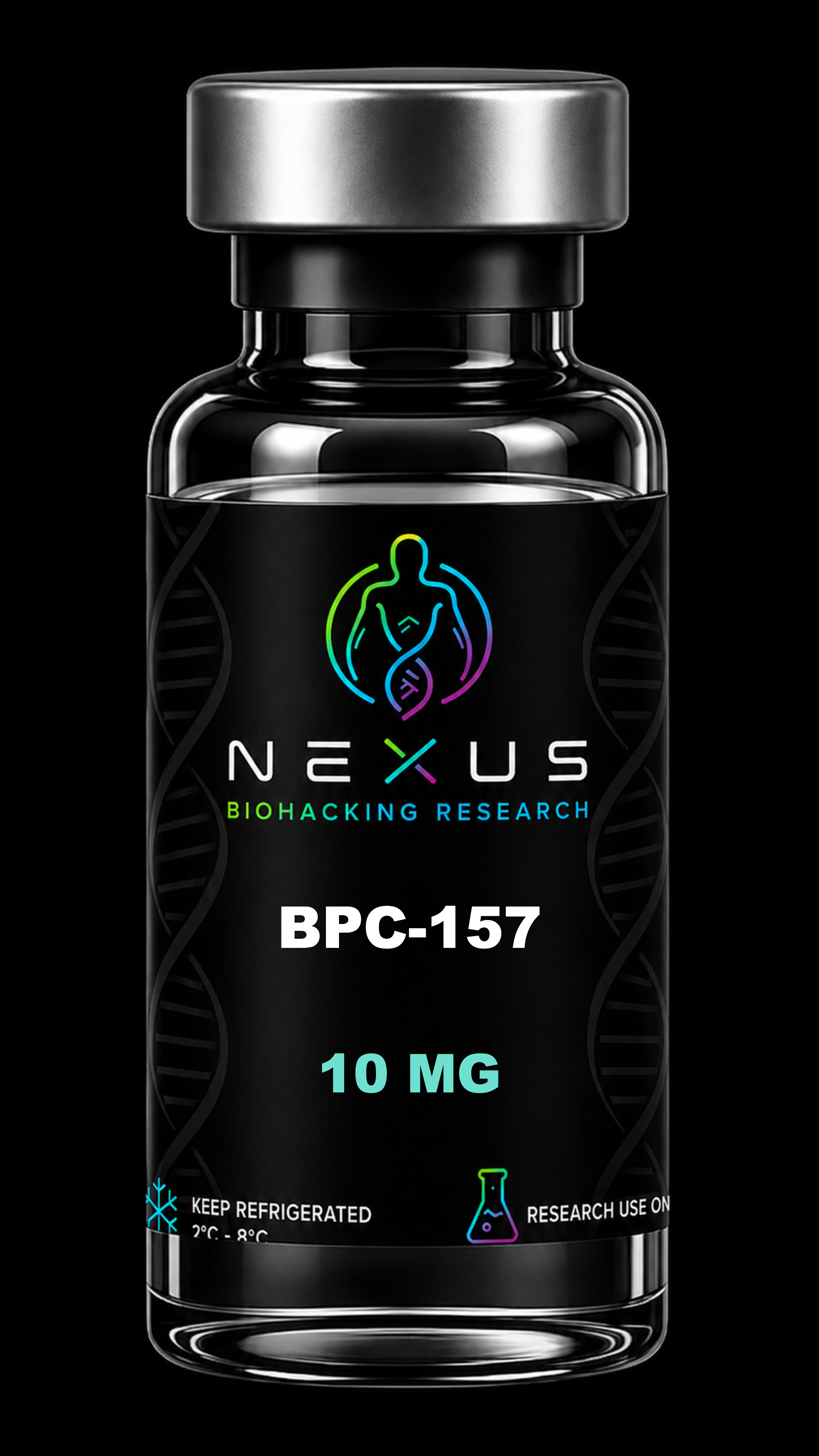
A 15-amino-acid peptide derived from a protective gastric protein, extensively studied for its role in angiogenesis and in connective and digestive tissue repair models. Stable lyophilized powder. For laboratory research use only.
Research areas
- In vitro angiogenesis
- Tendon / muscle repair models
- Gastrointestinal mucosal integrity (models)
Technical data
| Field | Value |
|---|---|
| Name | BPC-157 |
| Dosage | 5 / 10 mg |
| Sequence / composition | Gly-Glu-Pro-Pro-Pro-Gly-Lys-Pro-Ala-Asp-Asp-Ala-Gly-Leu-Val |
| Molecular formula | C₆₂H₉₈N₁₆O₂₂ |
| Molecular weight | ≈ 1,419.5 Da |
| CAS no. | 137525-51-0 |
| Target / mechanism | Angiogenesis and tissue repair pathways |
| Form | Lyophilized powder (unless stated otherwise) |
| Purity | ≥ 99% (HPLC) — see batch COA |
What sets BPC-157 apart from other repair peptides
BPC stands for Body Protection Compound. The molecule is a pentadecapeptide — fifteen amino acids — corresponding to a partial fragment of a protein identified in human gastric juice.
What surprises most: its stability. Where most peptides hydrolyse quickly, BPC-157 resists enzymatic degradation relatively well and holds up in the acidic environment of gastric juice, as preclinical pharmacokinetic studies document. That unusual robustness is what made it a privileged object of study for over thirty years.
Mechanism studied
Mechanistic work converges on angiogenesis. A 2020 Scientific Reports study combining ex vivo rat aortic ring assays and in vitro human endothelial cell (HUVEC) work described a precise pathway: BPC-157 induces phosphorylation of the Src kinase, activating caveolin-1, which releases endothelial nitric oxide synthase (eNOS) from its inhibited state — increasing nitric oxide production and endothelium-dependent vasodilation.
Several publications also report overexpression and activation of the VEGFR2 receptor, a key driver of endothelial cell migration, and regulation of FAK-paxillin complexes involved in cell adhesion and migration. These remain working hypotheses, described mostly in cell and animal models.
What the literature shows — and does not
The overwhelming majority of data is preclinical: cell cultures and rodents, mainly rats. Publications report apparent acceleration of repair processes, improved cell survival and migration, and effects on angiogenesis in those models.
A 2025 review in Pharmaceuticals (MDPI) on tendon and muscle tissue concludes that human data remain limited and clinical validation is pending. In short: no large randomised controlled human trial demonstrates efficacy to date. This is precisely why the compound remains a research reagent.
Reconstitution: a worked example
With 2 mL of bacteriostatic water: a 10 mg vial gives 10 ÷ 2 = 5 mg/mL (5,000 mcg/mL), so on a U-100 syringe 10 IU = 0.1 mL = 500 mcg. A 5 mg vial gives 2.5 mg/mL, and the same 10 IU is 250 mcg. Either way, 20 draws of 10 IU per vial.
The most common trap: the volume of water never changes how much peptide is in the vial. Only the volume to draw changes. Our reconstitution calculator computes any other combination live.
Add the solvent slowly down the vial wall, then swirl gently. No vigorous shaking, no vortex — shear denatures peptides.
Storage
Lyophilized powder: -20 °C or below, protected from light and moisture; stable for years when unopened. After reconstitution: 2–8 °C, protected from light, with a reference shelf life of 28 days. For longer storage, frozen aliquots are preferable to repeated freeze-thaw cycles.
Common laboratory mistakes
- Mixing up the two vial sizes when calculating. At equal water volume, a 10 mg vial yields double the concentration of a 5 mg vial.
- Using plain sterile water for a multi-draw vial. Without a preservative, the solution is no longer protected once the stopper has been pierced several times.
- Vortexing the vial. Vigorous agitation denatures peptides, including those reputed to be stable.
- Repeatedly refreezing the reconstituted solution. Each cycle degrades a fraction of the peptide.
- Extrapolating from the literature. The data come from animal models; they do not transfer.
Frequently asked questions
What exactly is BPC-157?
A pentadecapeptide — a chain of fifteen amino acids (Gly-Glu-Pro-Pro-Pro-Gly-Lys-Pro-Ala-Asp-Asp-Ala-Gly-Leu-Val) — corresponding to a partial fragment of a protein identified in human gastric juice. The name stands for Body Protection Compound. Molecular weight approximately 1,419.5 Da, CAS number 137525-51-0.
What is the difference between the 5 mg and 10 mg vials?
Only the amount of peptide. The molecule, the purity and the reconstitution protocol are identical. At equal solvent volume, the 10 mg vial gives twice the concentration.
What is the mechanism studied?
Primarily modulation of angiogenesis. A 2020 Scientific Reports study describes a Src then caveolin-1 cascade that releases endothelial nitric oxide synthase and raises NO production. Several publications also report VEGFR2 receptor activation.
Are there human clinical trials?
No large randomised controlled trial. Almost all available data is preclinical, from cell cultures and rodent models. A few small, heterogeneous preliminary human studies exist but support no firm conclusion.
Why is BPC-157 described as unusually stable?
Preclinical pharmacokinetic studies report unusual resistance to enzymatic hydrolysis and persistence in the acidic environment of gastric juice, where many peptides degrade rapidly.
What should it be reconstituted with?
Bacteriostatic water, which contains benzyl alcohol and allows multiple draws. Plain sterile water is unsuitable once the vial is pierced more than once.
How long does the reconstituted solution keep?
28 days at 2–8 °C, protected from light — the reference shelf life for a reconstituted vial. Beyond that, frozen aliquots are preferable to repeated freeze-thaw cycles.
Can it be combined with TB-500?
It is a common pairing in tissue-repair research protocols, the two peptides being studied on distinct pathways. Combined BPC-157 + TB-500 vials are available in our catalogue.
What is the purity and how is it verified?
Purity ≥ 99% verified by HPLC. A third-party certificate of analysis is available for every batch, stating compound identity, assay, purity and microbial safety controls.
In what context may this product be used?
Exclusively for laboratory and in vitro research. It is not intended for human or animal consumption, nor for diagnostic or therapeutic use.
📚 In-depth research
Read our complete research guide on Body Protection Compound-157 10mg.
Read the article →NEXUS Quality Standard
Every NEXUS research compound is produced under strict quality control procedures. Each batch undergoes independent analytical testing to verify identity, assay accuracy, purity, microbial safety, endotoxin levels, heavy metal screening, and full batch traceability.
For laboratory research only. Body Protection Compound-157 10mg is not suitable for human or animal consumption. Not a drug, food or cosmetic. To be handled by qualified personnel in accordance with applicable regulations.